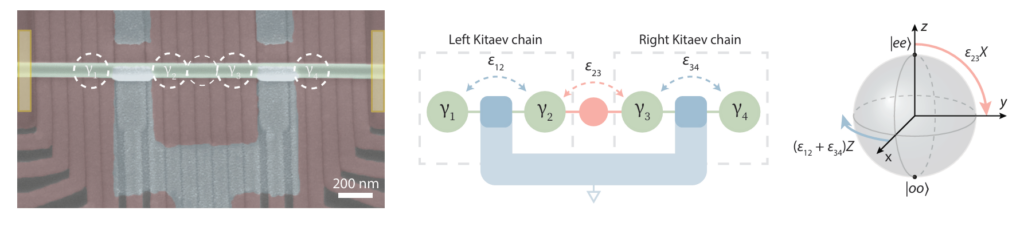
Twenty-five years after the first theoretical proposals, and following fifteen years of an intensive experimental effort, researchers at QuTech have demonstrated coherent control of a qubit based on Majorana quasiparticles. The result marks an important step towards using Majoranas in quantum computing. It also opens a new way to study the fundamental physics of Majorana quasiparticles. The results are published in Nature.
Qubits are the building blocks of quantum computers. Unlike classical bits, which are either 0 or 1, qubits can exist in quantum superpositions of both states. These superpositions make quantum computing powerful, but they are also fragile: interactions with the environment can disturb them and introduce errors. Protecting quantum information is therefore one of the central challenges in developing reliable quantum computers.
One proposed way to make qubits more robust is to encode information non-locally: across a system rather than in a single location. Physicist Alexei Kitaev proposed using Majorana quasiparticles for this purpose. In principle, when these quasiparticles are sufficiently separated, the information they encode together becomes less sensitive to local disturbances. This is the idea and the promise of topological qubits.
A different route to a Majorana qubit
“There are broadly speaking two routes towards a Majorana-based qubit,” explains Francesco Zatelli. “One is to first establish topologically protected Majorana states and then use them to build a qubit. Another is to create and control Majorana states without full topological protection, use them to demonstrate qubit operations, and then work towards improving their protection.”
For more than a decade, much of the field focused on the first route. However, materials challenges made it difficult to determine conclusively whether the observed experimental signals originated from Majorana states. In 2022, QuTech researchers began pursuing the second route, using so-called Kitaev chains: nanoscale devices that combine semiconductors and superconductors. With careful tuning of the individual components, researchers were able to systematically create and study Majorana states.
Kitaev chains consist of quantum dots, tiny regions in which individual electrons can be confined, connected through superconducting material. Under the right conditions, Majorana quasiparticles can form at the two ends of a chain. Making the chains longer is expected to improve the separation of these modes, potentially making the quantum information they encode insensitive to local disturbances.
This new approach has since developed into a wider research effort across QuTech. Following the demonstration of minimal Kitaev chains in Leo Kouwenhoven’s group in 2023, researchers have worked on improving their stability, developing ways to read out Majorana states, and exploring different device designs. Michael Wimmer’s group has contributed to the theoretical understanding of these systems, while Srijit Goswami’s group has demonstrated Kitaev chains in two-dimensional devices and extended them to longer chains. These advances complement the work leading to the present qubit demonstration.
From Majorana modes to a functioning qubit
To demonstrate the qubit, QuTech researchers Francesco Zatelli, Bart Roovers and Nick van Loo, who contributed equally as first authors, worked with their colleagues to build two minimal Kitaev chains. Each chain contains just two quantum dots and hosts two Majorana modes. Together, the four modes form the basis of a single qubit. The Majorana modes in these two-site chains are often referred to as poor man’s Majoranas, because they offer only limited protection against disturbances. Nevertheless, they allow the researchers to demonstrate essential qubit operations.
The researchers control the qubit by briefly switching on an interaction between the two chains. They first measure its initial state, allow it to evolve for a controlled period of time, and then measure it again. By repeating the experiment with different interaction times, they observe a regular pattern: the probability of finding the qubit in its initial state rises and falls in what are known as coherent oscillations. These oscillations demonstrate that the researchers can deliberately control the qubit’s quantum state.
Towards stronger protection
The coherent oscillations observed in the experiment currently decay within tens of nanoseconds. The researchers now want to investigate whether longer chains can better protect the quantum information against disturbances. “Observing if coherence improves with chain length is probably the best practical way to test topological protection,” says Bart Roovers, who is already experimenting with qubits consisting of two times three quantum dots.
Despite the modest coherence time, the current experiment marks an important step: researchers can now use Majorana modes not only to study their properties, but also to encode and manipulate quantum information. “For the first time, we can coherently control a qubit based on Majorana modes. This is something we have been working towards for several years,” says van Loo.
Kouwenhoven adds: “This qubit forms a solid starting point for both better qubits as well as a more detailed study of Majorana physics. There are some very fundamental outstanding challenges such as non-Abelian exchange statistics that now become in reach for experiments.” Following years of scientific challenges and a fundamentally different experimental approach, the result marks an exciting new chapter in Majorana research, and for quantum computing and physics in general.
Reference
Coherent parity oscillations in coupled minimal Kitaev chains
Francesco Zatelli, Bart Roovers, Nick van Loo, Antonio Lombardi, Juan D Torres Luna, Sebastian Miles, Vincent PM Sietses, Florian J Bennebroek Evertsz, Pablo Cova Fariña, Alberto Bordin, Ghada Badawy, Erik PAM Bakkers, Michael Wimmer, Leo P Kouwenhoven
D-Wave reported third quarter 2026 revenue of $4.5 million, up 21% year over year. Remaining performance obligations reached $38.3 million, up 1,221%, and the company executed a definitive agreement for up to $100 million in CHIPS and Science Act funding.
Seven organizations including Nautilus Technologies, Fujitsu company 1Finity, IIJ, Waseda University and Nagoya University have begun building a distributed quantum computing platform that links quantum clusters with the Tsurugi relational database over ultra-low-latency optical networks.
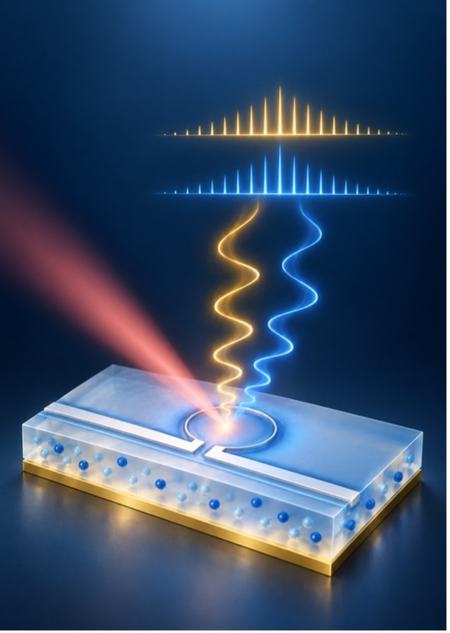
Billions of ytterbium ions in a yttrium orthovanadate crystal, coupled to a superconducting microwave resonator, synchronize through superradiance and pulse in a regular rhythm, forming a superradiant frequency comb. Unlike mirror-based combs, the spacing comes from atom-to-atom interference and the emission pairs microwaves with infrared light in step. The scheme could yield more stable combs and a microwave-optical link for connecting superconducting quantum circuits to fiber networks.
This week in nanotech
26 deals tracked
New products
 DLS-1 Mass Spectrometer for Fusion Gas AnalysisHiden Analytical Featured
 Nion-compatible In Situ STEM Holders for Electrical BiasingHummingbird Scientific Featured
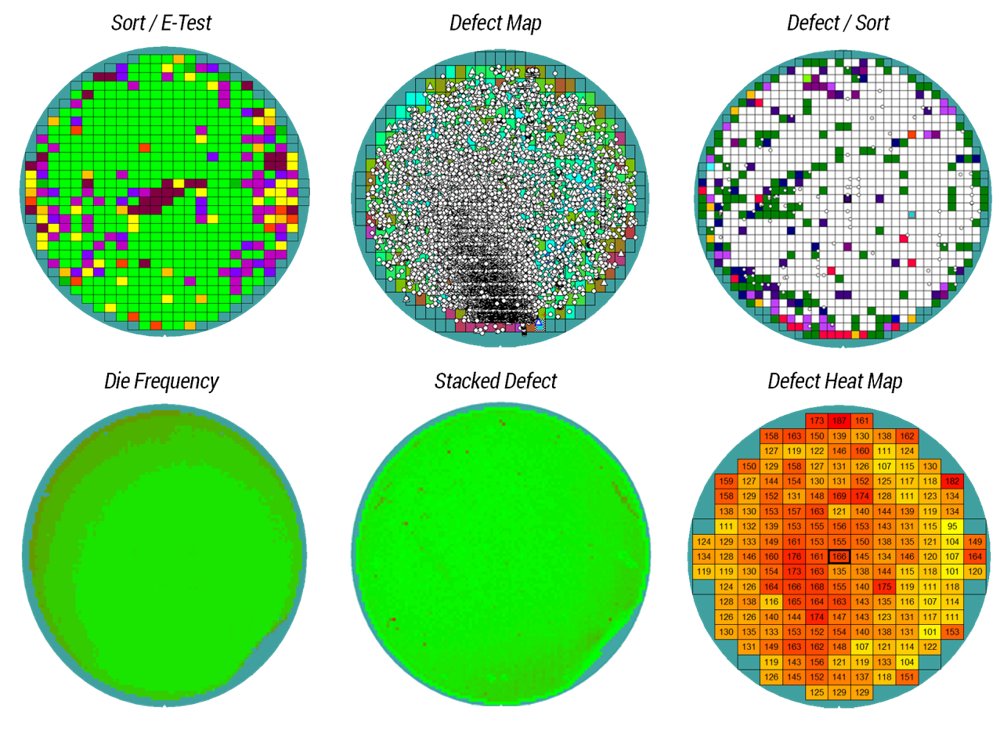 Discover Mapping SuiteOnto Innovation
Market insights
Last 30 days: Semiconductors & Electronics was the busiest vertical: 55 of 176 events (31%).
Money raised per month