North Carolina State University
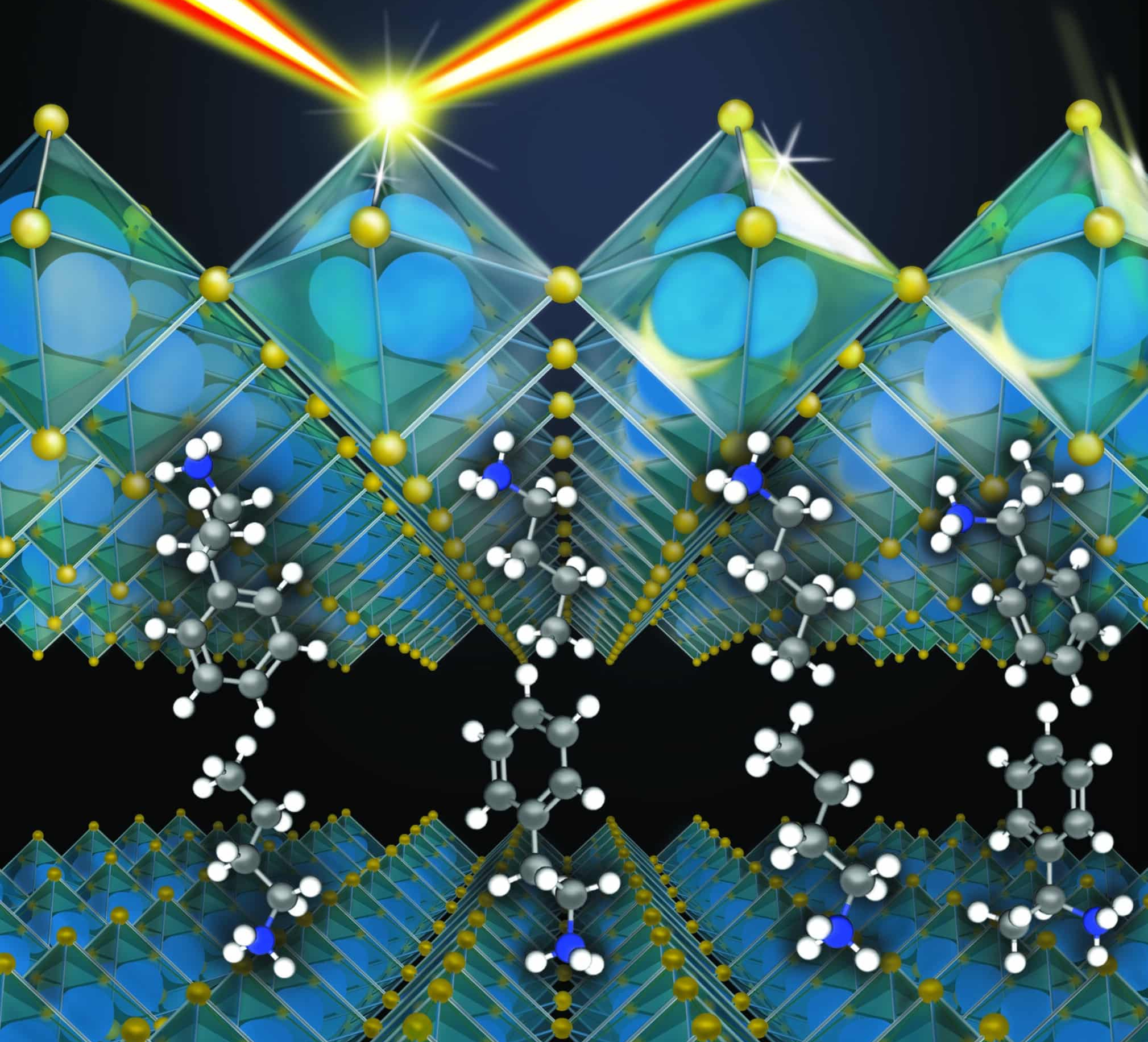
Researchers have demonstrated the ability to engineer materials that are both stiff and capable of insulating against heat. This combination of properties is extremely unusual and holds promise for a range of applications, such as the development of new thermal insulation coatings for electronic devices.
“Materials that have a high elastic modulus tend to also be highly thermally conductive, and vice versa,” says Jun Liu, co-corresponding author of a paper on the work and an associate professor of mechanical and aerospace engineering at North Carolina State University. “In other words, if a material is stiff, it does a good job of conducting heat. And if a material is not stiff, then it is usually good at insulating against heat.
“But there are instances where you’d want materials that are stiff, but are also good insulators,” Liu says. “For example, you might want to create thermal insulation coatings to protect electronics from high temperatures. Historically, that’s been a challenge.
“We’ve now discovered a range of materials that are both stiff and excellent thermal insulators. What’s more, we can engineer the materials as needed to control how stiff they are and how thermally conductive they are.”
Specifically, the researchers were working with a subset of the class of materials called two-dimensional hybrid organic-inorganic perovskites (2D HOIP).
“These are thin films consisting of alternating organic and inorganic layers in a highly ordered crystalline structure,” says Wei You, co-corresponding author of this paper and professor of chemistry and applied physical sciences at the University of North Carolina at Chapel Hill. “And we can tune the composition of either the inorganic or organic layer.”
“We found that we can control the elastic modulus and thermal conductivity of some 2D HOIPs by replacing some of the carbon-carbon chains in the organic layers with benzene rings,” says Qing Tu, co-corresponding author of this paper and an assistant professor of materials science and engineering at Texas A&M University. “Basically – within this specific subset of layered materials – the more benzene rings we add, the stiffer the material gets, and the better able it is to insulate against heat.”
“While discovering these materials in itself holds tremendous potential for a range of applications, as researchers we are particularly excited because we’ve identified the mechanism that is responsible for these characteristics – namely the critical role that the benzene rings play,” says Liu.
In experiments, the researchers found at least three distinct 2D HOIP materials that became less thermally conductive the stiffer they got.
“This work is exciting because it suggests a new pathway for engineering materials with desirable combinations of properties,” Liu says.
The researchers also discovered another interesting phenomenon with 2D HOIP materials. Specifically, they found that by introducing chirality into the organic layers – i.e., making the carbon chains in those layers asymmetrical – they could effectively maintain the same stiffness and thermal conductivity even when making substantial changes to the composition of the organic layers.
“This raises some interesting questions about whether we might be able to optimize other characteristics of these materials without having to worry about how those changes might influence the material’s stiffness or thermal conductivity,” says Liu.
Reference
Anomalous Correlation between Thermal Conductivity and Elastic Modulus in Two-Dimensional Hybrid Metal Halide Perovskites
Ankit Negi, Liang Yan, Cong Yang, Yeonju Yu, Doyun Kim, Subhrangsu Mukherjee, Andrew H. Comstock, Saqlain Raza, Ziqi Wang, Dali Sun, Harald Ade, Qing Tu, Wei You, and Jun Liu
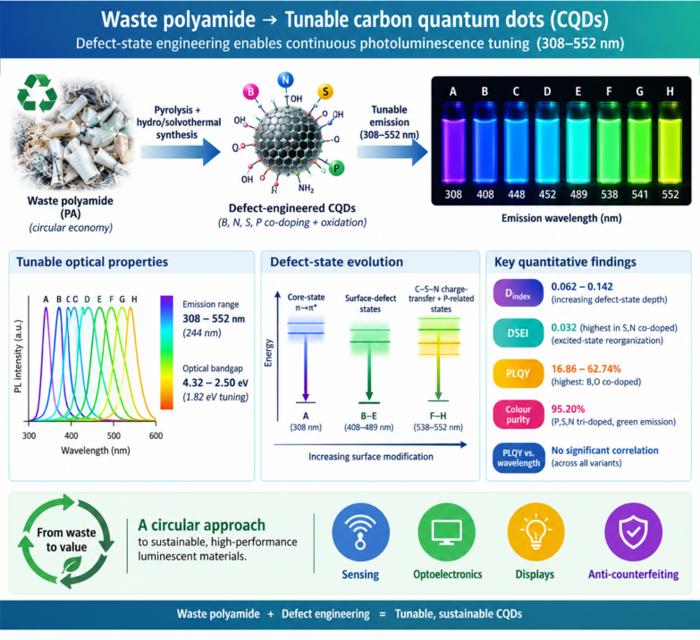
Waste polyamide-derived CQDs show continuous photoluminescence tuning from 308 to 552 nm through sequential defect-state engineering, with optical transition energies decreasing from 4.32 to 2.50 eV. @Christian Ebere Enyoh from Saitama University Carbon quantum dots (CQDs) are fluorescent carbon nanomaterials with potential applications in sensing, optoelectronics, displays, anti-counterfeiting, and environmental technologies. Their optical properties can be adjusted by modifying the carbon...
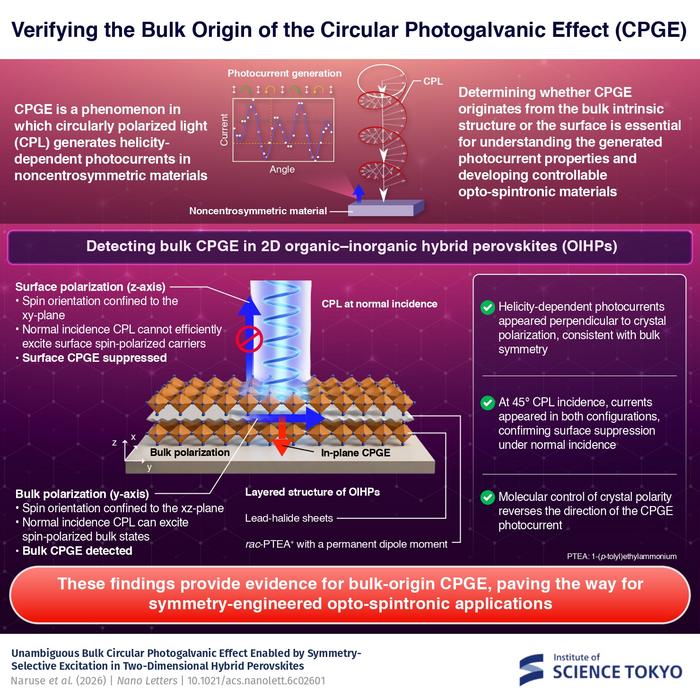
The researchers used circularly polarized light at normal incidence and found that helicity-dependent photocurrents appeared perpendicular to the crystal’s polarization but vanished when measured parallel to it, supporting a bulk origin of CPGE. @Institute of Science Tokyo The circular photogalvanic effect (CPGE), a phenomenon that generates helicity-dependent photocurrents in noncentrosymmetric materials, can originate purely from a crystal's internal structure without contribution from the...
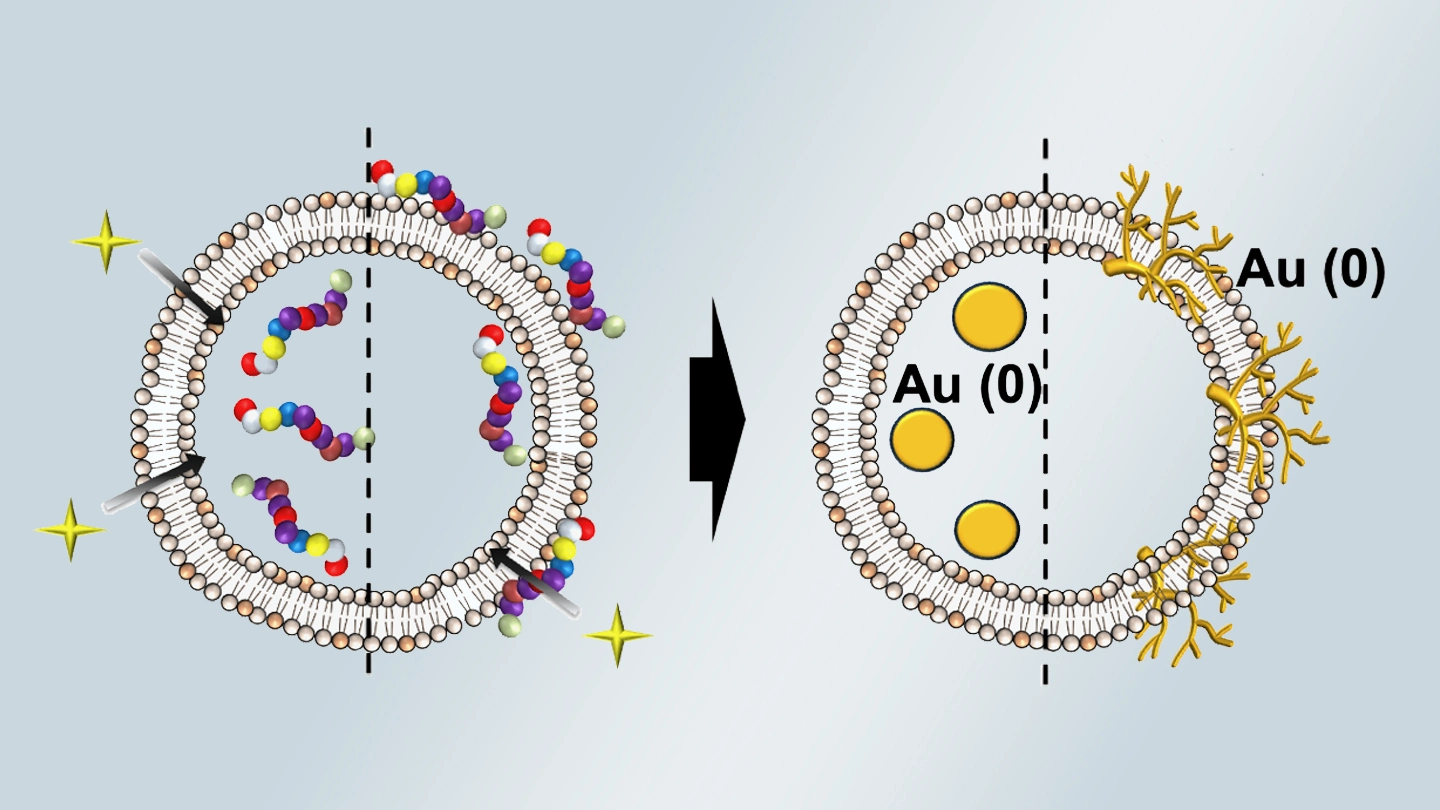
Summary of gold nanoparticle growth programming in liposome based on localization of biomineralization peptide The position of biomineralization peptides within liposomes can influence how gold nanoparticles grow, reports a research team from Institute of Science Tokyo. Peptides localized at the membrane interface promote branched structures, while those confined to the liposome interior favor spherical nanoparticles. The findings offer a new strategy for controlling nanoscale reaction...
