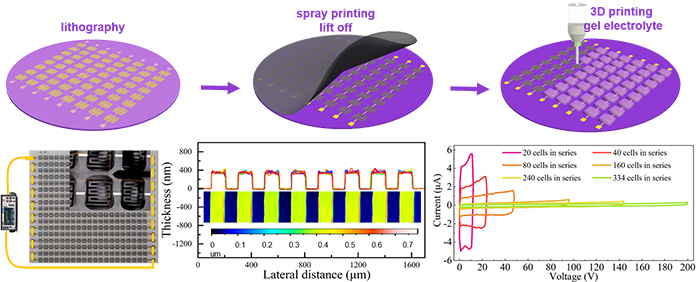
Microscale electrochemical energy storage systems with high systemic performance, superior cell number density, tunable capacitance, and output voltage are promising for miniaturized electronics.
A joint research team led by Prof. WU Zhong-Shuai and Prof. LU Yao from the Dalian institute of chemical physics (DICP) of the Chinese Academy of Sciences (CAS), in collaboration with Prof. CHENG Huiming's group from Shenzhen Institute of Advanced Technology and the Institute of Metal Research of CAS, has developed monolithic integrated micro-supercapacitors with ultrahigh systemic volumetric performance and areal output voltages.
This study was published in National Science Review on Nov. 26.
On-chip interdigitated micro-supercapacitors (MSCs), free of separators and external metal connection wires and simultaneously with reliable electrochemical performance and tunable connection, can boost cell number density and systemic performance for monolithic integrated MSCs (MIMSCs) with desirable customizability in a limited space.
However, scalable production of fully-functioning compact MIMSCs with high systemic performance, superior cell number density and tunable performance is still challenging. This is due to the difficulty of precise deposition of electrolytes on densely-packed MSCs for electrochemical isolation, sacrifice in electrochemical performance during complex microfabrication procedures, and limited performance uniformity among numerous individual cells in large scale arrays.
In this study, the researchers developed a universal and large-throughput microfabrication strategy to address the above issues by combining multi-step lithographic patterning, spray printing of MXene microelectrodes, and controllable three-dimensional (3D) printing of gel electrolytes.
They fabricated the monolithic integration of electrochemically isolated micro-supercapacitors in closely proximity by leveraging high-resolution micropatterning techniques for microelectrode deposition and 3D printing for precise electrolyte deposition.
They obtained the MIMSCs with a high areal number density of 28 cells cm^-2 (400 cells on 3.5×4.1 cm^2), a record areal output voltage of 75.6 V cm^-2, an acceptable systemic volumetric energy density of 9.8 mWh cm^-3, and a high-capacitance retention of 92 % after 4,000 cycles at the output voltage of 162 V.
"This work paves the way for monolithic integrated and microscopic energy storage assemblies for powering future microelectronics," said Prof. WU.
Reference
Monolithic integrated micro-supercapacitors with ultrahigh systemic volumetric performance and areal output voltage
Sen Wang, Linmei Li, Shuanghao Zheng, Pratteek Das, Xiaoyu Shi, Jiaxin Ma, Yu Liu, Yuanyuan Zhu, Yao Lu, Zhong-Shuai Wu, Hui-Ming Cheng
https://academic.oup.com/nsr/advance-article/doi/10.1093/nsr/nwac271/6847747
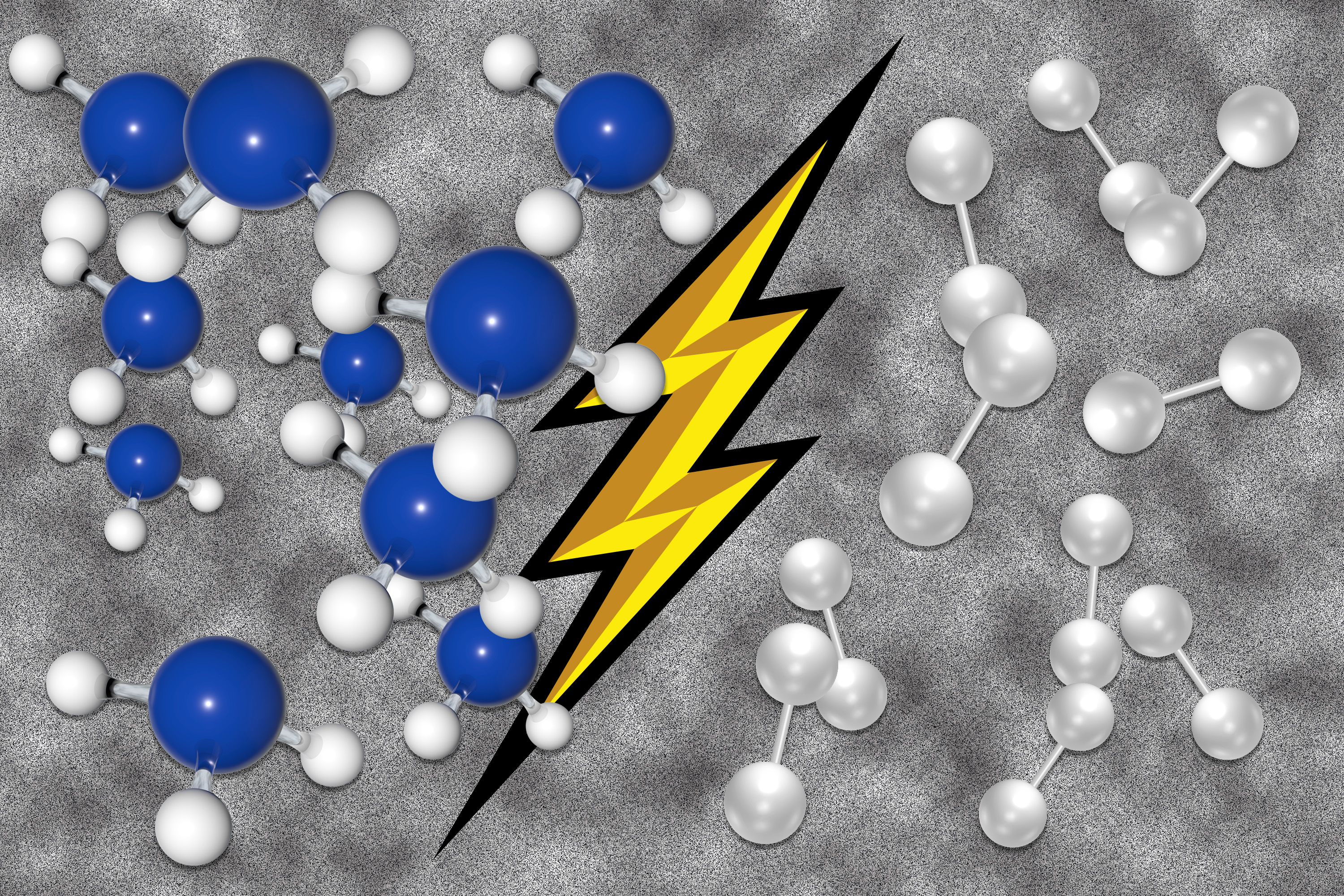
MIT researchers have developed a new way to extract pure hydrogen gas from ammonia and other hydrogen carrier molecules. Their strategy, which uses electricity to speed up the extraction, reduces the temperature and energy required to recover hydrogen from these molecules. As a liquid that is easily stored and transported, ammonia (NH3) is an attractive carrier for hydrogen, which is used in fuel cells, semiconductor manufacturing, chemical processing, and other applications. However,...
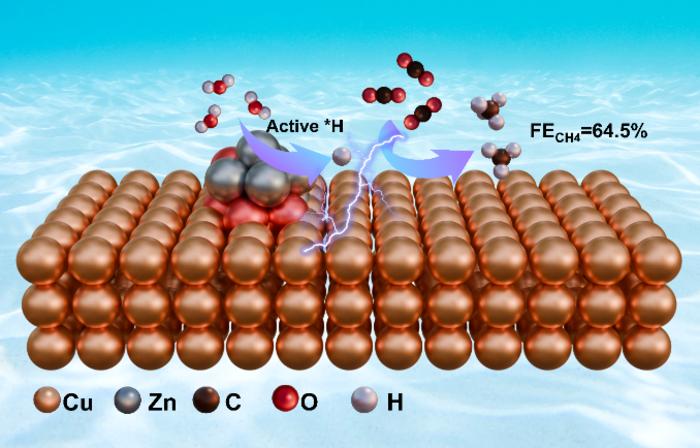
image: CuZn800@C was constructed via solvothermal method and utilizes the high-temperature volatility of zinc to prepare through calcination at different temperatures, which displays a high methane Faradaic efficiency of 64.5% and a remarkable partial current density of -551.3 mA/cm2 at -1.7 V vs. RHE, along with excellent stability. Zn and Cu form a tandem reaction system. Zn sites promote water splitting to provide protons, while Cu sites reduce the energy barrier for *CO hydrogenation....
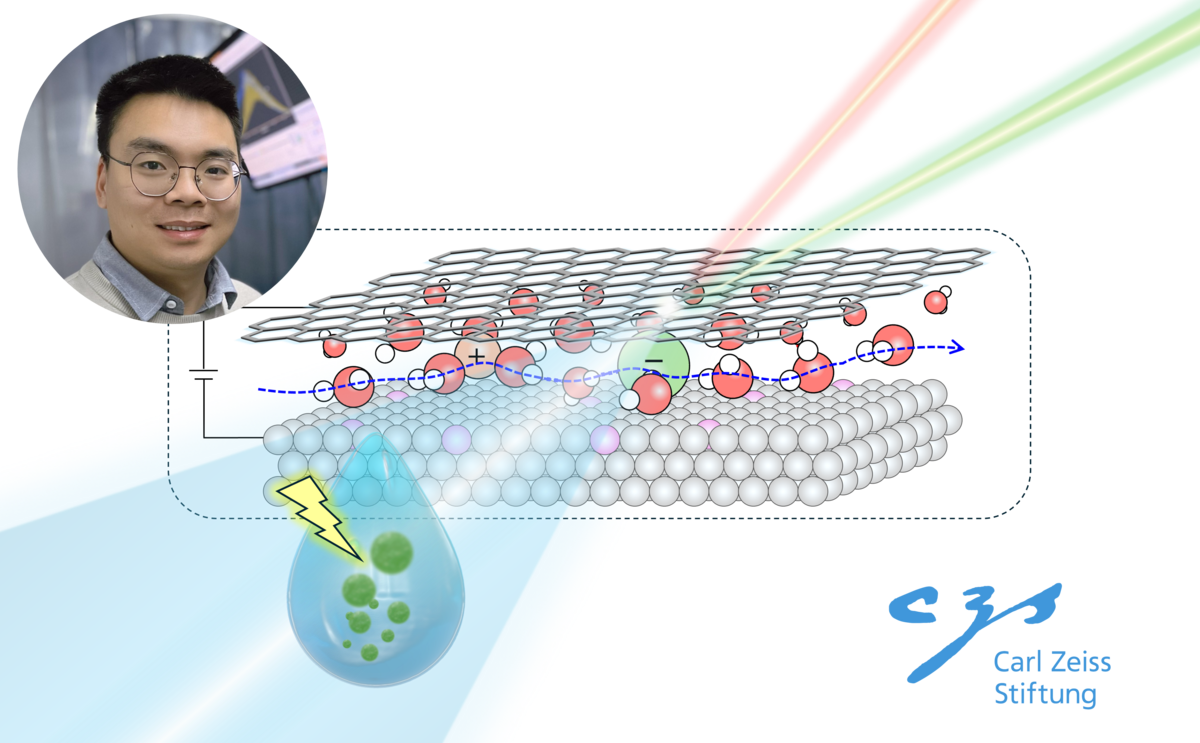
Electrochemical water splitting powered by renewable electricity is a promising pathway to sustainable hydrogen production, but its efficiency and scalability remain limited by costly catalysts and slow reaction kinetics. With €1.5 million in funding from the Carl-Zeiss-Stiftung for five years, Dr. Yongkang Wang and his team will pursue a new approach by visualizing and controlling water at the molecular level, using nanoscale confinement to shape its structure and dynamics at catalytic...
