École polytechnique fédérale de Lausanne (EPFL)

If scientists could find a way to control the process for making semiconductor components on a nanometric scale, they could give those components unique electronic and optical properties - opening the door to a host of useful applications.
Researchers at the Laboratory of Microsystems, in EPFL's School of Engineering, have taken an important step towards that goal with their discovery of semiconducting nanotubes that assemble automatically in solutions of metallic nanocrystals and certain ligands. The tubes have between three and six walls that are perfectly uniform and just a few atoms thick - making them the first such nanostructures of their kind.
What's more, the nanotubes possess photoluminescent properties: they can absorb light of a specific wavelength and then send out intense light waves of a different color, much like quantum dots and quantum wells. That means they can be used as fluorescent markers in medical research, for example, or as catalysts in photoreduction reactions, as evidenced by the removal of the colors of some organic dyes, based on the results of initial experiments. The researchers' findings have made the cover of ACS Central Science.
An accidental discovery
But the unique feature of these semiconducting nanotubes is how they are formed. "Our discovery happened almost by chance. We had set out to study the role that certain ligands play in making 2D semiconducting nanometric crystals," says Xiaopeng Huang, the study's lead author. But the research team found that some ligands caused molecules to spontaneously come together in precise cylindrical structures which until then had been impossible to create.
Investigating new properties
The researchers will now investigate the other physical and electrical properties of their nanotubes and look into methods for making nanotubes with just a single wall.
Spontaneous Formation of CdSe Photoluminescent Nanotubes with Visible-light Photocatalytic Performance
Xiaopeng Huang, Virendra K. Parashar and Martin A.M. Gijs
ACS Central Science.
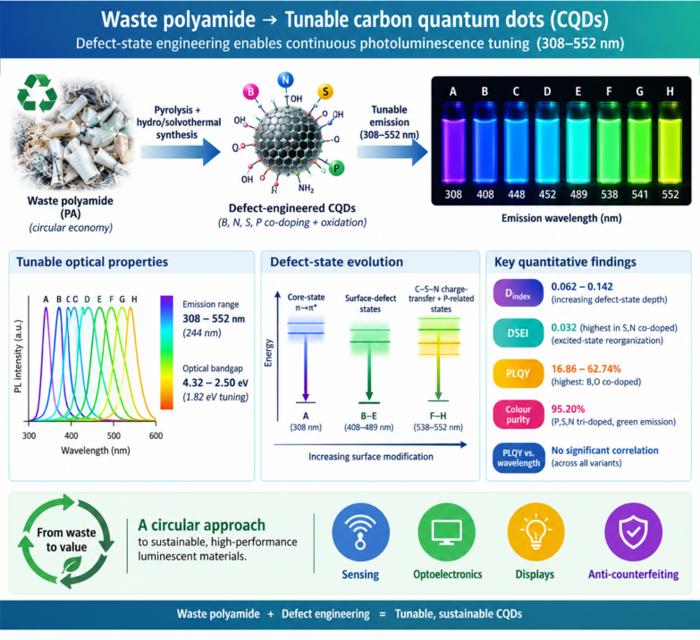
Waste polyamide-derived CQDs show continuous photoluminescence tuning from 308 to 552 nm through sequential defect-state engineering, with optical transition energies decreasing from 4.32 to 2.50 eV. @Christian Ebere Enyoh from Saitama University Carbon quantum dots (CQDs) are fluorescent carbon nanomaterials with potential applications in sensing, optoelectronics, displays, anti-counterfeiting, and environmental technologies. Their optical properties can be adjusted by modifying the carbon...
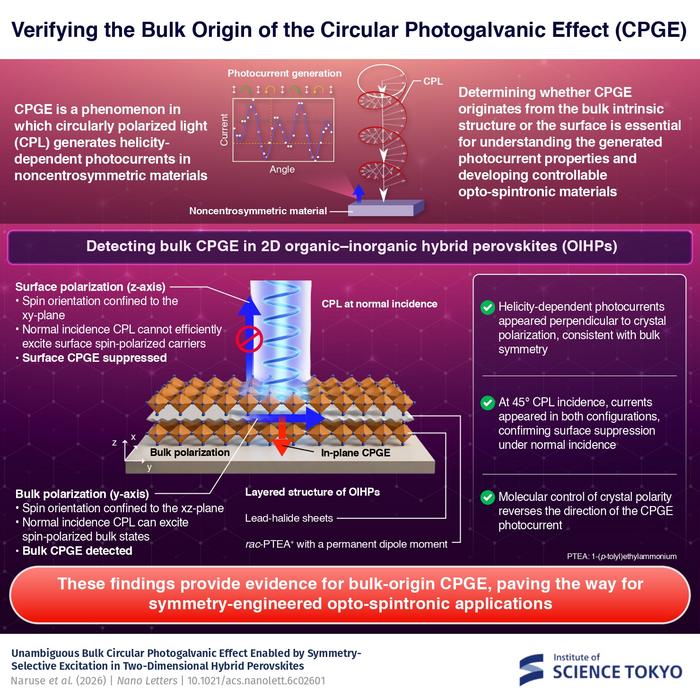
The researchers used circularly polarized light at normal incidence and found that helicity-dependent photocurrents appeared perpendicular to the crystal’s polarization but vanished when measured parallel to it, supporting a bulk origin of CPGE. @Institute of Science Tokyo The circular photogalvanic effect (CPGE), a phenomenon that generates helicity-dependent photocurrents in noncentrosymmetric materials, can originate purely from a crystal's internal structure without contribution from the...
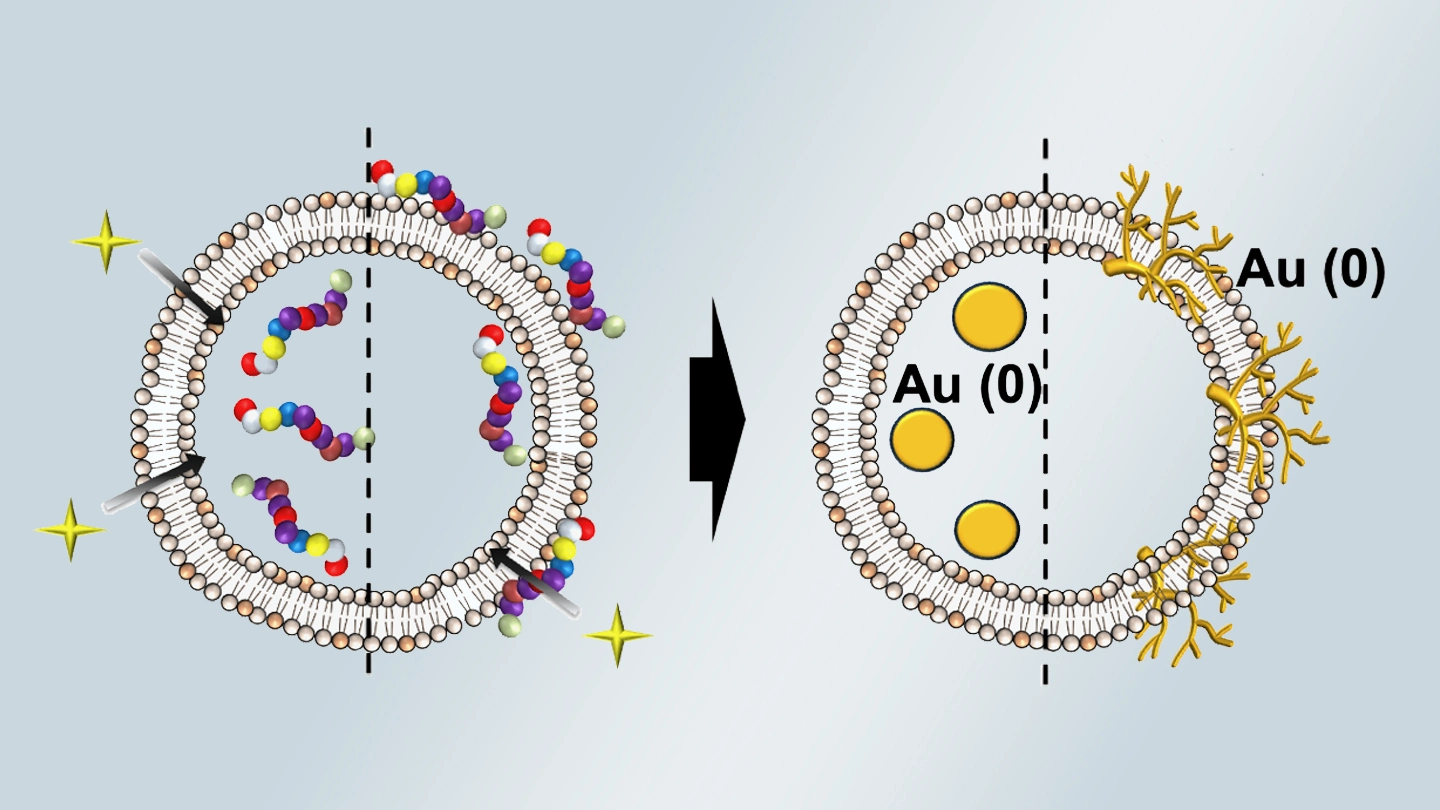
Summary of gold nanoparticle growth programming in liposome based on localization of biomineralization peptide The position of biomineralization peptides within liposomes can influence how gold nanoparticles grow, reports a research team from Institute of Science Tokyo. Peptides localized at the membrane interface promote branched structures, while those confined to the liposome interior favor spherical nanoparticles. The findings offer a new strategy for controlling nanoscale reaction...
