North Carolina State University
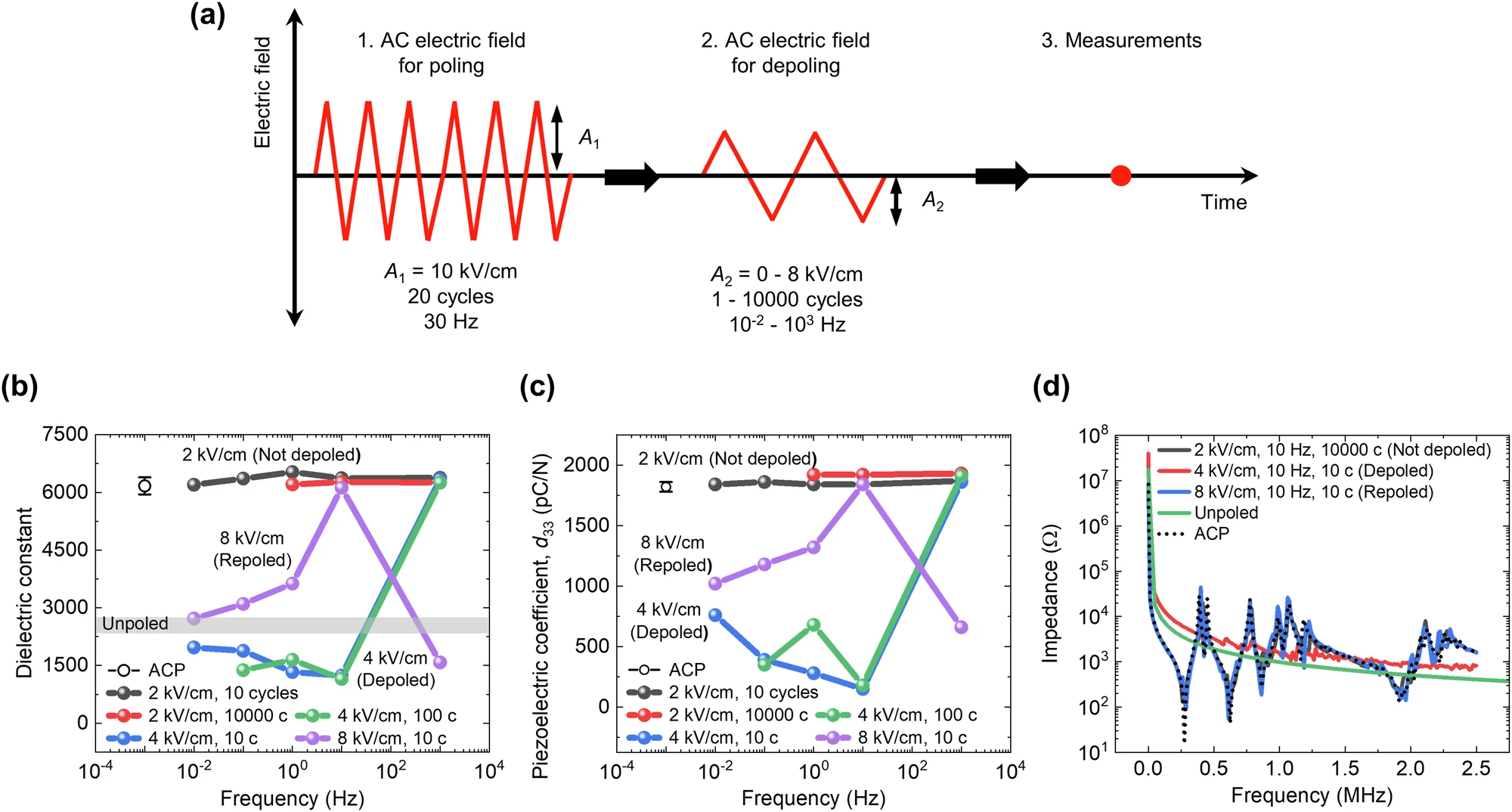
Heat and pressure can deteriorate the properties of piezoelectric materials that make state-of-the-art ultrasound and sonar technologies possible – and fixing that damage has historically required disassembling devices and exposing the materials to even higher temperatures. Now researchers have developed a technique to restore those properties at room temperature, making it easier to repair these devices – and paving the way for new ultrasound technologies.
Piezoelectric materials have many applications, including sonar technologies and devices that generate and sense ultrasound waves. But for these devices to efficiently generate sonar or ultrasound waves, the material needs to be “poled.”
That’s because the piezoelectric materials used for sonar and ultrasound applications are mostly ferroelectric. And like all ferroelectric materials, they exhibit a phenomenon called spontaneous polarization. That means they contain pairs of positively and negatively charged ions called dipoles. When a ferroelectric material is poled, that means all of its dipoles have been pulled into alignment with an external electric field. In other words, the dipoles are all oriented in the same direction, which makes their piezoelectric properties more pronounced.
“If those dipoles aren’t in alignment it’s difficult to generate targeted ultrasound waves with the amplitude needed for them to be practical,” says Xiaoning Jiang, corresponding author of a paper on the work and Dean F. Duncan Distinguished Professor of Mechanical and Aerospace Engineering at North Carolina State University.
“Preserving the poling of piezoelectric-ferroelectric materials poses some significant challenges, because the dipoles can begin losing their alignment when exposed to elevated temperatures or high pressures,” Jiang says.
“This is also a manufacturing problem, because it limits which other materials and processes you can use when making ultrasound devices,” Jiang says. “And because the elevated temperatures aren’t even really that high – you can see alignment problems as low as 70 degrees Celsius – even shipping or storing these technologies can sometimes adversely affect the poling and the efficiency of the devices.
“What’s more, extended use of some technologies can result in the device itself generating heat that risks depoling the piezoelectric-ferroelectric material.”
And once the dipoles in the material have come out of alignment, getting them back into alignment isn’t easy. The piezoelectric-ferroelectric material needs to be removed from the device and exposed to high heat – 300 degrees Celsius or more – in order to completely depole the material before “repoling” it and pulling the dipoles back into alignment.
“It’s important to re-use these piezoelectric-ferroelectric materials because they are usually expensive – you don’t want to just throw them away,” Jiang says. “But often the material is retrieved and the rest of the ultrasound device is discarded.
“We have developed a technique that allows us to depole and repole piezoelectric-ferroelectric materials at room temperature. That means we can pull the dipoles back into alignment without removing the material from the device – and this can be done repeatedly, as needed.”
To understand the new technique, you need to understand that there are two ways to pull the dipoles in a piezoelectric-ferroelectric material into alignment. The most widely used technique involves applying a direct current (DC) electric field to the material, which pulls all of the dipoles in the same direction.
“This way works well for creating alignment, but it is virtually impossible to depole the material using only a DC field,” Jiang said.
The other technique involves applying an alternating current (AC) electric field to the material, which causes the dipoles to oscillate in response to the waves in the field, until the field is removed, at which point the dipoles lock into place in alignment.
“We found that we can also depole the material using an AC field, even at room temperature. If the material was originally poled using a DC field, we could remove much of the poling with an AC field – but not all of it,” Jiang said. “However, if the material was originally poled with an AC field, we found that could also completely depole the material using an AC field.”
The finding has at least two significant ramifications for ultrasound technologies.
“If we can pole piezoelectric-ferroelectric materials at room temperature, it means we can alter the other materials and manufacturing processes we use when creating ultrasound devices to optimize their performance,” Jiang says. “We are no longer limited to materials and processes that won’t affect the polarization in the piezoelectric-ferroelectric components, because we can pole the material using an AC field after the device has been assembled.
“What’s more, it means that we can easily repole the materials in existing devices, hopefully giving us a long lifetime of peak performance for these technologies.”
Reference
Electrical de-poling and re-poling of relaxor-PbTiO3 piezoelectric single crystals without heat treatment
Hwang-Pill Kim, Mao-Hua Zhang, Bo Wang, Huaiyu Wu, Zhengze Xu, Sipan Liu, Sunho Moon, Yohachi Yamashita, Jong Eun Ryu, Jun Liu, Shujun Zhang, Long-Qing Chen & Xiaoning Jiang
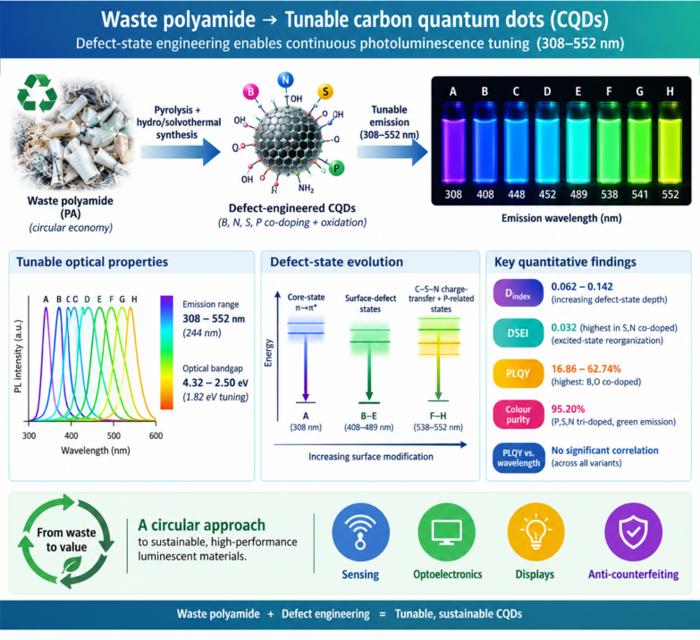
Waste polyamide-derived CQDs show continuous photoluminescence tuning from 308 to 552 nm through sequential defect-state engineering, with optical transition energies decreasing from 4.32 to 2.50 eV. @Christian Ebere Enyoh from Saitama University Carbon quantum dots (CQDs) are fluorescent carbon nanomaterials with potential applications in sensing, optoelectronics, displays, anti-counterfeiting, and environmental technologies. Their optical properties can be adjusted by modifying the carbon...

The researchers used circularly polarized light at normal incidence and found that helicity-dependent photocurrents appeared perpendicular to the crystal’s polarization but vanished when measured parallel to it, supporting a bulk origin of CPGE. @Institute of Science Tokyo The circular photogalvanic effect (CPGE), a phenomenon that generates helicity-dependent photocurrents in noncentrosymmetric materials, can originate purely from a crystal's internal structure without contribution from the...
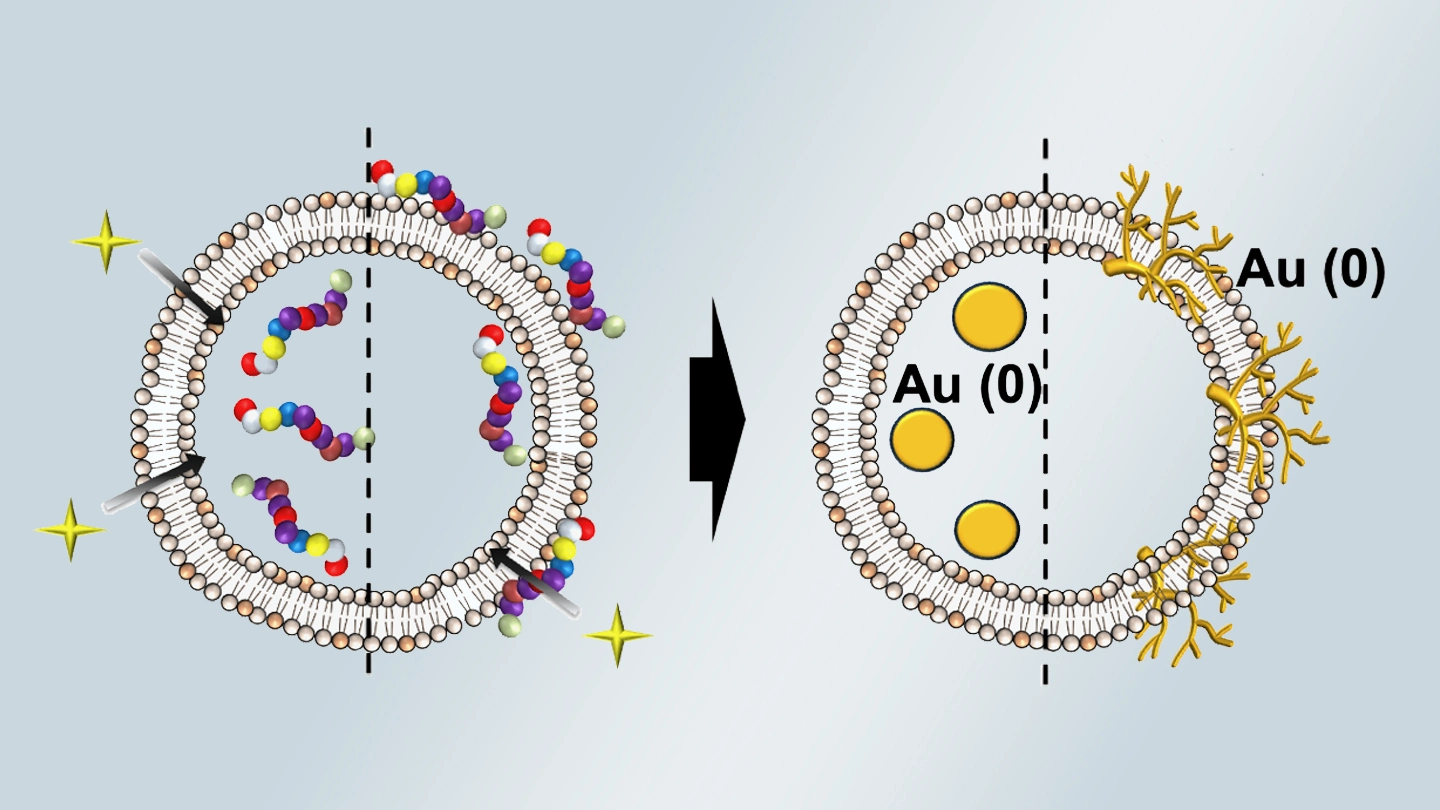
Summary of gold nanoparticle growth programming in liposome based on localization of biomineralization peptide The position of biomineralization peptides within liposomes can influence how gold nanoparticles grow, reports a research team from Institute of Science Tokyo. Peptides localized at the membrane interface promote branched structures, while those confined to the liposome interior favor spherical nanoparticles. The findings offer a new strategy for controlling nanoscale reaction...
