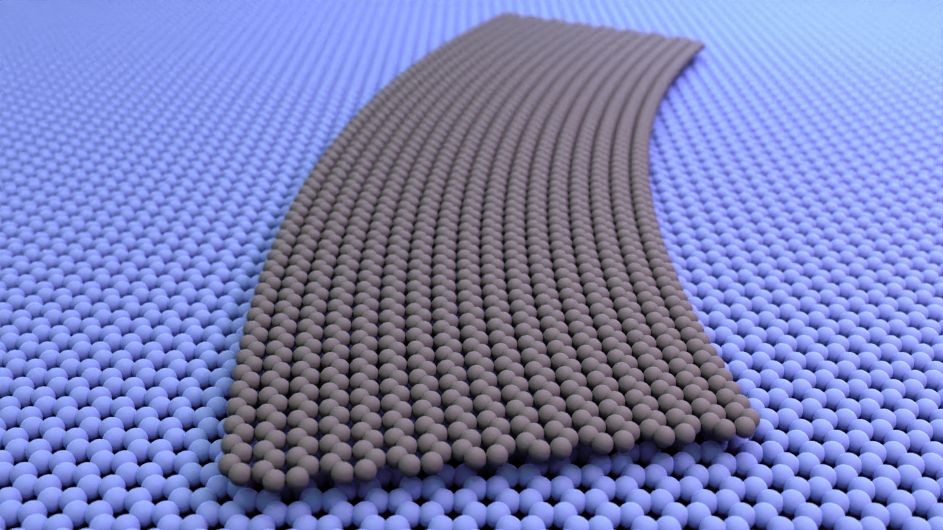
Think you know everything about a material? Try giving it a twist—literally. That’s the main idea of an emerging field in condensed matter physics called “twistronics,” which has researchers drastically changing the properties of 2D materials, like graphene, with subtle changes—as small as going from a 1.1° to 1.2°—in the angle between stacked layers. Twisted layers of graphene, for example, have been shown to behave in ways that single sheets have not, including acting like magnets, like electrical superconductors, or like a superconductor’s opposite, insulators, all due to small changes in the twist angle between sheets.
In theory, you could dial in any property by turning a knob that changes the twist angle. The reality, however, isn’t so straightforward, said Columbia physicist Cory Dean. Two twisted layers of graphene can become like a new material, but exactly why these different properties manifest is not well understood, let alone something that can be fully controlled yet.
Dean and his lab have come up with a simple new fabrication technique that may help physicists probe the fundamental properties of twisted layers of graphene and other 2D materials in a more systematic and reproducible way. Writing in Science, they use long “ribbons” of graphene, rather than square flakes, to create devices that offer a new level of predictability and control over both twist angle and strain.
Graphene devices have typically been assembled from atom-thin flakes of graphene that are just a few square micrometers. The resulting twist angle between the sheets is fixed in place, and the flakes can be tricky to layer together smoothly. “Imagine graphene as pieces of saran wrap—when you put two pieces together you get random little wrinkles and bubbles,” said postdoc Bjarke Jessen, a co-author on the paper. Those bubbles and wrinkles are akin to changes in the twist angle between the sheets and the physical strain that develops in between and can cause the material to buckle, bend, and pinch randomly. All these variations can yield new behaviors, but they have been difficult to control within and between devices.
Ribbons can help smooth things out. The lab’s new research shows that, with just a little push from the tip of an atomic force microscope, they can bend a graphene ribbon into a stable arc that can then be placed flat on top of a second, uncurved, graphene layer. The result is a continuous variation in the twist angle between the two sheets that spans from 0° to 5° across the length of the device, with evenly distributed strain throughout—no more random bubbles or wrinkles to contend with. “We no longer have to make 10 separate devices with 10 different angles to see what happens,” said postdoc and co-author Maëlle Kapfer. “And, we can now control for strain, which was completely lacking in prior twisted devices.”
The team used special high-resolution microscopes to confirm how uniform their devices were. With that spatial information, they developed a mechanical model that predicts twist angles and strain values simply based on the shape of the curved ribbon.
This first paper was focused on characterizing the behavior and properties of ribbons of graphene as well as other materials that can be thinned to single layers and stacked on top of each other. “It’s worked with every 2D material that we’ve tried so far,” noted Dean. From here, the lab plans to use their new technique to explore how the fundamental properties of quantum materials change as a function of twist angle and strain. For example, prior research has shown that two twisted layers of graphene act like a superconductor when the twist angle is 1.1. However, there are competing models to explain the origins of superconductivity at this so-called “magic angle,” as well as predictions of additional magic angles that have thus far been too difficult to stabilize, Dean said. With devices made with ribbons, which contain all angles between 0° and 5°, the team can more precisely explore the origins of this phenomenon, and others.
“What we are doing is like quantum alchemy: taking a material and turning it into something else. We now have a platform to systematically explore how that happens,” said Jessen.
Reference
Programming twist angle and strain profiles in 2D materials
Maëlle Kapfer, Bjarke S. Jessen, Megan E. Eisele, Matthew Fu, Dorte R. Danielsen, Thomas P. Darlington, Samuel L. Moore, Nathan R. Finney, Ariane Marchese, Valerie Hsieh, Paulina Majchrzak, Zhihao Jiang, Deepnarayan Biswas, Pavel Dudin, José Avila, Kenji Watanabe, Takashi Taniguchi, Søren Ulstrup, Peter Bøggild, P. J. Schuck, Dmitri N. Basov, James Hone, Cory R. Dean
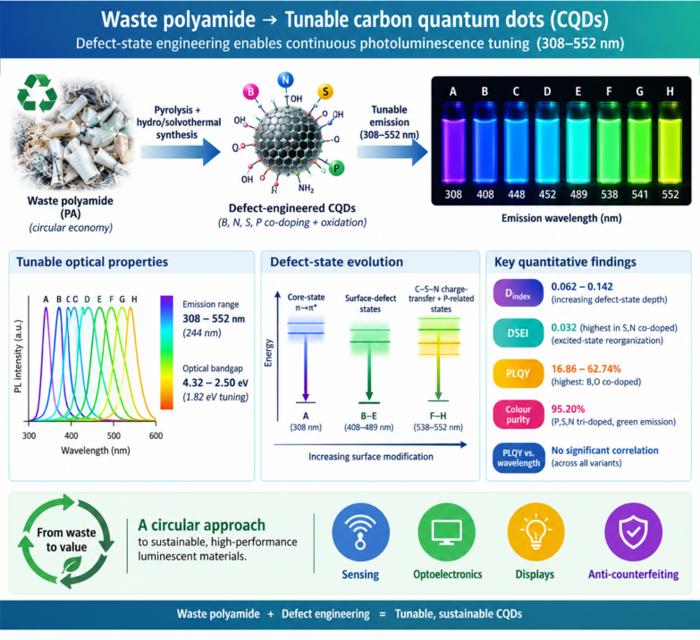
Waste polyamide-derived CQDs show continuous photoluminescence tuning from 308 to 552 nm through sequential defect-state engineering, with optical transition energies decreasing from 4.32 to 2.50 eV. @Christian Ebere Enyoh from Saitama University Carbon quantum dots (CQDs) are fluorescent carbon nanomaterials with potential applications in sensing, optoelectronics, displays, anti-counterfeiting, and environmental technologies. Their optical properties can be adjusted by modifying the carbon...
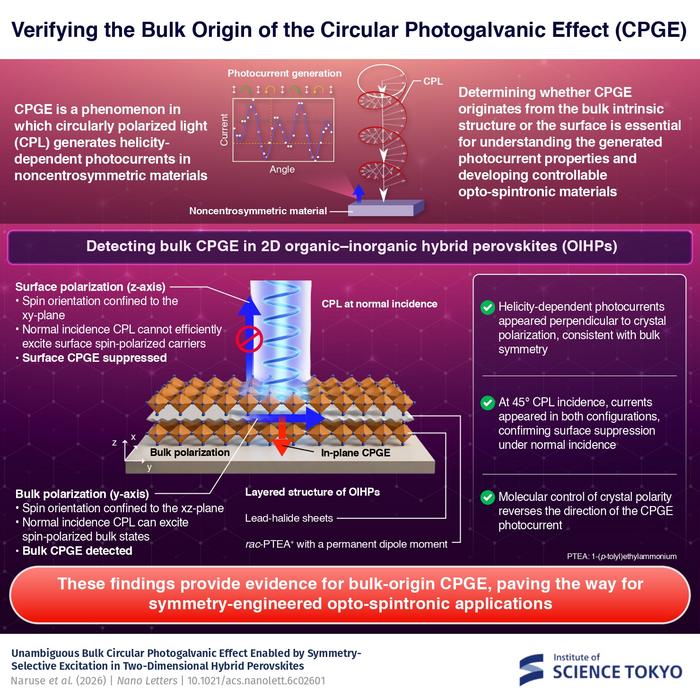
The researchers used circularly polarized light at normal incidence and found that helicity-dependent photocurrents appeared perpendicular to the crystal’s polarization but vanished when measured parallel to it, supporting a bulk origin of CPGE. @Institute of Science Tokyo The circular photogalvanic effect (CPGE), a phenomenon that generates helicity-dependent photocurrents in noncentrosymmetric materials, can originate purely from a crystal's internal structure without contribution from the...
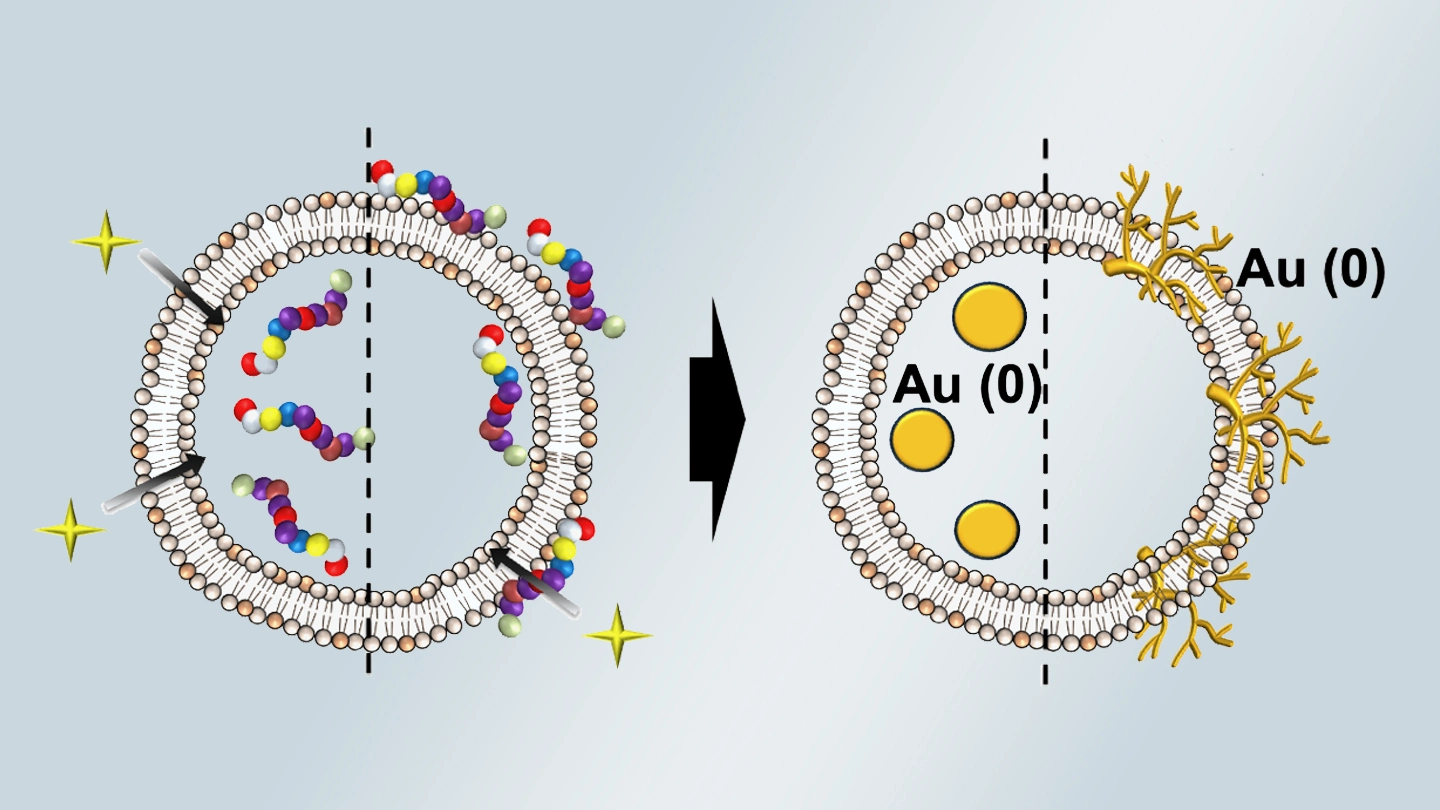
Summary of gold nanoparticle growth programming in liposome based on localization of biomineralization peptide The position of biomineralization peptides within liposomes can influence how gold nanoparticles grow, reports a research team from Institute of Science Tokyo. Peptides localized at the membrane interface promote branched structures, while those confined to the liposome interior favor spherical nanoparticles. The findings offer a new strategy for controlling nanoscale reaction...
