Researchers have been developing computers that deploy light, or photons, rather than electricity to power storage and calculations. These light-based computers have the potential to be more energy efficient than traditional computers while also running calculations at greater speeds.
However, a major challenge in the production of light-based computers—still in their infancy—is successfully rerouting microscopic light signals on a computer chip with minimal loss in signal strength. This is fundamentally a materials-design problem. These computers require a lightweight material to block additional light from all incoming directions—what’s known as an “isotropic bandgap material”—in order to maintain signal strength.
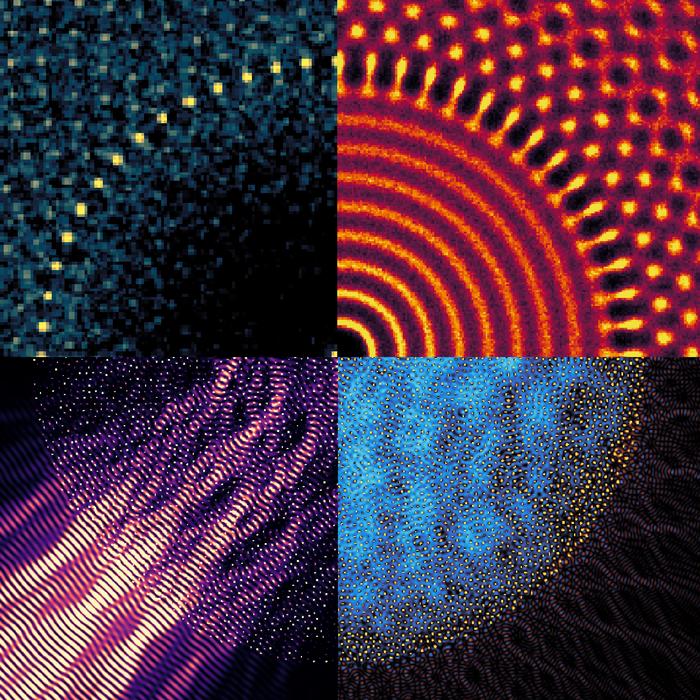
Scientists at New York University report the discovery of “gyromorphs”—a material that combines the seemingly incompatible properties of liquids and crystals and that performs better than any other known structure in blocking light from all incoming angles. The breakthrough, described in the journal Physical Review Letters, marks an innovative way to control optical properties and to potentially advance the capabilities of light-based computers.
“Gyromorphs are unlike any known structure in that their unique makeup gives rise to better isotropic bandgap materials than is possible with current approaches,” says Stefano Martiniani, an assistant professor of physics, chemistry, mathematics and neural science, and the paper’s senior author.
In designing isotropic bandgap materials, scientists have frequently turned to quasicrystals—first conceived by physicists Paul Steinhardt and Dov Levine in the 1980s and simultaneously observed in experiments by Dan Schechtman, who received the Nobel Prize in Chemistry in 2011. Quasicrystals have a mathematical order to their structure, but, unlike a crystal, one that does not repeat.
However, there is an unfortunate trade-off in quasicrystals, the NYU researchers note: either they block out light completely, but only from a few directions, or they attenuate light from all directions, but do not quite block it. That is why scientists have continued to seek alternative materials that can block out signal-sapping light.
In the Physical Review Letters work, the NYU researchers created “metamaterials,” which are engineered materials with properties stemming from their structure rather than their chemical nature. However, a challenge in creating metamaterials is first understanding how their structure gives rise to physical properties of interest.
To address these challenges, the scientists developed an algorithm to design disordered structures that were functional. In doing so, they discovered a novel form of “correlated disorder”—materials that are neither fully disordered nor fully ordered.
“Think of trees in a forest—they grow at random positions, but not completely random because they’re usually a certain distance from one another,” explains Martiniani. “This new pattern, gyromorphs, combines properties that we believed to be incompatible and displays a function that outperforms all ordered alternatives, including quasicrystals.”
The researchers noticed that every single isotropic bandgap material had a structural signature in common.
“We wanted to make this structural signature as pronounced as possible,” adds Mathias Casiulis, a postdoctoral fellow in NYU’s Department of Physics and the paper’s lead author. “The result was a new class of materials—gyromorphs—that reconcile seemingly incompatible features.
“This is because gyromorphs don’t have a fixed, repeating structure like a crystal, which gives them a liquid-like disorder, but, at the same time, if you look at them from a distance they form regular patterns. These properties work together to create bandgaps that lightwaves can’t penetrate from any direction.”
Reference
Gyromorphs: A New Class of Functional Disordered Materials
Mathias Casiulis, Aaron Shih, and Stefano Martiniani
Rice University researchers studying a class of atom-thin semiconductors known as transition metal dichalcogenides (TMDs) have discovered that light can trigger a physical shift in their atomic lattice, creating a tunable way to adjust the materials’ behavior and properties. The effect, observed in a TMD subtype named after the two-faced Roman god of transitions, Janus, could advance technologies that use light instead of electricity, from faster and cooler computer chips to ultrasensitive se...
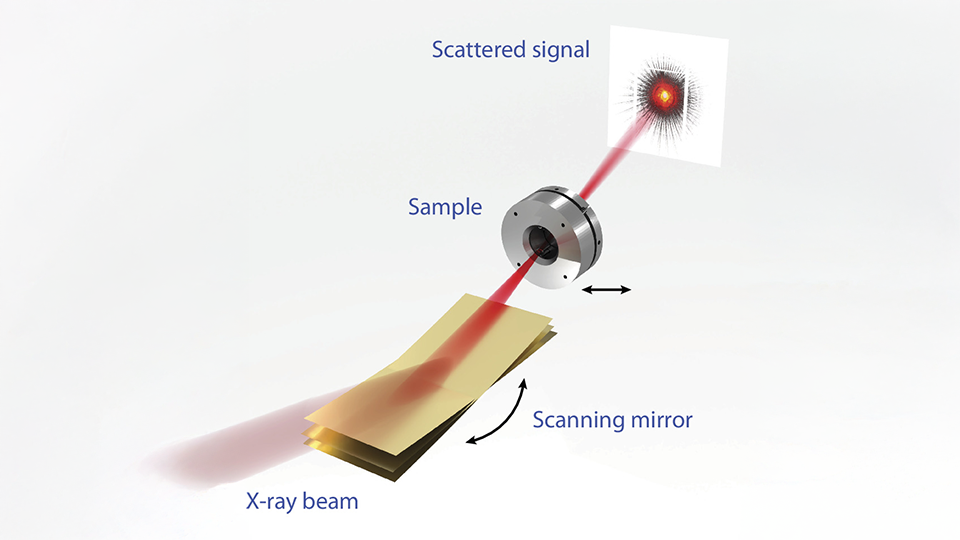
Sometimes a change of perspective can make a world of difference. A team of scientists from PETRA III, Centre for X-ray and Nanoscience (CXNS) at DESY, and MAX IV has rearranged the method in which one can use an X-ray beam to image a sample without using high-quality lenses. The method, called ptychography, has been widely used at synchrotrons and free-electron lasers to analyse the inner workings of materials quickly enough while avoiding major damage to the sample by the X-rays. The team h...
Quantum materials are a fascinating platform for future technologies, as they host a variety of exotic phenomena beyond the reach of classical physics. Among them, van der Waals heterostructures stand out: They are created by stacking different two-dimensional layers that can be only one atom thick. These structures are remarkably easy to manipulate, offering unprecedented tunability and a vast realm for exploration. A team from the Max-Planck-Institute for the Structure and Dynamics of Matte...
