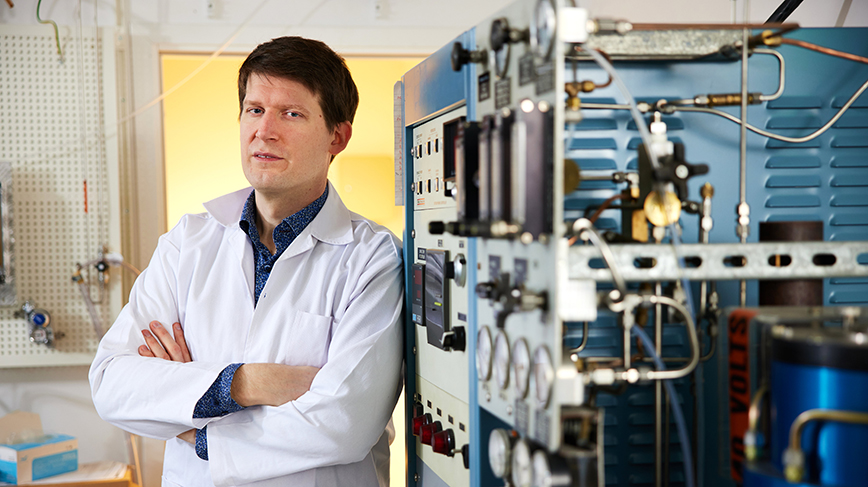
Researchers and industry in Sweden are working closely together to realise fourth generation lead-cooled nuclear power plants. Testing and preparatory work is in progress at KTH ahead of production of the reactors of the future.
“We are delighted with the Swedish Energy Agency decision to award research and development grants of SEK 99 million for the next step – construction of an electric powered test plant in Oskarshamn,” says KTH Professor Pär Olsson, coordinator of the Sunrise Research Centre.
Materials testing for lead-cooled nuclear technology is already in full flow in different labs at KTH. Components are being tested under different conditions, where, for example, material samples are trialled in a cask with hot lead.
“We are performing long-term testing of these components by studying how the lead affects the pumps for example, and how it flows and causes wear to materials over time,” Olsson says.
The ultimate goal is to be able to produce Sweden’s first SMR (Small Modular Reactor) in the next few years, and the next step on this path will be to build a prototype, an electrically heated experimental plant, that will be installed in Oskarshamn on the Baltic coast.
“The prototype plant will be the same height and run at the same temperature as the planned reactor, but will otherwise be on a smaller scale and will not contain any nuclear fuel. We will be able to perform all necessary safety tests apart from those directly related to the radiation process,” says Olsson.
Project Sunrise has been granted SEK 50 million from the Swedish Foundation for Strategic Research (SSF), money that is being shared between research groups at KTH, Luleå University of Technology, and Uppsala University.
“In the first phase, we are going to build two new test plants here at KTH, one of which is planned to be commissioned as early as this year,” Olsson explains.
Step two, Solstice, that has now received financing from the Swedish Energy Agency, will be managed by KTH in collaboration with Blykalla, SMR AB, and international energy company Uniper.
“Collaboration with industry is crucial in this phase,” says Olsson.
If the project proceeds according to plan, when can the first “real” lead-cooled reactor be taken into service?
“The optimistic goal is in eight years, 2030. I envisage the greatest time pressure will be the enormous financing that is required ahead of production of a lead-cooled nuclear reactor, we are talking billions. However, we hope to be able to take advantage of the so-called Nuclear Waste Fund Surcharge Agreement, and today’s decision on financing is a key sign that our schedule is up to scratch.”
For cost reasons, freshly mined uranium will be used in the first SMRs – it is more expensive to process spent nuclear fuel for re-use.
“However, SMRs of this type will eventually be able to operate entirely on used nuclear fuel, and then we will have usable uranium fuel available for thousands of
years hence without any problems.”
Radioactive waste from these lead-cooled reactor can be re-used in its turn. And compared to ordinary nuclear power, far less waste will therefore require final storage – for a shorter time.
“The final storage time required will only be 1,000 years instead of the 100,000 years today. While 1,000 years certainly sounds a long time, it is still a time period that is foreseeable in civilisation terms,” says Olsson.
And this is important, he says, as he views the development of civilisation as a greater safety risk with regard to radioactive waste than possible leaks in storage materials and rock.
“The question is whether in tens of thousands of years into the future people could decide to poke around and do something stupid with the radioactive waste, which is difficult to try to predict. This is therefore why I view a 1,000-year perspective instead of storage for 100,000 years as so much safer.”
