(Harvard SEAS)
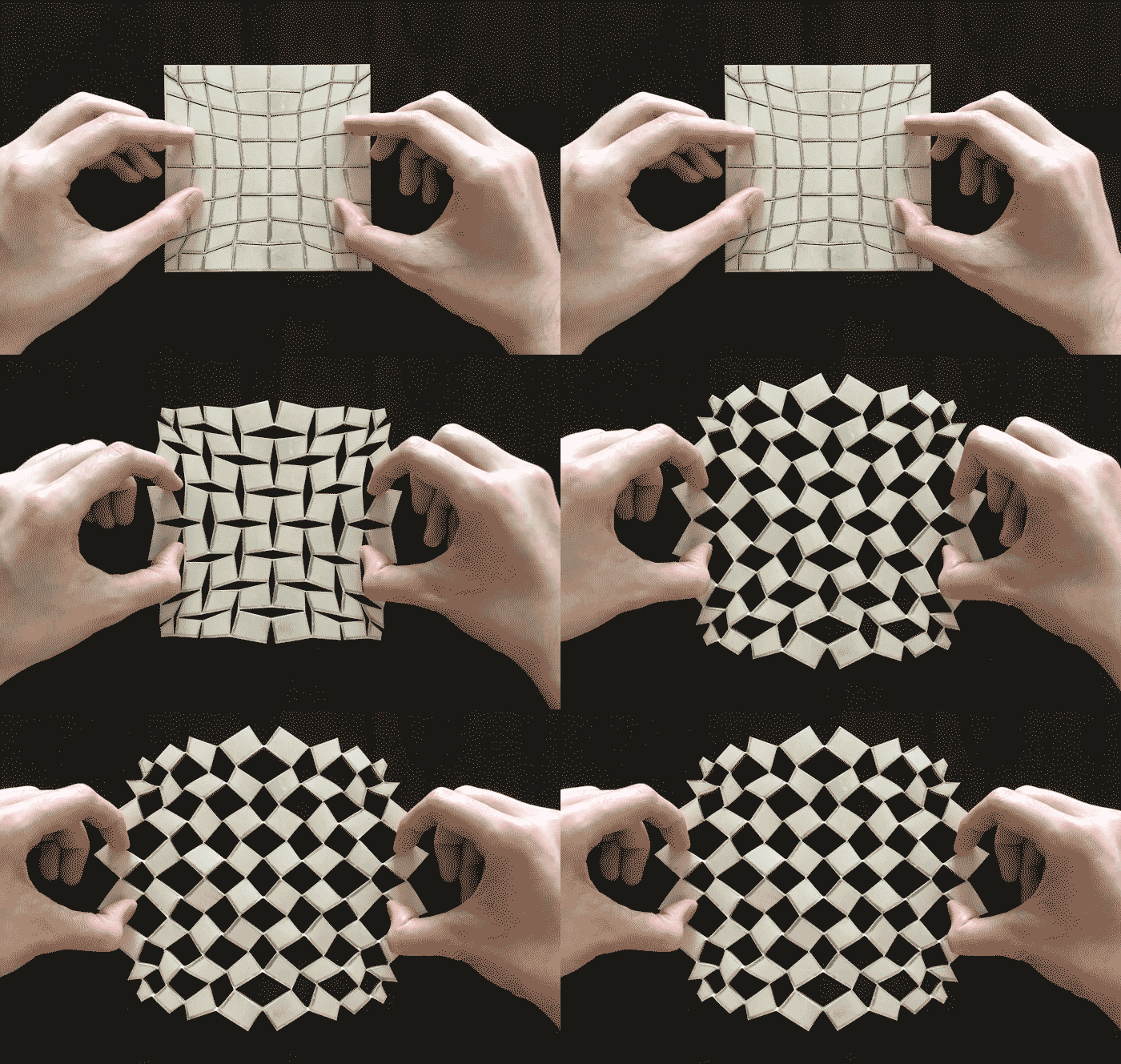
Researchers from the Harvard John A. Paulson School of Engineering and Applied Sciences (SEAS) have developed a mathematical framework that can turn any sheet of material into any prescribed shape, inspired by the paper craft termed kirigami (from the Japanese, kiri, meaning to cut and kami, meaning paper).
Unlike its better-known cousin origami, which uses folds to shape paper, kirigami relies on a pattern of cuts in a flat paper sheet to change its flexibility and allow it to morph into 3D shapes. Artists have long used this artform to create everything from pop-up cards to castles and dragons.
"We asked if it is possible to uncover the basic mathematical principles underlying kirigami and use them to create algorithms that would allow us to design the number, size and orientation of the cuts in a flat sheet so that it can morph into any given shape," said L. Mahadevan, de Valpine Professor of Applied Mathematics, Physics, and Organismic and Evolutionary Biology, the senior author on the paper.
"Specifically, if we are given a general shape in two-or-three dimensions, how should we design the cut patterns in a reference shape so that we can get it to deploy to the final shape in one motion?" said Gary P. T. Choi, a graduate student at SEAS and first author of the paper. "In this work, we solve that problem by identifying the constraints that have to be satisfied in order to achieve this cut pattern, use a numerical optimization approach to determine the patterns, and then verify this experimentally."
The research is published in Nature Materials.
This research follows previous work by the Mahadevan lab that characterized how origami-based patterns could be used as building blocks to create almost any three-dimensional curved shape.
"We were actually able to do a little more with kirigami than we were able to do with origami," said Levi Dudte, graduate student in the Mahadevan lab and co-author of the paper. "The presence of cuts and holes in the interior of the material gives kirigami the ability to change its shape significantly."
"Our work draws on inspiration from art, tempered by the rigor of mathematics, and the challenges of engineering shape. Finding kirigami tessellations that can convert a square to a circle, or a flat sheet into a poncho is just the start. We think that this is just the beginning of a class of new ways to engineer shape in the digital age using geometry, topology, and computation," said Mahadevan.
Next the researchers aim to explore how to combine cuts and folds to achieve any shape with a given set of properties, thus linking origami and kirigami.
Programming shape using kirigami tessellations
Gary P. T. Choi, Levi H. Dudte & L. Mahadevan
Nature Materials volume 18, pages 999–1004 (2019)
DOI: 10.1038/s41563-019-0452-y
Contact information:
L Mahadevan
Professor of Applied Mathematics, of Organismic and Evolutionary Biology at Harvard SEAS
lm@seas.harvard.edu
Phone: (617) 496-9599
Harvard John A. Paulson School of Engineering and Applied Sciences
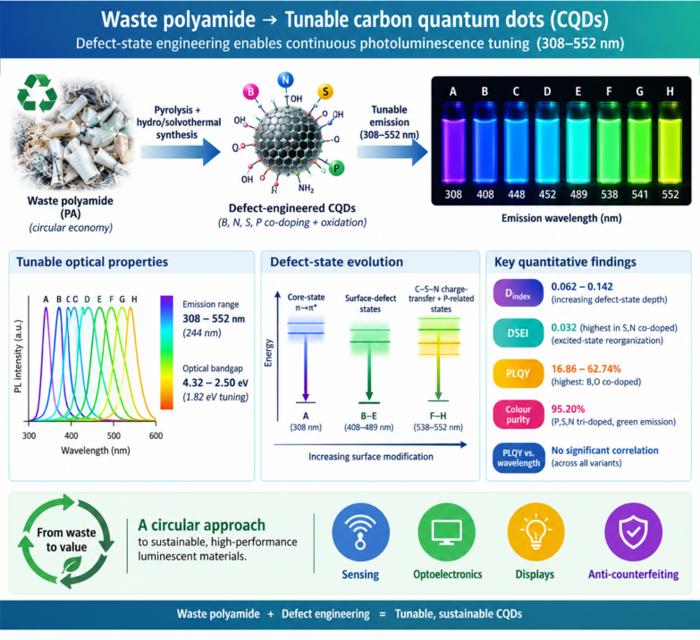
Waste polyamide-derived CQDs show continuous photoluminescence tuning from 308 to 552 nm through sequential defect-state engineering, with optical transition energies decreasing from 4.32 to 2.50 eV. @Christian Ebere Enyoh from Saitama University Carbon quantum dots (CQDs) are fluorescent carbon nanomaterials with potential applications in sensing, optoelectronics, displays, anti-counterfeiting, and environmental technologies. Their optical properties can be adjusted by modifying the carbon...
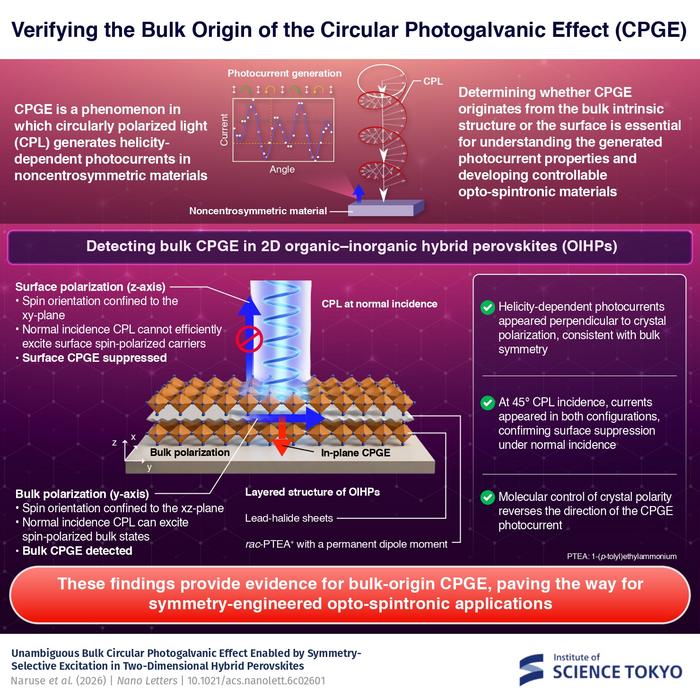
The researchers used circularly polarized light at normal incidence and found that helicity-dependent photocurrents appeared perpendicular to the crystal’s polarization but vanished when measured parallel to it, supporting a bulk origin of CPGE. @Institute of Science Tokyo The circular photogalvanic effect (CPGE), a phenomenon that generates helicity-dependent photocurrents in noncentrosymmetric materials, can originate purely from a crystal's internal structure without contribution from the...
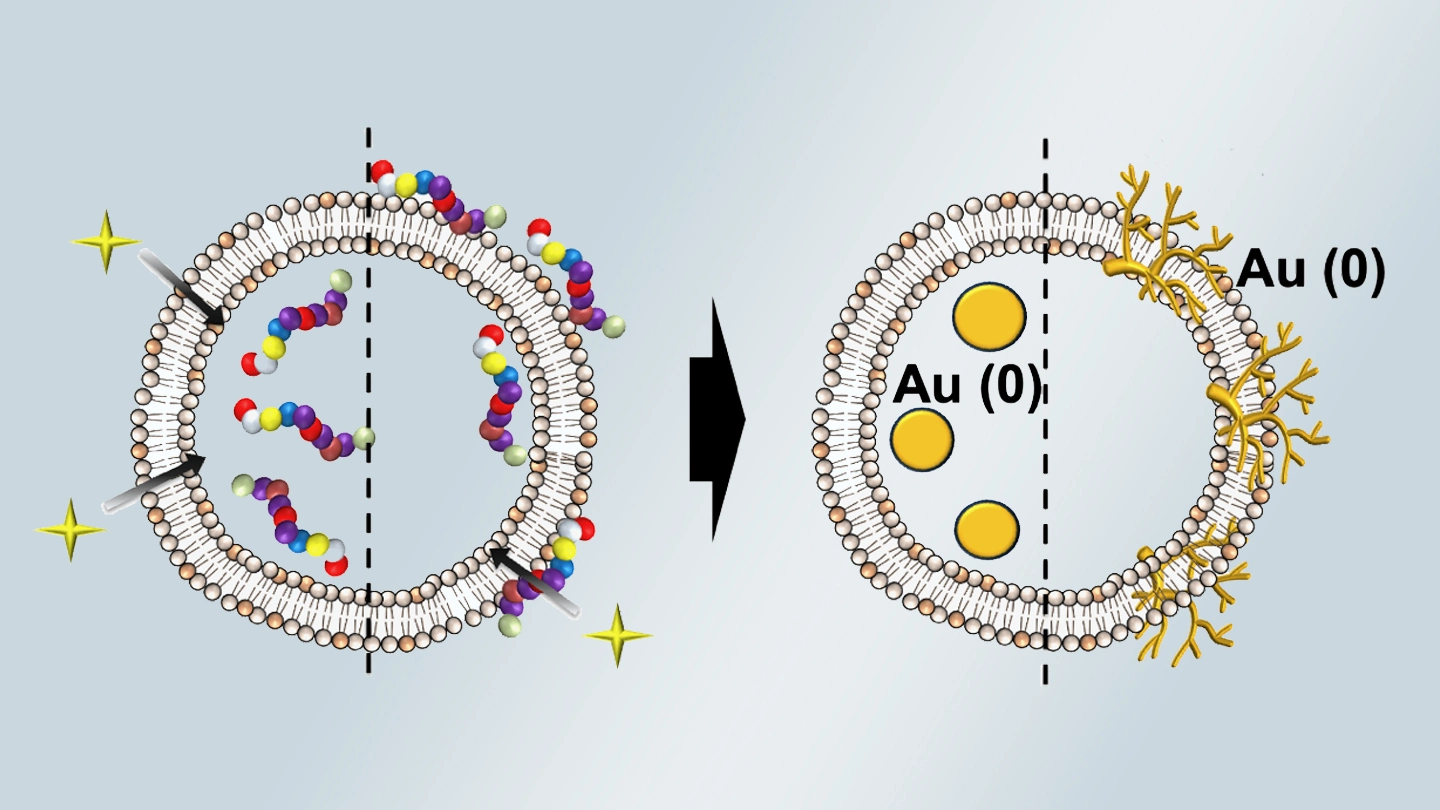
Summary of gold nanoparticle growth programming in liposome based on localization of biomineralization peptide The position of biomineralization peptides within liposomes can influence how gold nanoparticles grow, reports a research team from Institute of Science Tokyo. Peptides localized at the membrane interface promote branched structures, while those confined to the liposome interior favor spherical nanoparticles. The findings offer a new strategy for controlling nanoscale reaction...
