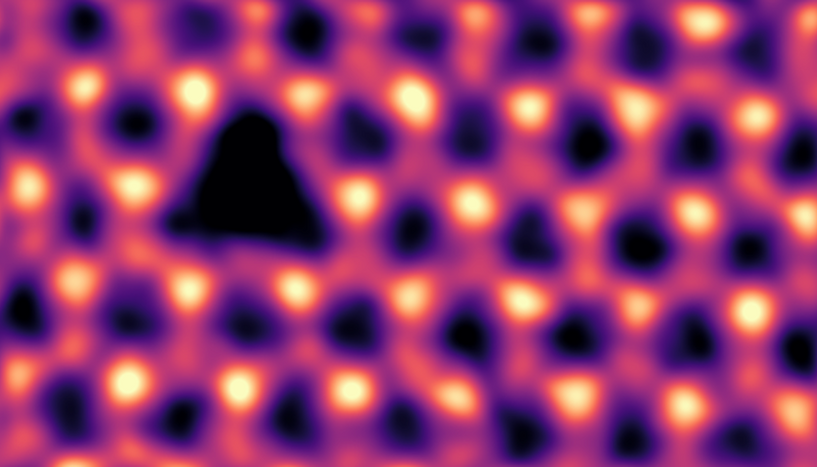
Single photons have applications in quantum computation, information networks, and sensors, and these can be emitted by defects in the atomically thin insulator hexagonal boron nitride (hBN). Missing nitrogen atoms have been suggested to be the atomic structure responsible for this activity, but it is difficult to controllably remove them. A team at the Faculty of Physics of the University of Vienna has now shown that single atoms can be kicked out using a scanning transmission electron microscope under ultra-high vacuum. The results are published in the journal Small.
Transmission electron microscopy allows us to see the atomic structure of materials, and it is particularly well suited to directly reveal any defects in the lattice of the specimen, which may be detrimental or useful depending on the application. However, the energetic electron beam may also damage the structure, either due to elastic collisions or electronic excitations, or a combination of both. Further, any gases left in the vacuum of the instrument can contribute to damage, whereby dissociated gas molecules can etch away atoms of the lattice. Until now, transmission electron microscopy measurements of hBN have been conducted at relatively poor vacuum conditions, leading to rapid damage. Due to this limitation, it has not been clear whether vacancies – single missing atoms – can be controllably created.
At the University of Vienna, the creation of single atomic vacancies has now been achieved using aberration-corrected scanning transmission electron microscopy in near ultra-high vacuum. The material was irradiated at a range of electron-beam energies, which influences the measured damage rate. At low energies, damage is dramatically slower than previously measured under poorer residual vacuum conditions. Single boron and nitrogen vacancies can be created at intermediate electron energies, and boron is twice as likely to be ejected due to its lower mass. Although atomically precise measurements are not feasible at the higher energies previously used to make hBN emit single photons, the results predict that nitrogen in turn becomes easier to eject – allowing these shining vacancies to be preferentially created.
Robust statistics collected by painstaking experimental work combined with new theoretical models were vital for reaching these conclusions. Lead author Thuy An Bui has worked on the project since her Master's thesis: "At each electron energy, I needed to spend many days at the microscope carefully collecting one series of data after another," she says. "Once the data was collected, we used machine learning to help analyse it accurately, though even this took a great deal of work." Senior author Toma Susi adds: "To understand the damage mechanism, we created an approximate model that combines ionization with knock-on damage. This allowed us to extrapolate to higher energies and shed new light on defect creation."
Despite its insulating nature, the results show that monolayer hexagonal boron nitride is surprisingly stable under electron irradiation when chemical etching can be prevented. In the future, it may be possible to use electron irradiation to purposefully create specific vacancies that emit single photons of light by selectively irradiating the desired lattice sites with a focused electron probe. New opportunities for atomically precise manipulation, until now demonstrated for impurity atoms in graphene and in bulk silicon, may also be uncovered.
Reference
Creation of Single Vacancies in hBN with Electron Irradiation
Thuy An Bui, Gregor T. Leuthner, Jacob Madsen, Mohammad R. A. Monazam, Alexandru I. Chirita, Andreas Postl, Clemens Mangler, Jani Kotakoski, Toma Susi
https://onlinelibrary.wiley.com/doi/10.1002/smll.202301926
Quantinuum reported third quarter 2026 financial results and raised its 2026 revenue outlook after landing its largest cloud agreement. The company also unveiled a roadmap for its Nexus developer platform.
IonQ reported record third quarter revenue of $173.8 million, up 336 percent year over year, and raised full year 2026 guidance to $505 to $515 million on 110 percent quantum computing growth. Backlog more than doubled to $1.2 billion, with demand led by Superion 256 system deployments, including NVIDIA's first on-premise quantum computer. The company also advanced to Stage C of DARPA's Quantum Benchmarking Initiative and acquired Elisity to extend quantum security.
IonQ announced a partnership with QuantumCT, Connecticut's statewide quantum initiative, which will purchase access to IonQ's trapped-ion quantum computers for state organizations. The contract includes more than 150 hours of cloud runtime.
This week in nanotech
$10.2M raised
1 funding round · 13 deals tracked
New products
 Ti-WCMBN Nanomaterialia Featured
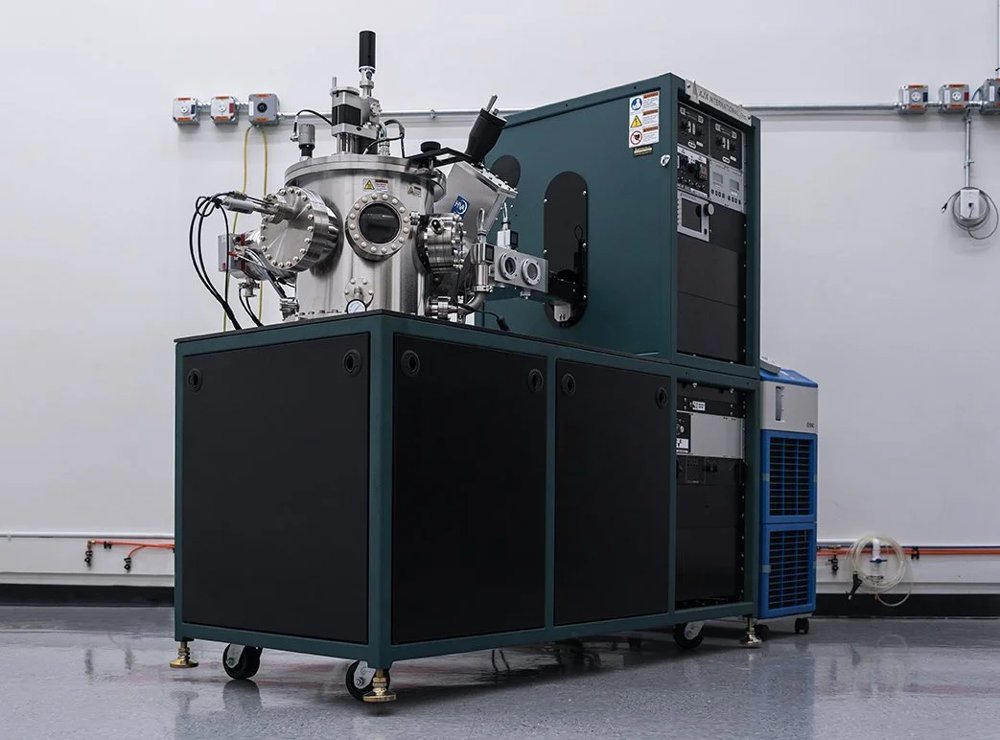 Orion Sputtering Deposition SystemsAJA International Featured
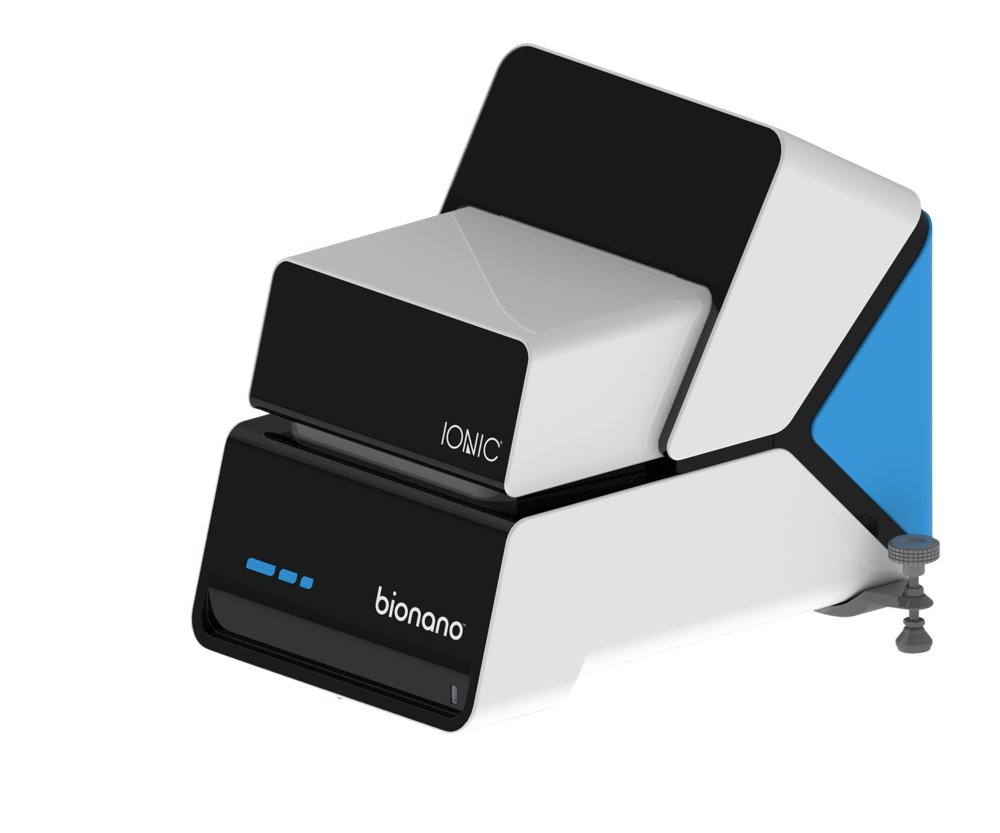 Ionic® Purification SystemBionano Genomics, Inc.
Market insights
Last 30 days: Quantum Technologies was the busiest vertical: 52 of 174 events (30%).
Money raised per month