
Inspired by nature, nanotechnology researchers have identified ‘spontaneous curvature’ as the key factor determining how ultra-thin, artificial materials can transform into useful tubes, twists and helices.
Greater understanding of this process - which mimics how some seed pods open in nature - could unlock an array of new chiral materials that are 1,000 times thinner than a human hair, with the potential to improve the design of optical, electronic and mechanical devices.
Chiral shapes are structures that cannot be superimposed on their mirror image, much like how your left hand is a mirror image of your right hand but cannot fit perfectly on top of it.
Spontaneous curvature induced by tiny molecules can be used to change the shape of thin nanocrystals, influenced by the crystal width, thickness, and symmetry.
The research, published in the Proceedings of the National Academy of Sciences, was conducted by members of the National Centre for Scientific Research (CNRS) in France, together with their ARC Centre of Excellence in Exciton Science colleagues, based at the University of Sydney.
Shapeshifting at the nanoscale
Imagine a piece of paper that, when dipped into a solution, twists or curls into a spiral without any external force. This is akin to what happens at the nanoscale with certain thin materials.
Researchers have discovered that when certain types of semiconducting nanoplatelets - extremely thin, flat crystals - are coated with a layer of organic molecules called ligands, they curl into complex shapes, including tubes, twists and helices. This transformation is driven by the different forces the ligands apply to the top and bottom surfaces of the nanoplatelets.
The significance of this finding lies in the ability to predict and control the shape of these nanoplatelets by understanding the interaction between the ligands and the nanoplatelet surface.
From nature’s design to nanoscale innovation
The inspiration for this research stems from observing natural phenomena where helical structures are prevalent, from the DNA in our cells to the spontaneous twisting of seed pods. These structures possess unique properties that are highly desirable in materials science for their potential applications in mechanics, electronics, and optics.
Nanoplatelets, with their ability to form helical structures, and exceptional optical properties due to quantum confinement, stand out as a prime candidate for creating new materials with specific characteristics. These could include materials that selectively reflect light, conduct electricity in novel ways, or have unique mechanical properties.
A framework for future technologies
The implications of this research are considerable. By providing a framework to understand and control the shape of nanoplatelets, scientists have a new tool to design materials with precisely-tuned properties for use in technologies ranging from advanced electronics to responsive, smart materials.
For instance, nanoplatelets could be engineered to change shape in response to environmental conditions, such as temperature or light, paving the way for materials that adapt and respond to their surroundings. This could lead to breakthroughs in creating more efficient sensors.
Moreover, the study hints at the possibility of creating materials that can switch between different shapes with minimal energy input, a feature that could be exploited in developing new forms of actuators or switches at the nanoscale.
Reference
Ligand-induced incompatible curvatures control ultrathin nanoplatelet polymorphism and chirality
Doron Grossman, Marion Krapez, Pierre Bauer, Austin Hubley, Jérémie Margueritat, Benoit Mahler, Asaph Widmer-Cooper, Benjamin Abécassis
https://www.pnas.org/doi/abs/10.1073/pnas.2316299121
ARC Centre of Excellence in Exciton Science
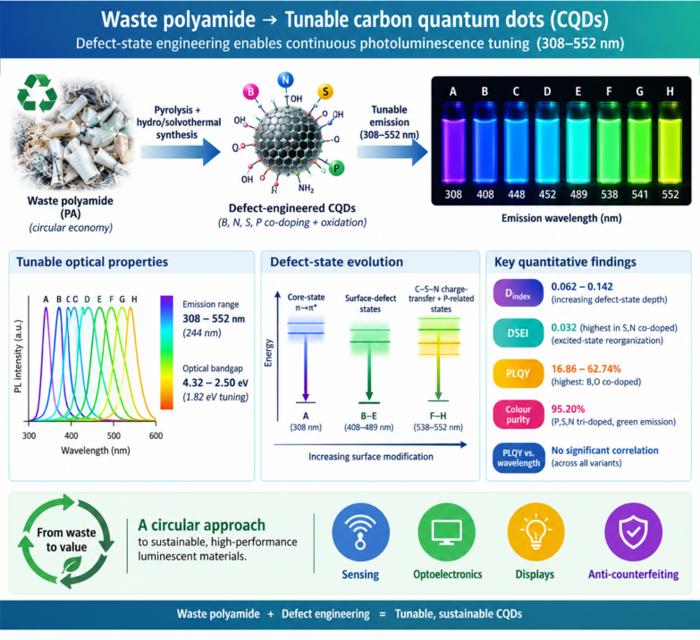
Waste polyamide-derived CQDs show continuous photoluminescence tuning from 308 to 552 nm through sequential defect-state engineering, with optical transition energies decreasing from 4.32 to 2.50 eV. @Christian Ebere Enyoh from Saitama University Carbon quantum dots (CQDs) are fluorescent carbon nanomaterials with potential applications in sensing, optoelectronics, displays, anti-counterfeiting, and environmental technologies. Their optical properties can be adjusted by modifying the carbon...
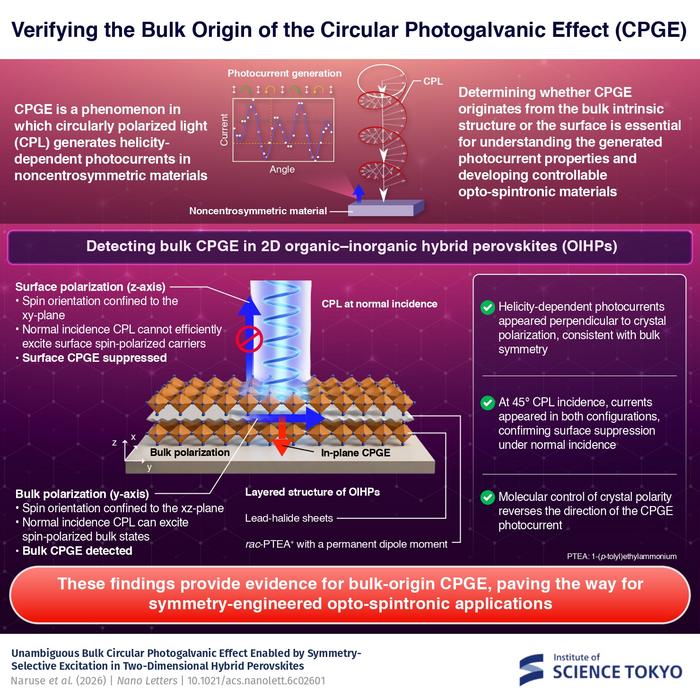
The researchers used circularly polarized light at normal incidence and found that helicity-dependent photocurrents appeared perpendicular to the crystal’s polarization but vanished when measured parallel to it, supporting a bulk origin of CPGE. @Institute of Science Tokyo The circular photogalvanic effect (CPGE), a phenomenon that generates helicity-dependent photocurrents in noncentrosymmetric materials, can originate purely from a crystal's internal structure without contribution from the...
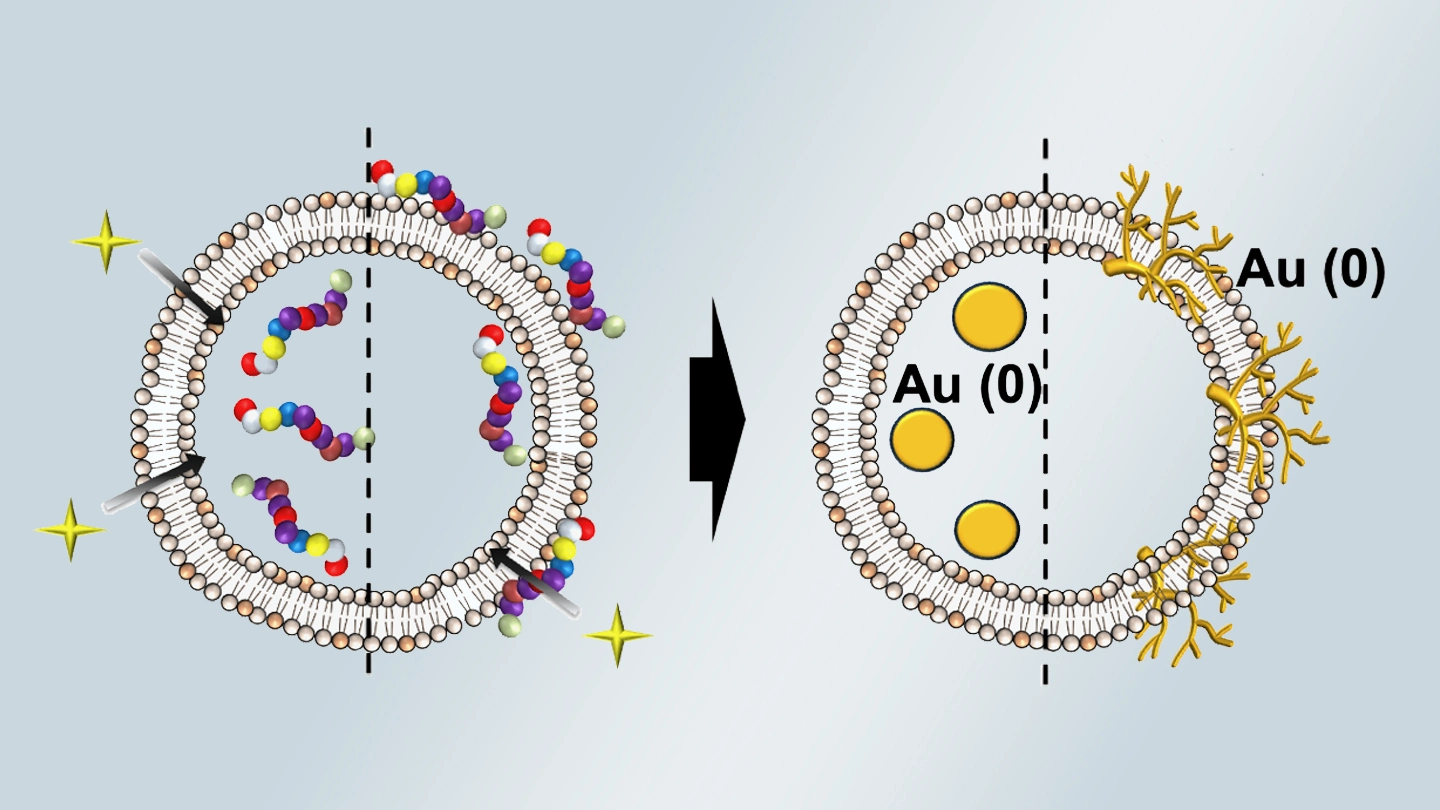
Summary of gold nanoparticle growth programming in liposome based on localization of biomineralization peptide The position of biomineralization peptides within liposomes can influence how gold nanoparticles grow, reports a research team from Institute of Science Tokyo. Peptides localized at the membrane interface promote branched structures, while those confined to the liposome interior favor spherical nanoparticles. The findings offer a new strategy for controlling nanoscale reaction...
