Max Planck Institute for Solid State Research

Zhang et al. demonstrate that the debated 326-K phase transition in Ta2NiSe5 involves a collaboration of three microscopic factors
The excitonic insulator is a macroscopic condensate of electron-hole pairs, i.e., excitons, predicted to emerge in a narrow-gap semiconductor or semimetal. Despite apparent analogies to a superconductor, which is a macroscopic condensate of electron-electron pairs, the excitonic insulator has yet to be firmly established as the ground state of a bulk compound. The quasi-one-dimensional chalcogenide Ta2NiSe5 undergoes an insulator transition below Tc = 326 K and is currently a leading candidate for a bulk excitonic insulator. However, a simultaneous lattice distortion at Tc has led to a polarizing debate as to whether the transition is electronically or structurally driven.
Zhang et al. approach this question by uniquely applying high-temperature thermal transport, which is not only sensitive to charge carriers, but also neutral heat carriers, such as excitons or phonons. They uncover a giant and anisotropic soft-phonon transport anomaly around Tc. By tracking this anomaly as a function of sulfur substitution, the authors explain how a bare lattice instability of 130 K is boosted to Tc = 326 K by its coupling to electronic instabilities, which include both the excitonic insulator and a single-particle hybridization gap. Ta2NiSe5 therefore represents the best of these three instabilities.
This project was carried out in collaboration with the Crystal Growth group and partly supported by the Deutsche Forschungsgemeinschaft (DFG, German Research Foundation) – TRR 360 – 492547816, “Constrained Quantum Matter.”
Reference
Electronic Tuning of the Soft-Phonon Transport Anomaly in Ta 2 Ni(S x Se 1– x ) 5
Yuan-Shan Zhang, Masahiko Isobe, Hidenori Takagi, Dennis Huang
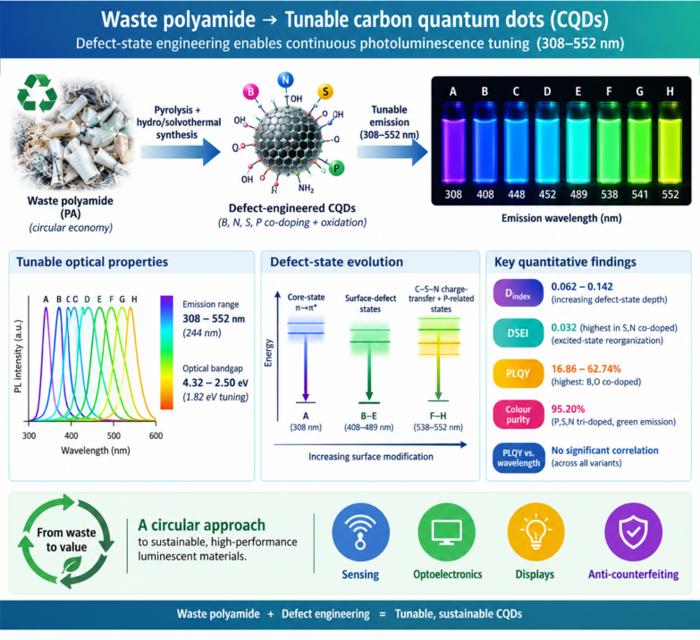
Waste polyamide-derived CQDs show continuous photoluminescence tuning from 308 to 552 nm through sequential defect-state engineering, with optical transition energies decreasing from 4.32 to 2.50 eV. @Christian Ebere Enyoh from Saitama University Carbon quantum dots (CQDs) are fluorescent carbon nanomaterials with potential applications in sensing, optoelectronics, displays, anti-counterfeiting, and environmental technologies. Their optical properties can be adjusted by modifying the carbon...

The researchers used circularly polarized light at normal incidence and found that helicity-dependent photocurrents appeared perpendicular to the crystal’s polarization but vanished when measured parallel to it, supporting a bulk origin of CPGE. @Institute of Science Tokyo The circular photogalvanic effect (CPGE), a phenomenon that generates helicity-dependent photocurrents in noncentrosymmetric materials, can originate purely from a crystal's internal structure without contribution from the...
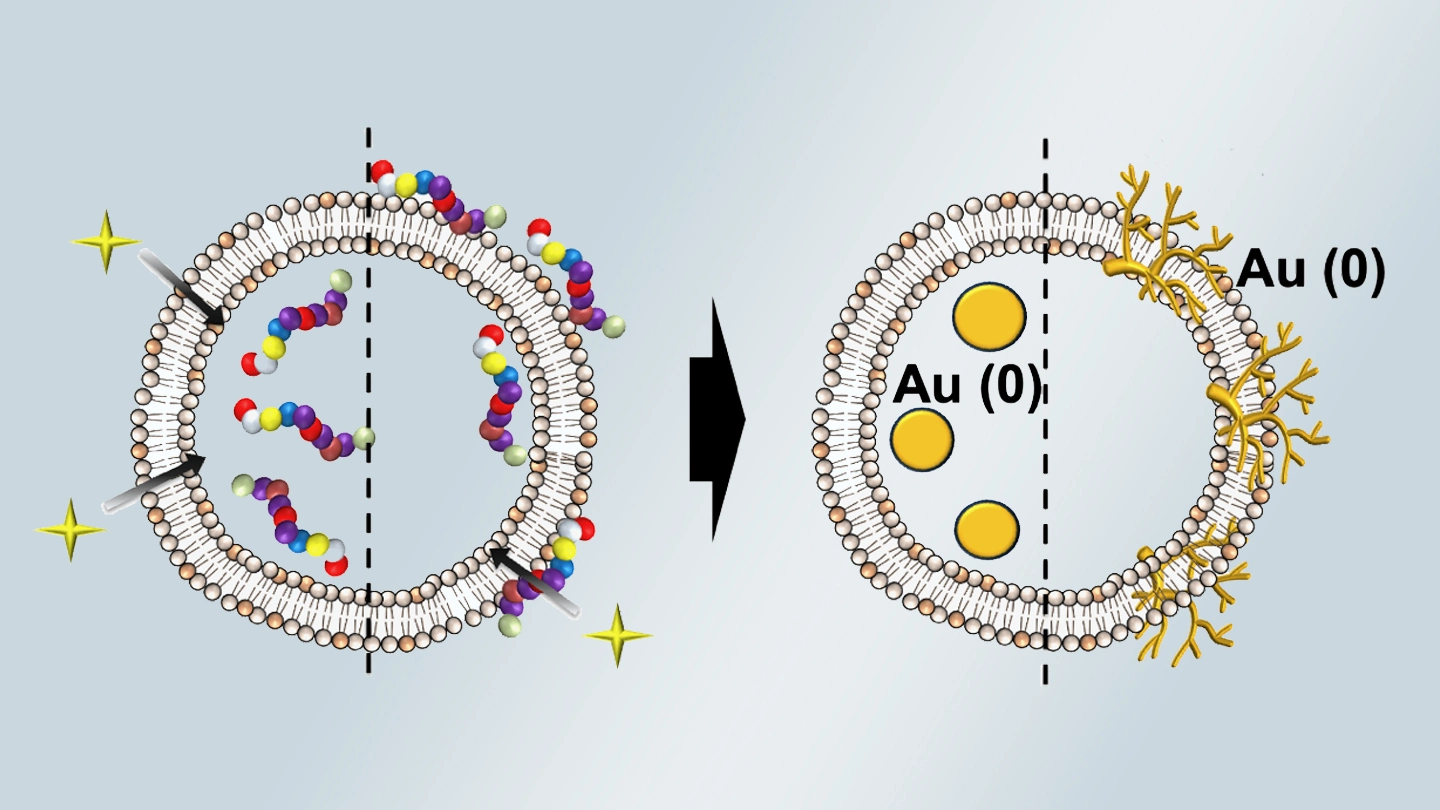
Summary of gold nanoparticle growth programming in liposome based on localization of biomineralization peptide The position of biomineralization peptides within liposomes can influence how gold nanoparticles grow, reports a research team from Institute of Science Tokyo. Peptides localized at the membrane interface promote branched structures, while those confined to the liposome interior favor spherical nanoparticles. The findings offer a new strategy for controlling nanoscale reaction...
