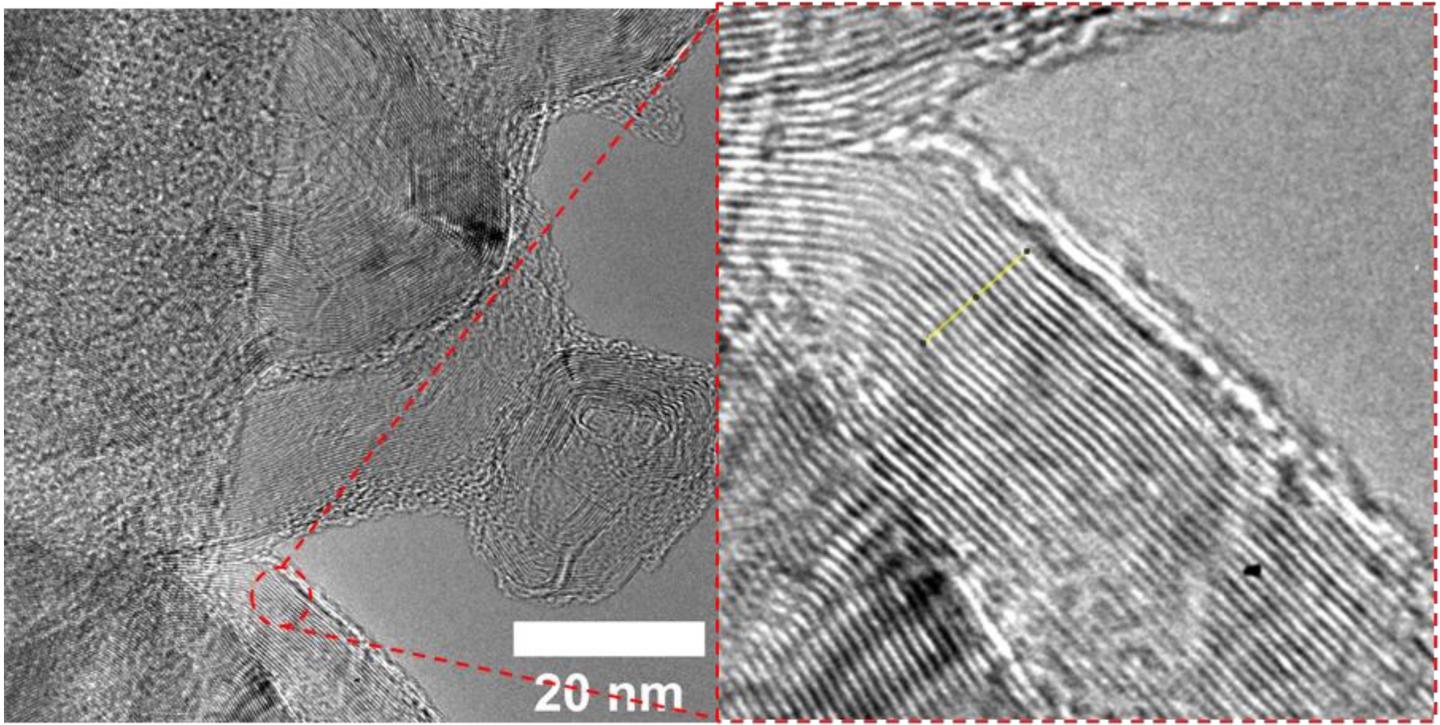
Rice University scientists have optimized a process to convert waste from rubber tires into graphene that can, in turn, be used to strengthen concrete.
The environmental benefits of adding graphene to concrete are clear, chemist James Tour said.
"Concrete is the most-produced material in the world, and simply making it produces as much as 9% of the world's carbon dioxide emissions," Tour said. "If we can use less concrete in our roads, buildings and bridges, we can eliminate some of the emissions at the very start."
Recycled tire waste is already used as a component of Portland cement, but graphene has been proven to strengthen cementitious materials, concrete among them, at the molecular level.
While the majority of the 800 million tires discarded annually are burned for fuel or ground up for other applications, 16% of them wind up in landfills.
"Reclaiming even a fraction of those as graphene will keep millions of tires from reaching landfills," Tour said.
The "flash" process introduced by Tour and his colleagues in 2020 has been used to convert food waste, plastic and other carbon sources by exposing them to a jolt of electricity that removes everything but carbon atoms from the sample.
Those atoms reassemble into valuable turbostratic graphene, which has misaligned layers that are more soluble than graphene produced via exfoliation from graphite. That makes it easier to use in composite materials.
Rubber proved more challenging than food or plastic to turn into graphene, but the lab optimized the process by using commercial pyrolyzed waste rubber from tires. After useful oils are extracted from waste tires, this carbon residue has until now had near-zero value, Tour said.
Tire-derived carbon black or a blend of shredded rubber tires and commercial carbon black can be flashed into graphene. Because turbostratic graphene is soluble, it can easily be added to cement to make more environmentally friendly concrete.
The research led by Tour and Rouzbeh Shahsavari of C-Crete Technologies is detailed in the journal Carbon.
The Rice lab flashed tire-derived carbon black and found about 70% of the material converted to graphene. When flashing shredded rubber tires mixed with plain carbon black to add conductivity, about 47% converted to graphene. Elements besides carbon were vented out for other uses.
The electrical pulses lasted between 300 milliseconds and 1 second. The lab calculated electricity used in the conversion process would cost about $100 per ton of starting carbon.
The researchers blended minute amounts of tire-derived graphene -- 0.1 weight/percent (wt%) for tire carbon black and 0.05 wt% for carbon black and shredded tires -- with Portland cement and used it to produce concrete cylinders. Tested after curing for seven days, the cylinders showed gains of 30% or more in compressive strength. After 28 days, 0.1 wt% of graphene sufficed to give both products a strength gain of at least 30%.
"This increase in strength is in part due to a seeding effect of 2D graphene for better growth of cement hydrate products, and in part due to a reinforcing effect at later stages," Shahsavari said.
Reference
Flash Graphene from Rubber Waste
Paul A. Advincula, Duy Xuan Luong, Weiyin Chen, Shivaranjan, Raghuraman, Rouzbeh Shahsavari, James M. Tour
https://www.sciencedirect.com/science/article/abs/pii/S0008622321003249?via%3Dihub
Contact
James Tour
Professor of Chemistry
tour@rice.edu
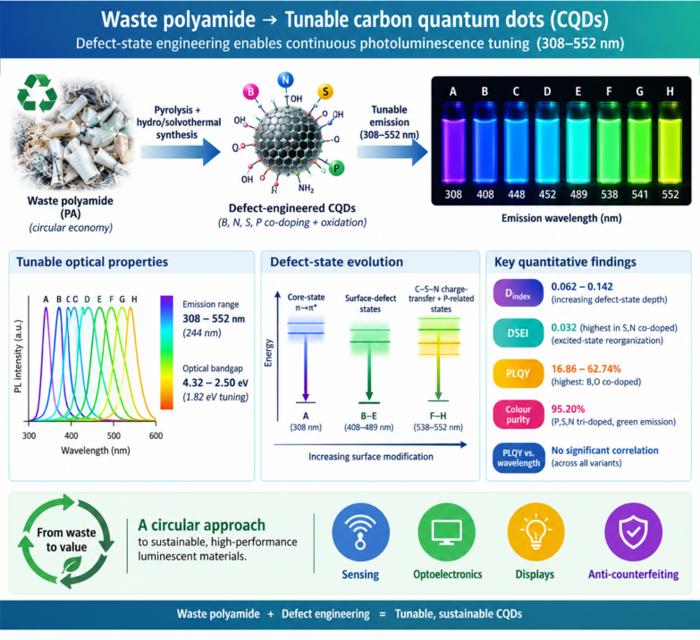
Waste polyamide-derived CQDs show continuous photoluminescence tuning from 308 to 552 nm through sequential defect-state engineering, with optical transition energies decreasing from 4.32 to 2.50 eV. @Christian Ebere Enyoh from Saitama University Carbon quantum dots (CQDs) are fluorescent carbon nanomaterials with potential applications in sensing, optoelectronics, displays, anti-counterfeiting, and environmental technologies. Their optical properties can be adjusted by modifying the carbon...
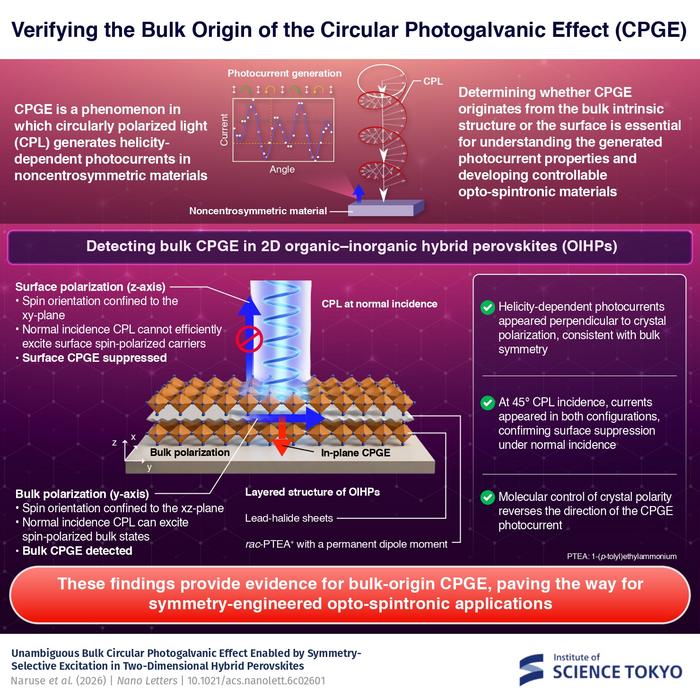
The researchers used circularly polarized light at normal incidence and found that helicity-dependent photocurrents appeared perpendicular to the crystal’s polarization but vanished when measured parallel to it, supporting a bulk origin of CPGE. @Institute of Science Tokyo The circular photogalvanic effect (CPGE), a phenomenon that generates helicity-dependent photocurrents in noncentrosymmetric materials, can originate purely from a crystal's internal structure without contribution from the...
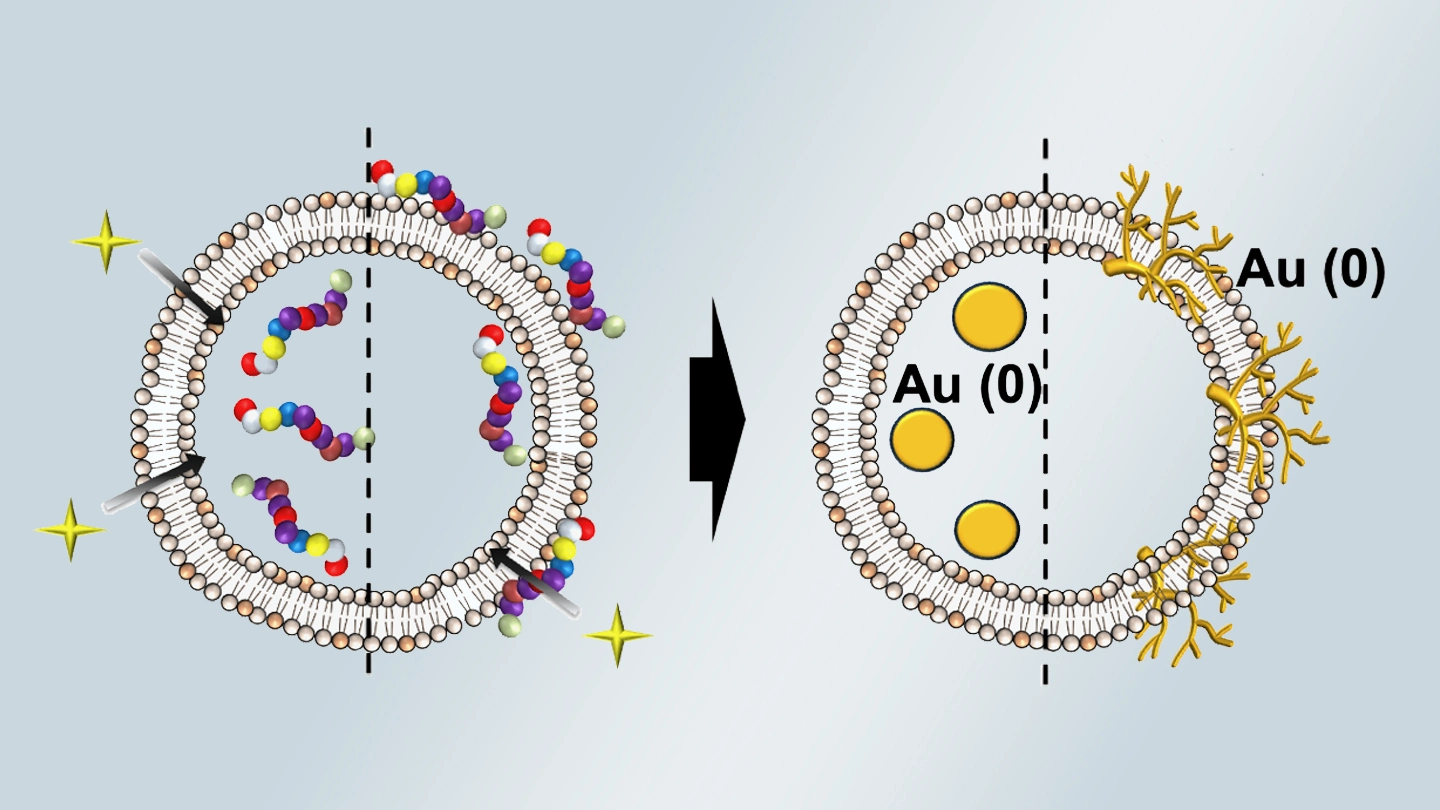
Summary of gold nanoparticle growth programming in liposome based on localization of biomineralization peptide The position of biomineralization peptides within liposomes can influence how gold nanoparticles grow, reports a research team from Institute of Science Tokyo. Peptides localized at the membrane interface promote branched structures, while those confined to the liposome interior favor spherical nanoparticles. The findings offer a new strategy for controlling nanoscale reaction...
