Pennsylvania State University (Penn State)
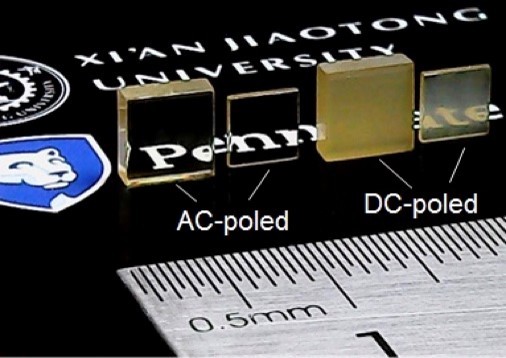
Use of an AC rather than a DC electric field can improve the piezoelectric response of a crystal. Now, an international team of researchers say that cycles of AC fields also make the internal crystal domains in some materials bigger and the crystal transparent.
"There have been reports that the use of AC fields could significantly improve the piezoelectric responses -- for example by 20% to 40% -- over DC fields and the improvements have always been attributed to the smaller internal ferroelectric domain sizes that resulted from the cycles of AC fields," said Long-Qing Chen, Hamer Professor of Materials Science and Engineering, professor of engineering science and mechanics, and professor of mathematics at Penn State. "About three years ago, Dr. Fei Li, then a research associate at the Materials Research Institute at Penn State, largely confirmed the improvement of piezoelectric performances from application of AC fields. However, it was not clear at all how the internal ferroelectric domains evolved during AC cycles.
"Our group does mostly computer modeling, and more than a year ago we started looking into what happens to the internal domain structures if we apply AC fields to a ferroelectric piezoelectric crystal. We are very curious about how the domain structures evolve during AC cycles. Our computer simulations and theoretical calculations did show an improved piezoelectric response, but our simulations also demonstrated that the ferroelectric domain sizes actually got bigger during AC cycles rather than smaller as reported in the literature."
Piezoelectric materials generate electric charges when a mechanical force is applied and deform or change shape when an electric field is applied. The researchers investigated lead magnesium niobate-lead titanate -- PMN-PT -- a commercially available piezoelectric material. The computational results were unexpected because most people in the piezoelectric community believe that the smaller the domains are, the higher the piezoelectric response.
Domains within a crystal are areas within which the electric dipoles or electric polarization arrange themselves along the same direction. Before the alignment of dipoles or polarization of a PMN-PT crystal using an electric field, there are many tiny domains with polarization along different directions. As cycles of AC electric fields are applied to the crystal, the domains realign, becoming fewer and larger. After several AC cycles, the domains are large and in layers.
"The simulation results were in contradiction to reports in the literature," said Chen. "We needed to dig deeper to see if reality agrees with our simulation results."
Researchers at Xi'an Jiaotong University in China then grew their own PMN-PT crystals and carefully examined the domain configurations within their samples using various experimental characterization techniques under different AC cycling conditions. They confirmed the computational predictions from Penn State that domains actually become larger during AC cycles.
The larger domain size and the particular layer domain structures also suggest that a ray of light shown onto the crystal would be unimpeded and shine right through -- the crystal would be transparent. The crystals not only possess ultrahigh piezoelectricity, but also are highly transparent after their surfaces are carefully polished. In the past, crystals like this have always been opaque.
The researchers report today (Jan. 15) in Nature that "the work presents a paradigm to achieve an unprecedented combination of properties and functionalities through ferroelectric domain engineering, and the new transparent ferroelectric crystals reported here are expected to open up a wide range of hybrid device applications, such as medical imaging, self-energy-harvesting touch screens and invisible robotic devices."
Transparent ferroelectric crystals with ultrahigh piezoelectricity
Chaorui Qiu, Bo Wang, Nan Zhang, Shujun Zhang, Jinfeng Liu, David Walker, Yu Wang, Hao Tian, Thomas R. Shrout, Zhuo Xu, Long-Qing Chen & Fei Li
Nature, 2020
DOI: 10.1038/s41586-019-1891-y
Contact information:
Long-Qing Chen
Penn State Professor of Materials Science and Engineering, professor of engineering science and mechanics, and professor of mathematics
lqc3@psu.edu
Phone: (814) 863-8101
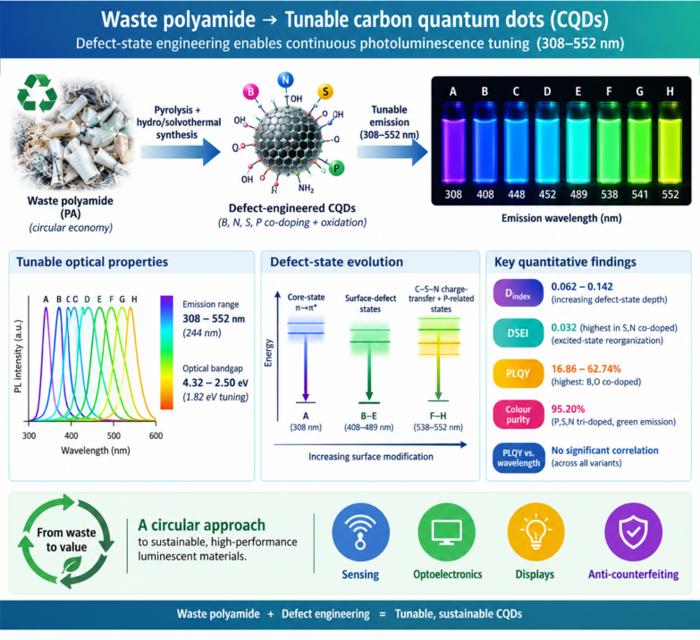
Waste polyamide-derived CQDs show continuous photoluminescence tuning from 308 to 552 nm through sequential defect-state engineering, with optical transition energies decreasing from 4.32 to 2.50 eV. @Christian Ebere Enyoh from Saitama University Carbon quantum dots (CQDs) are fluorescent carbon nanomaterials with potential applications in sensing, optoelectronics, displays, anti-counterfeiting, and environmental technologies. Their optical properties can be adjusted by modifying the carbon...
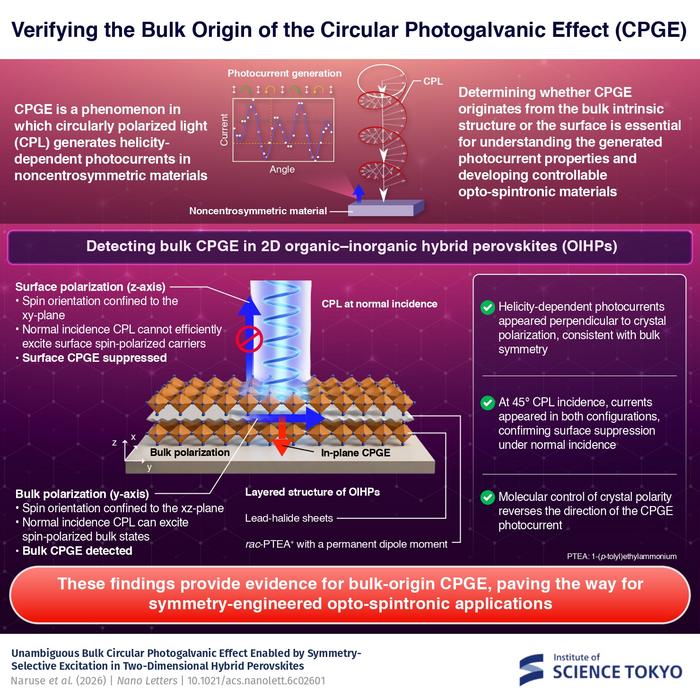
The researchers used circularly polarized light at normal incidence and found that helicity-dependent photocurrents appeared perpendicular to the crystal’s polarization but vanished when measured parallel to it, supporting a bulk origin of CPGE. @Institute of Science Tokyo The circular photogalvanic effect (CPGE), a phenomenon that generates helicity-dependent photocurrents in noncentrosymmetric materials, can originate purely from a crystal's internal structure without contribution from the...
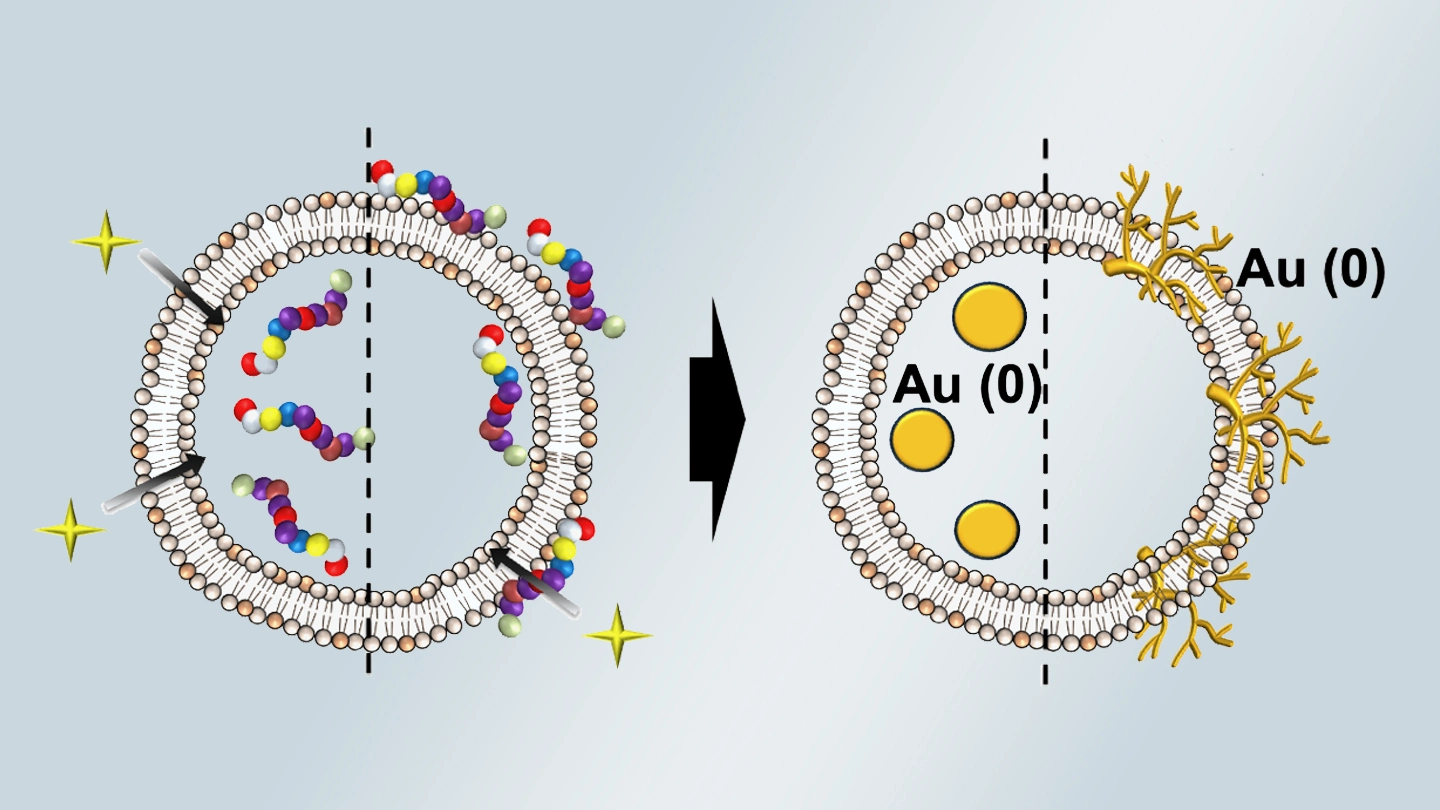
Summary of gold nanoparticle growth programming in liposome based on localization of biomineralization peptide The position of biomineralization peptides within liposomes can influence how gold nanoparticles grow, reports a research team from Institute of Science Tokyo. Peptides localized at the membrane interface promote branched structures, while those confined to the liposome interior favor spherical nanoparticles. The findings offer a new strategy for controlling nanoscale reaction...
