University of Wisconsin-Madison (UW-Madison)
When most people think of ceramics, they might envision their favorite mug or a flowerpot. But modern technology is full of advanced ceramics, from silicon solar panels to ceramic superconductors and biomedical implants.
Many of those advanced polycrystalline ceramics are combinations of crystalline grains which, at the microscopic level, resemble a stone fence held together with limestone mortar. Like that fence, the strength of the ceramic is determined by the strength of the mortar--which in ceramics is the grain boundary, or the areas where the different grains meet.
Previously, most researchers believed the chemistry of these grain boundaries in ceramics was very stable. But a new study by materials science engineers at the University of Wisconsin-Madison shows that's not the case. In fact, in the important ceramic material silicon carbide, carbon atoms collect at those grain boundaries when the material is exposed to radiation. The finding could help engineers better understand the properties of ceramics and could aid in fine-tuning a new generation of ceramic materials.
The details of the study appear today in the journal Nature Materials.
Since the 1970s, researchers have been aware of similar radiation-induced segregation in metal alloys. Because metal atoms share electrons freely, they are able to mix and unmix easily. When they are bombarded by ion radiation, some of the atoms in the metals will pop out of place and move toward the grain boundaries, and if different types of atoms move at different rates, the chemistry of the alloy can be altered.
Atoms in ceramics are very selective about which neighbors they bond with and the bonds are much stronger than in metals. That's why researchers believed these atoms weren't subject to the same type of segregation. But when Izabela Szlufarska, a professor of materials science and engineering at UW-Madison, began looking closely at the grain boundaries of silicon carbide, that's not what she found.
"In silicon carbide, the silicon and carbon really want to be paired together; they want to be 50 percent carbon and 50 percent silicon," she says.
However, when her team ran simulations and also imaged the grain boundaries, the carbon concentration was only 45 percent at the boundaries. "The chemistry was just really off," she says. "That was the first surprise, since this material really wants to have ordered atoms."
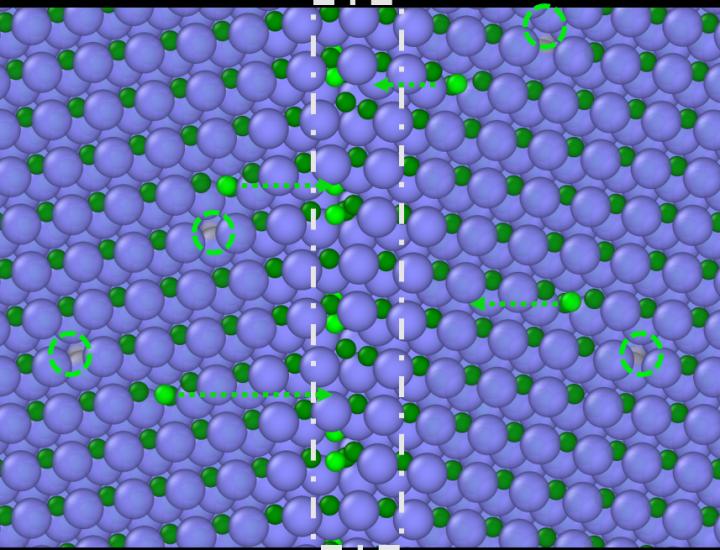
This suggested that silicon carbide might also be susceptible to radiation-induced segregation. So Szlufarska and her team bombarded the substance with ion radiation, finding that between 300 degrees Celsius and 600 degrees Celsius, the grain boundaries experienced carbon enrichment.
At those energy levels, the radiation causes some carbon atoms to pop out of place, creating a pair of defects in the silicon carbide including an empty spot called a vacancy and a loose carbon atom called an interstitial. Those unattached interstitial atoms migrate to the grain boundaries where they accumulate, affecting the material's chemistry.
Besides the fact that researchers simply didn't believe this type of segregation could take place in ceramics, Szlufarska says that, until recently, they also lacked the tools to even investigate the phenomenon. After painstaking fabrication and preparation of the silicon carbide bi-crystals, state-of-the-art scanning transmission electron microscopy conducted at UW-Madison and Oak Ridge National Laboratory allowed the team to resolve the chemical composition along the grain boundaries.
The team believes the phenomenon is likely to occur in other polycrystalline ceramics as well. The process is a double-edged sword: On the one hand, radiation-induced segregation means ceramics are subject to the same types of damage and deterioration at their grain boundaries as metal alloys, though at different temperatures. On the other hand, the segregation could be useful in materials engineering to produce specialized versions of ceramics like silicon carbide, which is used in nuclear energy, jet engines and other high-tech applications.
"Maybe the radiation can be used as a tool to fine tune grain boundary chemistry," says Xing Wang, study co-author and a professor at Pennsylvania State University who worked on the research while earning his doctorate at UW-Madison. "That could be useful to us in the future."
Radiation-induced segregation in a ceramic
Xing Wang, Hongliang Zhang, Tomonori Baba, Hao Jiang, Cheng Liu, Yingxin Guan, Omar Elleuch, Thomas Kuech, Dane Morgan, Juan-Carlos Idrobo, Paul M. Voyles & Izabela Szlufarska
Nature Materials (2020)
DOI: 10.1038/s41563-020-0683-y
Contact information:
Professor of materials science and engineering at UW–Madison
szlufarska@wisc.edu
Phone: (608) 265-5878
Computational Materials Group (CMG) @ UW-Madison
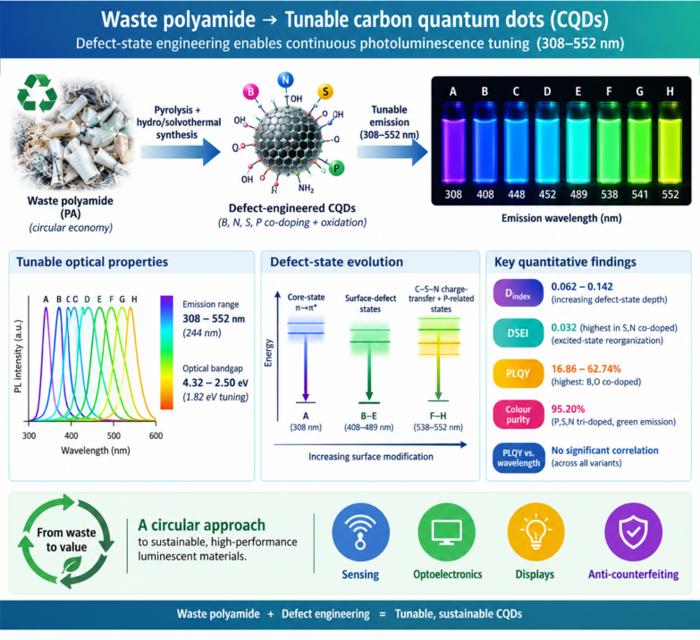
Waste polyamide-derived CQDs show continuous photoluminescence tuning from 308 to 552 nm through sequential defect-state engineering, with optical transition energies decreasing from 4.32 to 2.50 eV. @Christian Ebere Enyoh from Saitama University Carbon quantum dots (CQDs) are fluorescent carbon nanomaterials with potential applications in sensing, optoelectronics, displays, anti-counterfeiting, and environmental technologies. Their optical properties can be adjusted by modifying the carbon...
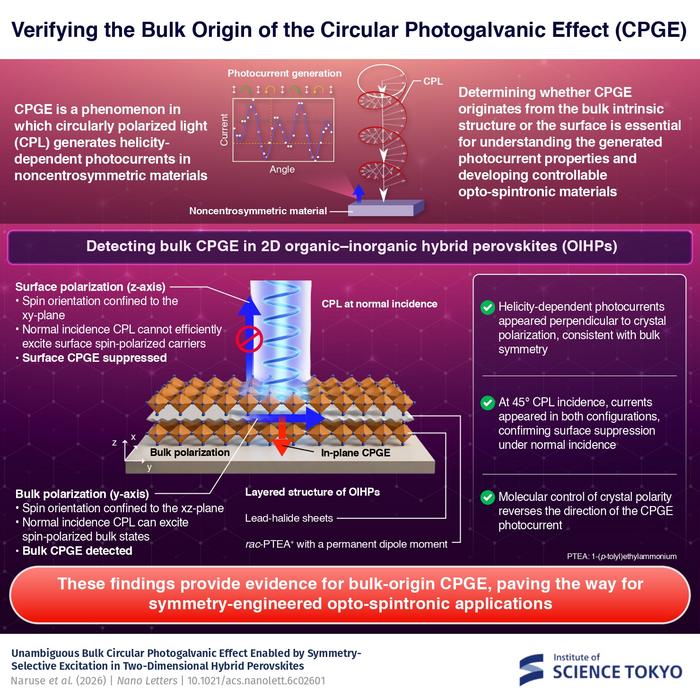
The researchers used circularly polarized light at normal incidence and found that helicity-dependent photocurrents appeared perpendicular to the crystal’s polarization but vanished when measured parallel to it, supporting a bulk origin of CPGE. @Institute of Science Tokyo The circular photogalvanic effect (CPGE), a phenomenon that generates helicity-dependent photocurrents in noncentrosymmetric materials, can originate purely from a crystal's internal structure without contribution from the...
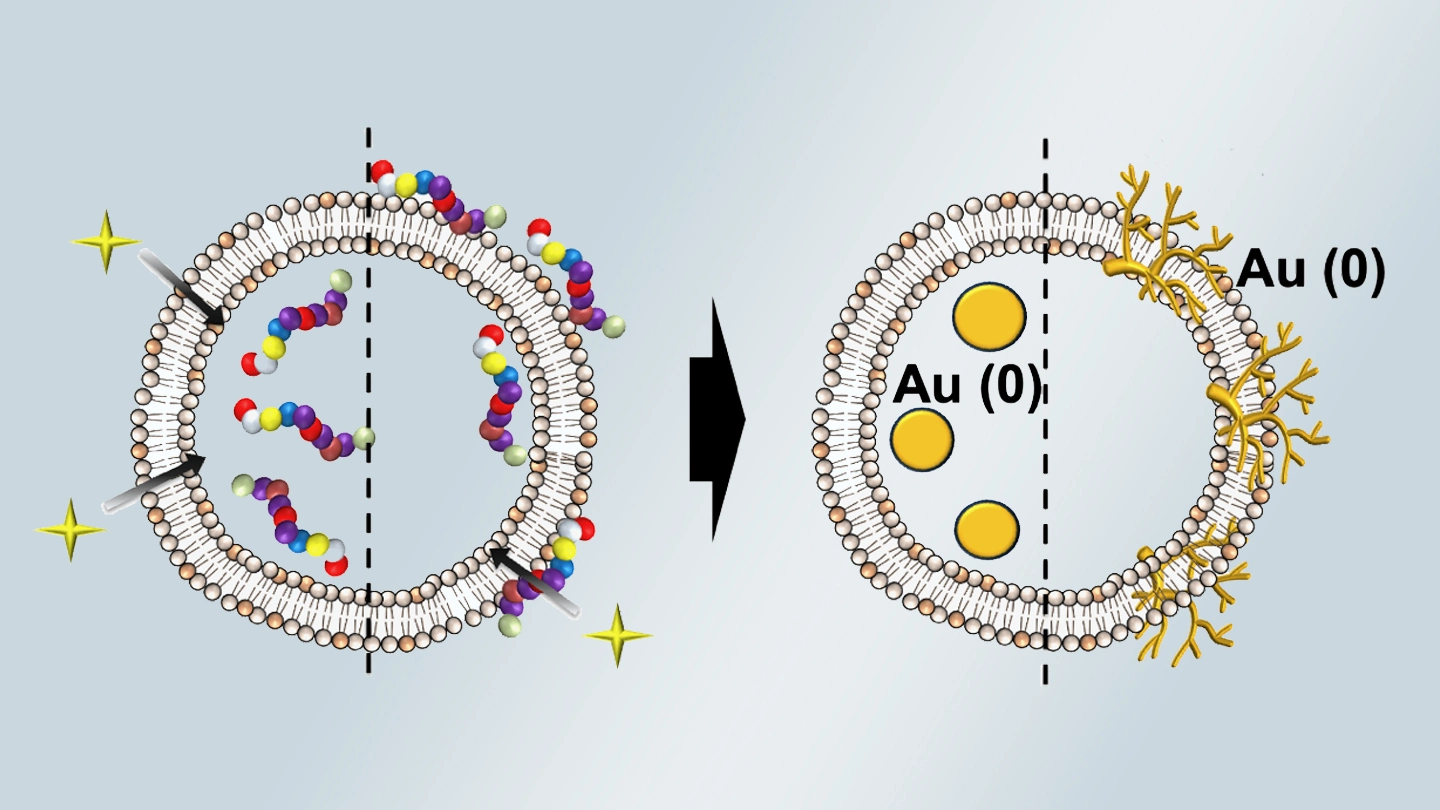
Summary of gold nanoparticle growth programming in liposome based on localization of biomineralization peptide The position of biomineralization peptides within liposomes can influence how gold nanoparticles grow, reports a research team from Institute of Science Tokyo. Peptides localized at the membrane interface promote branched structures, while those confined to the liposome interior favor spherical nanoparticles. The findings offer a new strategy for controlling nanoscale reaction...
