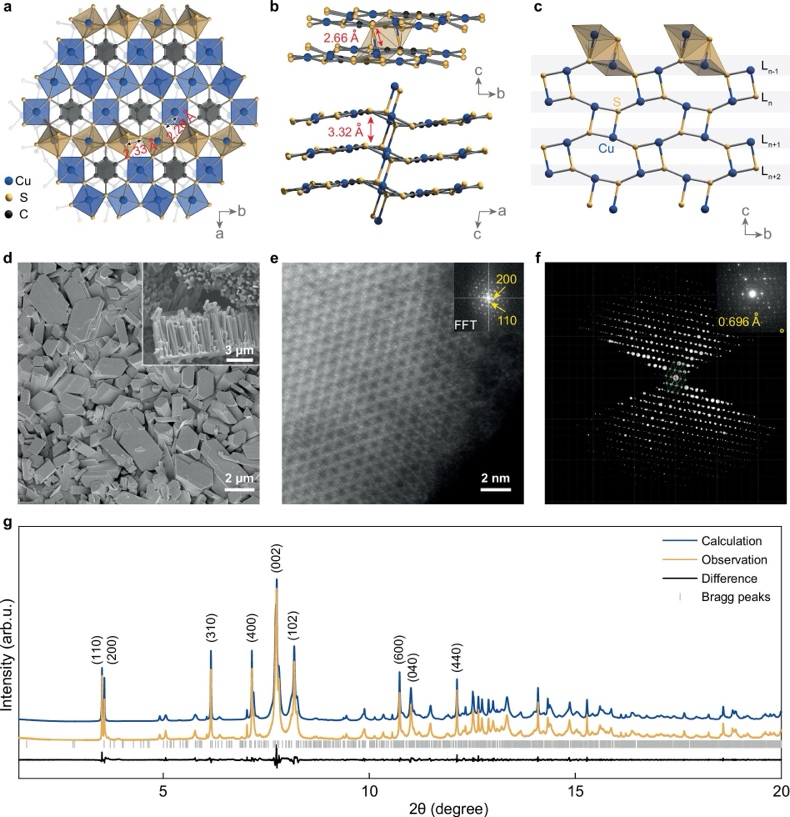
In a groundbreaking achievement, researchers from Peking University's School of Materials Science and Engineering, led by Professor Jin-Hu Dou, have synthesized a novel non-van-der-Waals two-dimensional (2D) coordination polymer with intrinsic superconducting properties. The findings, published in Nature Communications on October 29, 2024, introduce the first precise crystal structure of the Cu₃BHT coordination polymer, marking a significant leap in the development of advanced electronic materials and quantum state exploration.
Highlights of the Study
The study presents the synthesis of Cu₃BHT, a coordination polymer with a quasi-2D Kagome structure characterized by interlayer covalent Cu-S bonds. This discovery deviates significantly from the previously hypothesized graphite-like structure. Using high-quality single crystals, the team conducted atomic-level structural determinations, revealing a lattice that supports unique electronic properties, including superconductivity at 0.25 K.
Why It Matters
Two-dimensional coordination polymers (2D MOFs) have rapidly emerged as promising materials for electronic applications. Their modular lattice design, formed by metal centers and conjugated ligands, allows exceptional control over electronic states, enabling applications in quantum transport and superconductivity. This work challenges the traditional view of 2D MOFs as insulators, presenting them as tunable frameworks for next-generation superconducting materials.
Key Findings
Structural Breakthrough:
-High-quality single crystals of Cu₃BHT were synthesized, enabling atomic-level structural analysis.
-The study revealed a quasi-two-dimensional Kagome structure, contradicting the earlier assumption of a graphite-like layered structure.
Superconducting Properties:
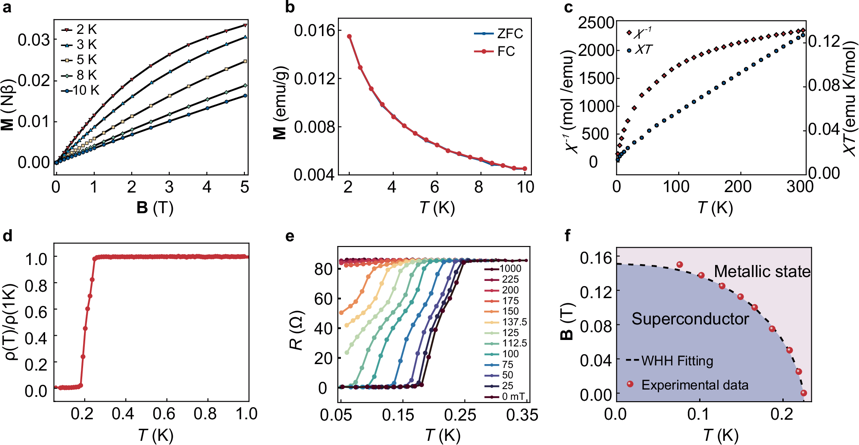
-Cu₃BHT exhibits metallic conductivity, reaching 10³ S/cm at room temperature and 10⁴ S/cm at 2 K.
-A superconducting transition occurs at 0.25 K, attributed to enhanced electron-phonon coupling and electron-electron interactions.
Novel Interactions:
-The study identifies interlayer covalent Cu-S bonds, a stark contrast to typical van der Waals interactions, which play a key role in the material's unique properties.
Reference
Synthesis and structure of a non-van-der-Waals two-dimensional coordination polymer with superconductivity
Zhichao Pan, Xing Huang, Yunlong Fan, Shaoze Wang, Yiyu Liu, Xuzhong Cong, Tingsong Zhang, Shichao Qi, Ying Xing, Yu-Qing Zheng, Jian Li, Xiaoming Zhang, Wei Xu, Lei Sun, Jian Wang & Jin-Hu Dou
https://www.nature.com/articles/s41467-024-53786-1
Peking University
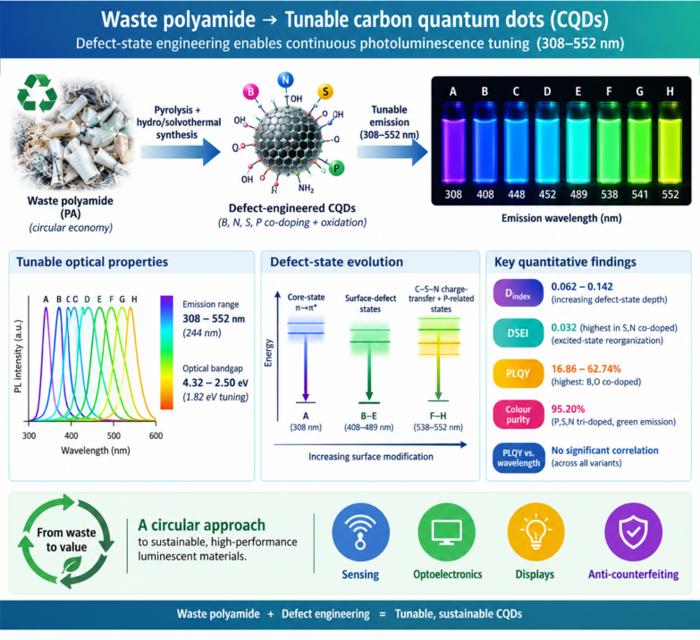
Waste polyamide-derived CQDs show continuous photoluminescence tuning from 308 to 552 nm through sequential defect-state engineering, with optical transition energies decreasing from 4.32 to 2.50 eV. @Christian Ebere Enyoh from Saitama University Carbon quantum dots (CQDs) are fluorescent carbon nanomaterials with potential applications in sensing, optoelectronics, displays, anti-counterfeiting, and environmental technologies. Their optical properties can be adjusted by modifying the carbon...
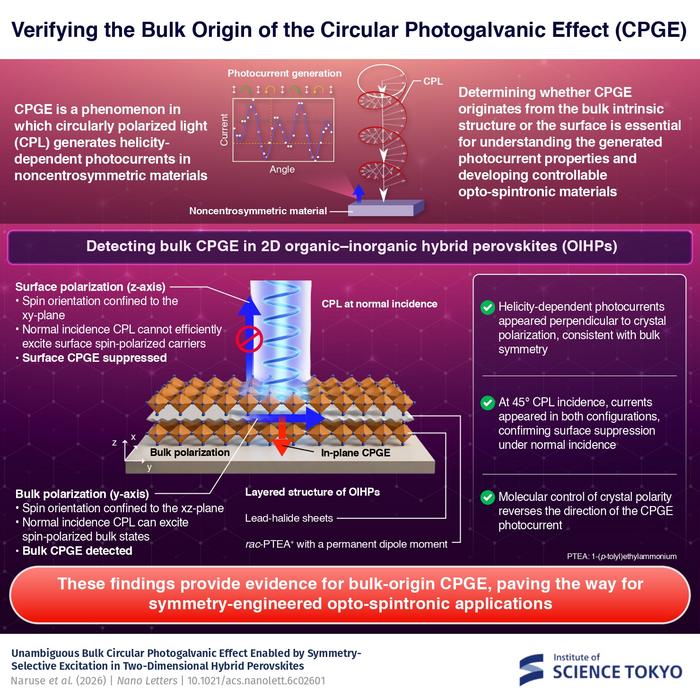
The researchers used circularly polarized light at normal incidence and found that helicity-dependent photocurrents appeared perpendicular to the crystal’s polarization but vanished when measured parallel to it, supporting a bulk origin of CPGE. @Institute of Science Tokyo The circular photogalvanic effect (CPGE), a phenomenon that generates helicity-dependent photocurrents in noncentrosymmetric materials, can originate purely from a crystal's internal structure without contribution from the...
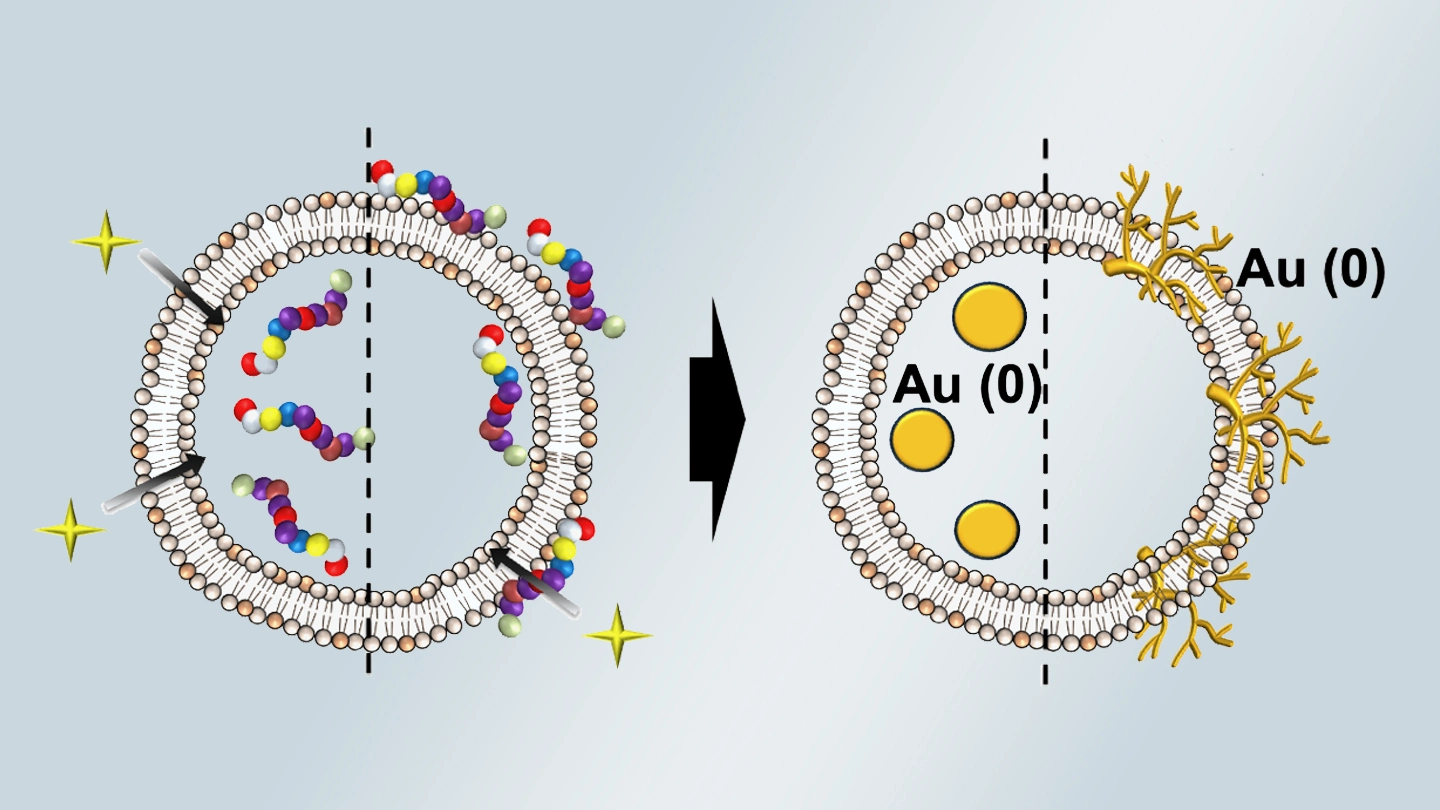
Summary of gold nanoparticle growth programming in liposome based on localization of biomineralization peptide The position of biomineralization peptides within liposomes can influence how gold nanoparticles grow, reports a research team from Institute of Science Tokyo. Peptides localized at the membrane interface promote branched structures, while those confined to the liposome interior favor spherical nanoparticles. The findings offer a new strategy for controlling nanoscale reaction...
