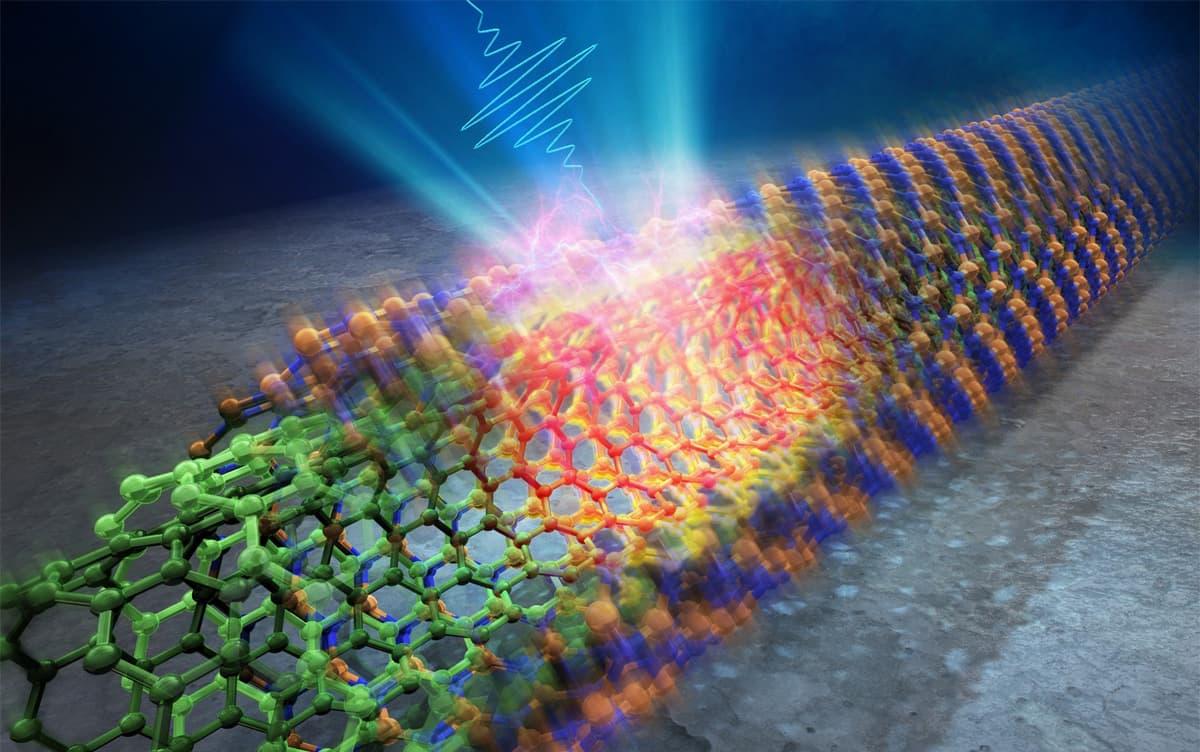
In a collaborative work in the Dynacom framework (French Japanese Laboratory), recent studies have highlighted that materials composed of layered tubes, which are atomically thick and classified as low-dimensional materials, exhibit new properties. Although the static properties of these structures, such as electrical conduction, are well documented, their dynamic properties, including electron transfer between layers and atomic motion triggered by light exposure, have received less attention.
In this study, researchers constructed nested cylindrical structures by wrapping carbon nanotubes (CNTs) in boron nitride nanotubes. They then examined the motion of electrons and atoms induced by ultrashort light pulses on a one-dimensional (1D) material. Electron motion was monitored using broadband ultrafast optical spectroscopy, which captures instantaneous changes in molecular and electronic structures due to light irradiation with a precision of ten trillionths of a second (10−13 s). Atomic motion was observed through ultrafast time-resolved electron diffraction, which similarly achieved monitoring of structural dynamics with ten-trillionth-of-a-second accuracy.
The study revealed that when different types of low-dimensional materials are layered, a pathway or channel forms, allowing electrons to escape from specific subparts of the material. Additionally, it was found that electrons excited in the CNTs by light exposure could transfer into the BNNTs via these electronic channels, where their energy is rapidly converted into thermal energy, facilitating extremely fast thermal conversion.
This research has uncovered a new physical phenomenon at the interface between two dissimilar materials, offering not only ultrafast thermal energy transport but also potential applications in the development of ultrafast optical devices and the rapid manipulation of electrons and holes generated by light.
Reference
Photoinduced dynamics during electronic transfer from narrow to wide bandgap layers in one-dimensional heterostructured materials
Yuri Saida, Thomas Gauthier, Hiroo Suzuki, Satoshi Ohmura, Ryo Shikata, Yui Iwasaki, Godai Noyama, Misaki Kishibuchi, Yuichiro Tanaka, Wataru Yajima, Nicolas Godin, Gaël Privault, Tomoharu Tokunaga, Shota Ono, Shin-ya Koshihara, Kenji Tsuruta, Yasuhiko Hayashi, Roman Bertoni & Masaki Hada
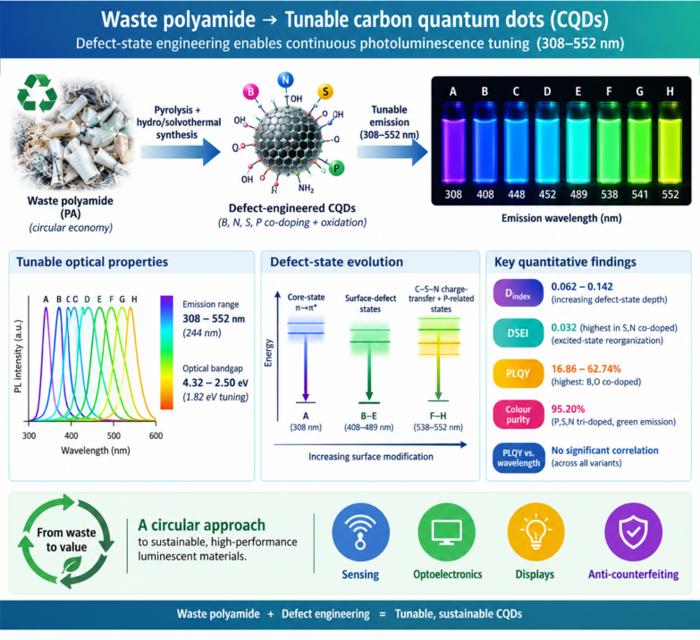
Waste polyamide-derived CQDs show continuous photoluminescence tuning from 308 to 552 nm through sequential defect-state engineering, with optical transition energies decreasing from 4.32 to 2.50 eV. @Christian Ebere Enyoh from Saitama University Carbon quantum dots (CQDs) are fluorescent carbon nanomaterials with potential applications in sensing, optoelectronics, displays, anti-counterfeiting, and environmental technologies. Their optical properties can be adjusted by modifying the carbon...
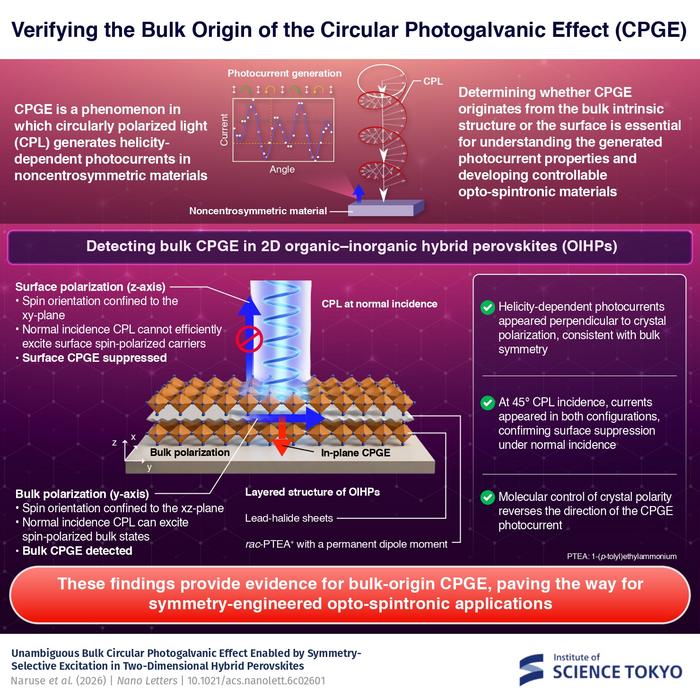
The researchers used circularly polarized light at normal incidence and found that helicity-dependent photocurrents appeared perpendicular to the crystal’s polarization but vanished when measured parallel to it, supporting a bulk origin of CPGE. @Institute of Science Tokyo The circular photogalvanic effect (CPGE), a phenomenon that generates helicity-dependent photocurrents in noncentrosymmetric materials, can originate purely from a crystal's internal structure without contribution from the...
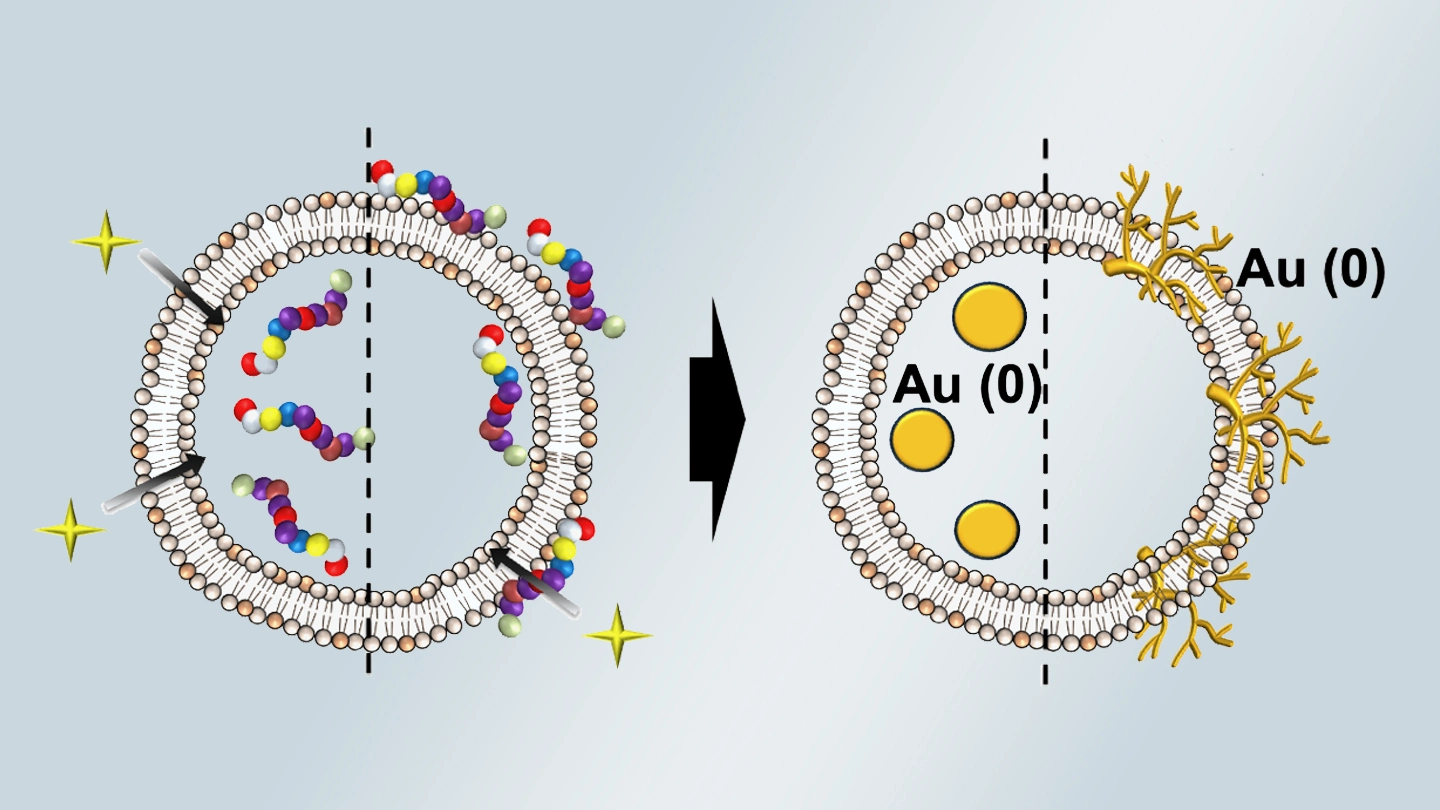
Summary of gold nanoparticle growth programming in liposome based on localization of biomineralization peptide The position of biomineralization peptides within liposomes can influence how gold nanoparticles grow, reports a research team from Institute of Science Tokyo. Peptides localized at the membrane interface promote branched structures, while those confined to the liposome interior favor spherical nanoparticles. The findings offer a new strategy for controlling nanoscale reaction...
