Indian Institute of Science (IISc)
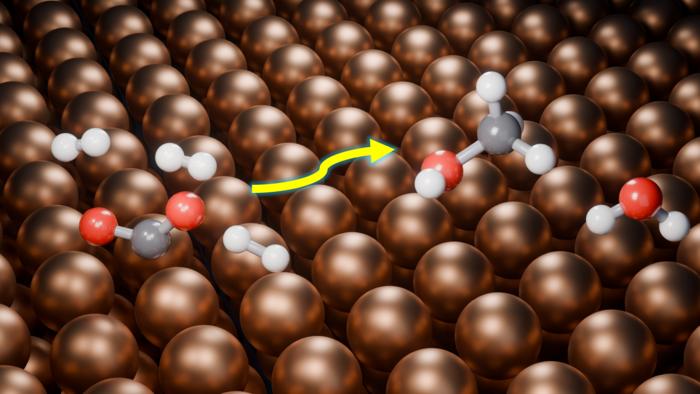
Scientists are increasingly exploring carbon dioxide (CO₂) hydrogenation – where CO₂ reacts with hydrogen over a catalyst to give rise to products like methanol – to convert CO₂ into useful chemicals and fuels. However, it involves thousands of tiny chemical steps happening on the catalyst surface. To model these steps computationally, researchers traditionally select a relatively small number of likely reactions, because modeling every possible reaction using quantum mechanics is prohibitively expensive. But this means that hundreds of important reactions may be missed.
Researchers at the Indian Institute of Science (IISc) have now developed a data-driven computational framework that maps nearly 10,000 chemical reactions involved in converting CO₂ into fuels and chemicals on a copper catalyst. The approach could help scientists better understand and eventually design effective catalysts for turning CO₂ into chemicals and fuels. The study was published in Nature Communications.
“We began with a worry familiar to anyone who does mechanistic modelling: How do you know that your reaction network has not omitted the one step that matters?” says first author Anand Mohan Verma, who worked on the study as a CV Raman Postdoctoral Fellow at IISc and is currently an Assistant Professor at the Motilal Nehru National Institute of Technology Allahabad (MNNIT Allahabad).
The researchers first generated a carefully curated, extensive database of 152 reactions using quantum-mechanical simulations. Then, they trained machine learning models to rapidly predict activation energy barriers for additional reactions. In addition, they used automated tools to predict all possible reactions involving 105 surface species, and which of these would occur as single-step reactions. This allowed the researchers to expand the original network to 9,389 elementary reactions.
“When we modelled the process using the 152 reactions considered initially, the network wrongly predicted formic acid, not methanol, as the major product, and underestimated how much CO₂ gets converted. Only when we expanded the network to include thousands of additional, previously overlooked reactions did the predictions fall in line with what we and others see experimentally,” explains corresponding author Ananth Govind Rajan, Associate Professor in the Department of Chemical Engineering, IISc.
When incorporated into a kinetic model, the expanded network predicted an approximately 40-fold increase in CO₂ conversion and correctly identified methanol and carbon monoxide as major products, consistent with experimental observations. Experimental validation of the model was performed by collaborators G Valavarasu and Santhosh Kotni at Hindustan Petroleum Corporation Limited’s Green Research and Development Centre, and Amol Amrute and colleagues at the Agency for Science, Technology, and Research in Singapore. The machine learning models involved inputs from Ambedkar Dukkipati, Professor in the Department of Computer Science and Automation, IISc.
The larger network also revealed that, in several key steps, hydrogen can be transferred to reaction intermediates directly as molecular H₂, rather than only through individual hydrogen atoms. Quantum-mechanical calculations confirmed that this pathway can be particularly favourable for hydrogen transfer to oxygen-containing intermediates.
“The idea that hydrogen can transfer as an intact molecule, without first splitting into atoms, runs against what most of us were taught,” says co-author Shivam Chaturvedi, PhD student in the Department of Chemical Engineering, IISc. “This surfaced only because the network was large enough to allow for it, and the observation held up when we went back and computed those steps explicitly. This also suggests that catalysts that interact more strongly with H₂ could potentially enhance pathways leading to methanol.”
The framework, which combines quantum-mechanical simulations, machine learning, automated reaction enumeration, and kinetic modelling, can also potentially be applied to other industrially important catalytic processes, including CO₂ reduction on other catalysts, nitrogen reduction, and water splitting, the researchers say
Reference
Data-driven massive reaction networks reveal mechanistic pathways underlying catalytic CO2 hydrogenation
Anand M. Verma, Shivam Chaturvedi, Swastik Paul, Srinibas Nandi, Rahul Sheshanarayana, Kotni Santhosh, G. Valavarasu, Ambedkar Dukkipati, Chuandayani Gunawan Gwie, Pei Ying Moo, Chun Qi Joy Ng, Amol Amrute, and Ananth Govind Rajan

Engineers at Washington University in St. Louis have shown that a single optical microresonator, combined with machine learning, can extract multiple measurements at once. Light trapped inside the device travels in many paths, and each optical mode responds differently to changes, producing barcode-like patterns that algorithms decode into distinct signals. In tests on a nine-zone keyboard platform, one sensor detected both touch location and applied pressure.
Cornell and Pacific Northwest National Laboratory researchers have developed a predictive model for how crystals such as calcite incorporate silica nanoparticles, revealing that the energy needed to cross water layers at the crystal surface strongly governs uptake, and that amines rather than carboxylic acids bind best.
Photon-based qubits could make quantum computers faster and more energy efficient, but scaling quantum photonic integrated circuits remains difficult. Engineers have now tackled several barriers at once: a silicon nitride platform that emits exactly one photon at room temperature, controllable placement of atomic defects, a switch that operates on single photons through an electron avalanche in silicon, and a machine learning framework that predicts decoherence and cuts spectral diffusion by up…
This week in nanotech
15 deals tracked
New products
 Nion-compatible In Situ STEM Holders for Electrical BiasingHummingbird Scientific Featured
 Orion Sputtering Deposition SystemsAJA International Featured
 Aether®Lam Research
Market insights
Last 30 days: Quantum Technologies drew the most money: $126.3M.
Money raised per month