Washington University in St. Louis
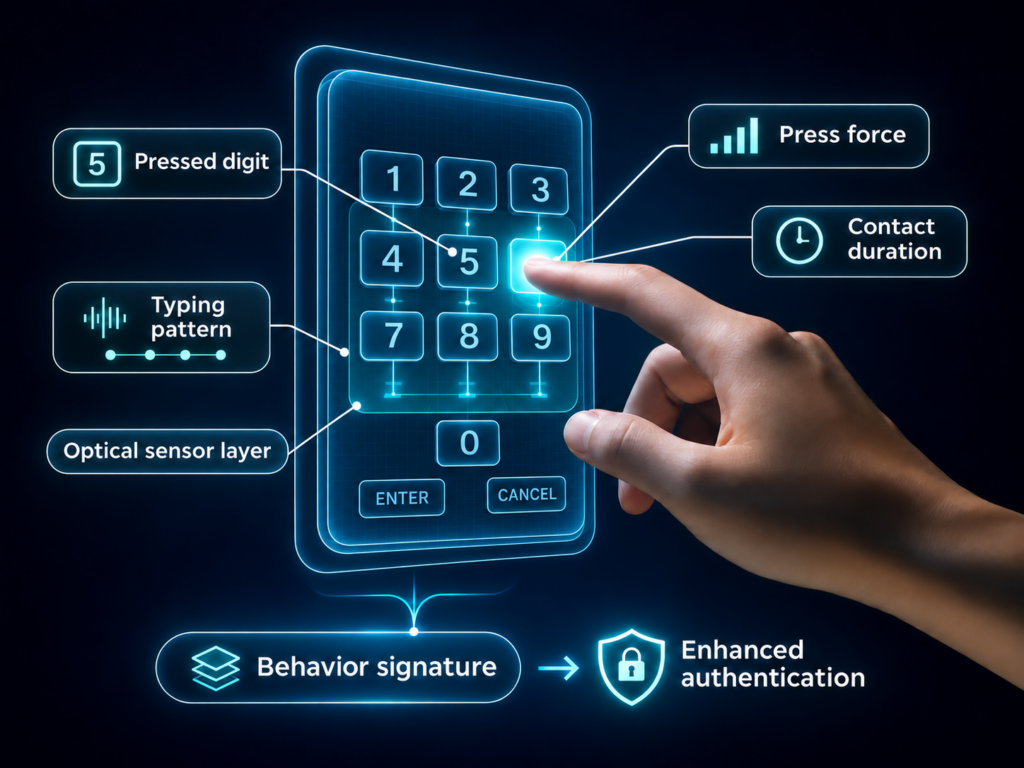
Picture a keyboard that knows not only which key you pressed, but also how hard you pressed it, using just one tiny sensor.
Research from Washington University in St. Louis is paving the way for smaller, smarter sensors that bring this idea closer to reality. The new work has potential applications for robotics, human health monitoring and cybersecurity.
By combining the physics of light with artificial intelligence (AI) tools, WashU engineers have figured out how to extract multiple pieces of information from a single optical sensor. The research, published in Laser & Photonics Reviews, was led by Lan Yang, the Edwin H. & Florence G. Skinner Professor of Electrical & Systems Engineering, in collaboration with the group of Chenyang Lu, the Fullgraf Professor of Computer Science & Engineering, both at the WashU McKelvey School of Engineering.
“What excites us most is that a single, tiny optical sensor can perform functions that typically require multiple sensors,” Yang said. “By using multiple sensing channels and analyzing how different optical modes respond to changes, we can extract much richer information from one device. This opens up new possibilities for developing smaller, smarter sensing technologies.”
“The sensor captures a wealth of information, but the challenge is making sense of it,” Lu said. “Machine learning helps us decode these complex light patterns and turn them into useful measurements, enabling a single sensor to detect and distinguish multiple physical changes.”
Beyond detecting touch, the underlying principle offers a new way to design sensors, Yang and Lu said. Instead of adding more physical sensing elements, researchers can use AI tools to extract more information from different optical modes within the same device.
Hidden in the light
Most of today’s conventional sensors are designed to measure one type of change. To measure several things at once, engineers must often combine multiple sensing elements. Although effective, this approach can make devices larger, more complicated and harder to calibrate.
The WashU team took a different approach. They built a tiny optical device that traps light inside, where it travels in many different paths. When something changes around the device, each light pattern responds in its own way. Taken together, these responses create unique optical “barcodes” that carry information about the changes. By analyzing how these barcodes change, researchers can learn several things at once, such as where the device was touched and how much pressure was applied.
AI can help fill in the final piece of the puzzle, the WashU researchers said. By learning from examples of known changes, machine-learning algorithms can recognize hidden relationships within these complex light patterns and translate them into useful measurements.
“The research points toward an exciting possibility,” Lu said. “A new generation of intelligent sensors can understand multiple elements of a changing world through the rich information carried by light.”
Many potential applications
To demonstrate their approach, the WashU engineers tested a miniature keyboard-like platform with nine touch locations.
Instead of using an array of nine sensors, the researchers used a single, tiny light-trapping device — called an optical microresonator — to determine both where the surface was pressed and how far it moved. Their tests also showed that this approach was effective when the optical measurements became noisier or contained fewer data points — important considerations for practical sensing systems.
“With further development, this strategy could support compact, intelligent devices for robotic touch, environmental monitoring and biomedical sensing,” said first author Jie Liao, a postdoctoral research associate in Yang’s group. “For example, future health-monitoring technologies could benefit from measuring several related physiological changes together and provide a more complete picture than any single measurement alone.”
Cybersecurity is another area where new kinds of photonic sensors could help, suggested co-author Hangyue Li, a doctoral student in Lu’s group. As an example, Li offered: What if your smartphone recognized not only the access code that you are entering, but also something unique about the way that you enter it?
“People are interested in adding another degree of authentication,” Li said. “The pattern you type in — including how much pressure you apply on different numbers — that could increase the safety.”
Reference
AI‐Empowered Hyper‐Information Barcodes for Multiparameter Sensing With a Single Multimode Microresonator
Liao, Jie, Hangyue Li, Chenyang Lu, and Lan Yang.
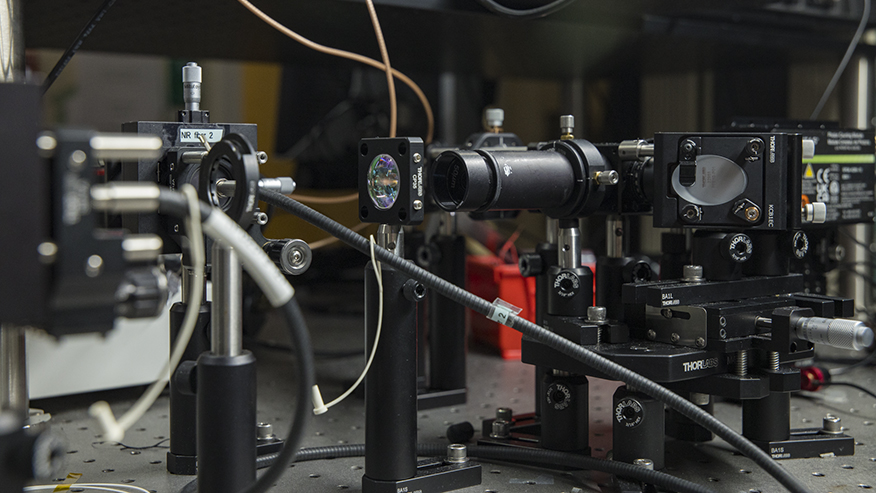
Photon-based qubits could make quantum computers faster and more energy efficient, but scaling quantum photonic integrated circuits remains difficult. Engineers have now tackled several barriers at once: a silicon nitride platform that emits exactly one photon at room temperature, controllable placement of atomic defects, a switch that operates on single photons through an electron avalanche in silicon, and a machine learning framework that predicts decoherence and cuts spectral diffusion by up…
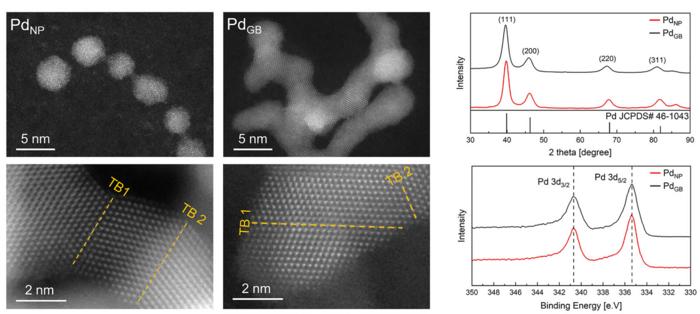
A palladium nanoparticle network with abundant grain boundaries enables catalytic hydrogen sensing in hot, humid air without an external heater, detecting concentrations as low as 100 parts per million at 80 degrees Celsius and 90 percent relative humidity. The boundaries promote palladium hydride formation and weaken water binding, keeping catalytic sites accessible, and the device meets ISO 26142 humidity requirements.
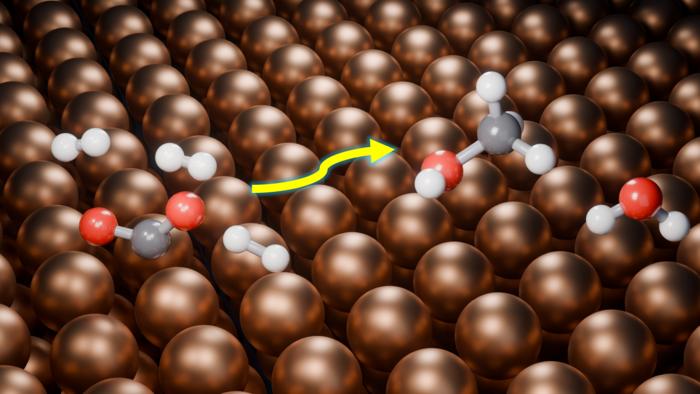
A data-driven framework from Indian Institute of Science researchers mapped nearly 10,000 elementary reactions in CO2 hydrogenation over copper, using quantum-mechanical simulations to train machine learning models that predict activation energy barriers and automated tools to enumerate reactions among 105 surface species.
This week in nanotech
$18.9M raised
4 funding rounds · 38 deals tracked
New products
 Ti-WCMBN Nanomaterialia Featured
 DLS-1 Mass Spectrometer for Fusion Gas AnalysisHiden Analytical Featured
 PKVH / PKVL ZAxis With an opening modelTHK PRECISION CO.,LTD.
Market insights
Last 30 days: Semiconductors & Electronics drew the most money: $547.7M.
Money raised per month