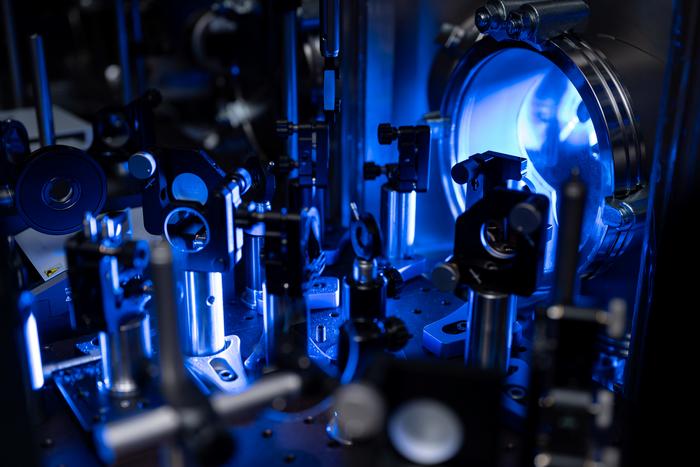
By superimposing two ultrashort laser pulses that converge from different directions, a team of physicists at the University of Oldenburg in Germany has succeeded in generating three-dimensional light fields. Using the same method, they were also able to excite electrons into quantum states that had been previously inaccessible in experiments. This approach opens up new experimental avenues for identifying chiral structures, controlling interactions between light and matter, and generating specific electronic quantum states, the researchers report in the science journal Physical Review Research. “With our method, we can generate electronic quantum states that have previously only been described theoretically and also make them spatially visible,” explains Prof. Dr Matthias Wollenhaupt, who leads the research team. “We have thus expanded the experimental optics toolkit to include a new class of three-dimensional light fields.”
To generate the 3D light fields, the team superimposed two specially shaped femtosecond laser pulses. The latter are extremely short bursts of light that last just a few millionths of a billionth of a second. The researchers combined two laser beams of different colours, making their beams intersect at a single point and thus creating three-dimensional light fields the shape of which they were able to control. “The fields oscillate in all three spatial directions, opening up new possibilities for investigating and controlling specific light-matter interactions,” explains Darius Köhnke, one of the two lead authors of the study and a PhD student in the Ultrafast Coherent Dynamics research group. The key advantage of this procedure is that researchers can use 3D light fields to generate quantum states of electrons that were previously inaccessible in experiments.
The team demonstrated this by using their 3D light field to selectively excite electrons in potassium atoms into higher-energy states – known as excited states – and then release them from the atom. The researchers were able to simultaneously observe the changes in the electron states at short intervals. Their method thus functioned like an ultra-high-speed camera for quantum processes: as with the stroboscopic flash lighting technique, they were able to capture the successive stages of the different electron states, forming a movie of their evolution.
The researchers explain that the new method is particularly promising for the investigation of chiral molecules, which play a key role in biology and medicine. Chiral molecules exist in two forms which are mirror images of each other but cannot be superimposed, much like a pair of human left and right hands. Many biomolecules, including amino acids, carbohydrates and active ingredients in medicinal products can be chiral. Their two forms frequently have different properties. For example, the active ingredient thalidomide in the medication Contergan has one form which causes birth defects during pregnancy and another which is harmless. However, it can be very difficult to separate or distinguish between the two different forms.
Three-dimensional light fields could lead to important advances in the field of chiral sensing: “Theoretical studies show that three-dimensional light fields can also possess chiral properties,” explains Wollenhaupt. The possibilities that three-dimensional light fields open up for the investigation and control of molecular chirality were recently highlighted by physicist Prof. Dr Olga Smirnova of the Max Born Institute for Nonlinear Optics in Berlin in an article published in the journal Science entitled “A New Age of Molecular Chirality”. The physicists write that the current study lays an important foundation for such applications.
Reference
Multiphoton ionization with three-dimensional light fields
D. Köhnke, H.-C. Ahlswede, T. Bayer, and M. Wollenhaupt
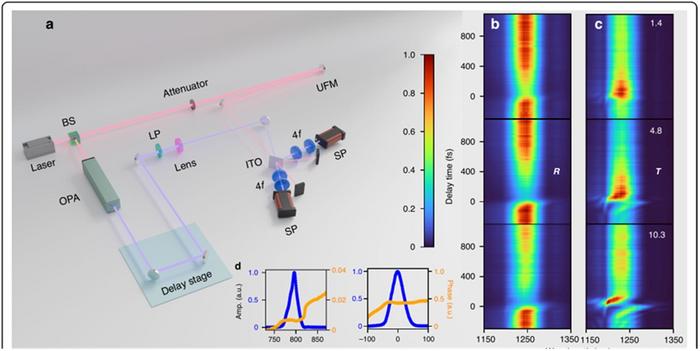
Researchers at Imperial College London and the University of Exeter tracked how a 310-nm indium tin oxide film switches its optical response under intense femtosecond pulses, near its epsilon-near-zero wavelength. Transmission rose by up to 280 percent while reflection fell by as much as 74 percent, then saturated as electrons below the Fermi level were depleted. A microscopic model fits the shift and predicts switching within a few femtoseconds.
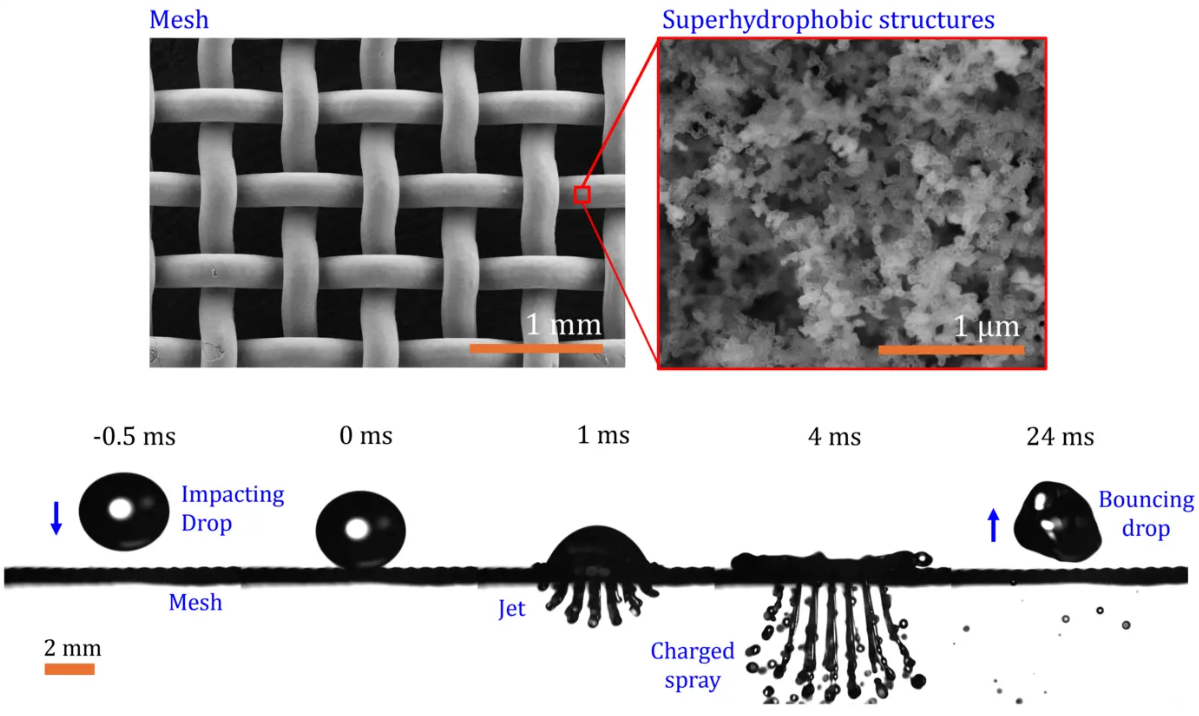
Water droplets shattering on superhydrophobic nets can generate usable electric charge, and a team from Tohoku University and the Max Planck Institute for Polymer Research has mapped how to maximise it. Combining charge measurements with high-speed imaging, the researchers tracked droplet breakup into fine secondary spray and showed that charge-to-mass ratios rise as mesh size and wire diameter shrink. The findings offer a design basis for sustainable rain-powered electricity generation.
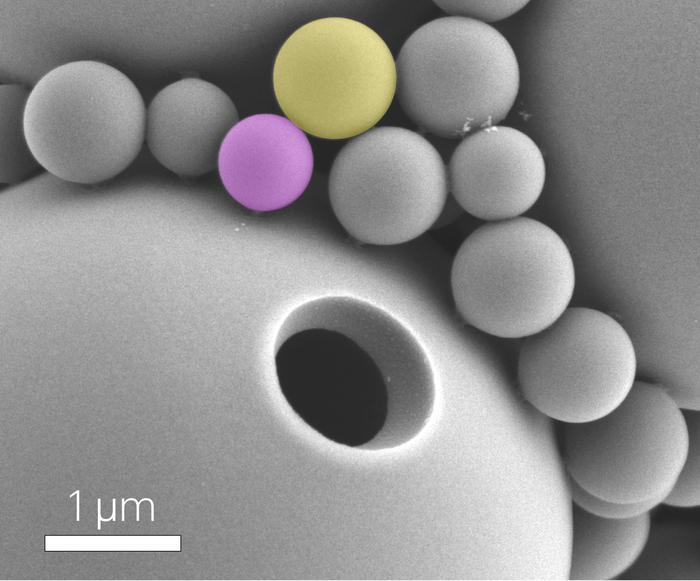
Researchers have fabricated hollow polymer capsules with single openings that use surrounding turbulence, not chemistry, to selectively take in or expel particles, an effect they call the PAC-MAN effect. The shell shields its interior to create a calm pocket, and only swirls smaller than the hole enter, so hole geometry decides which particles are captured or excluded.
This week in nanotech
15 deals tracked
New products
 Ti-WCMBN Nanomaterialia Featured
 Nion-compatible In Situ STEM Holders for Electrical BiasingHummingbird Scientific Featured
 GDN (Glyco-Diosgenin)Distolife Shanghai Co., Ltd
Market insights
Last 30 days: Quantum Technologies drew the most money: $126.3M.
Money raised per month
Behind the deal
Who led Eindhoven University of Technology’s $1.1M Grant?
See the investors with Insights Pro →