Max Planck Institute for Polymer Research
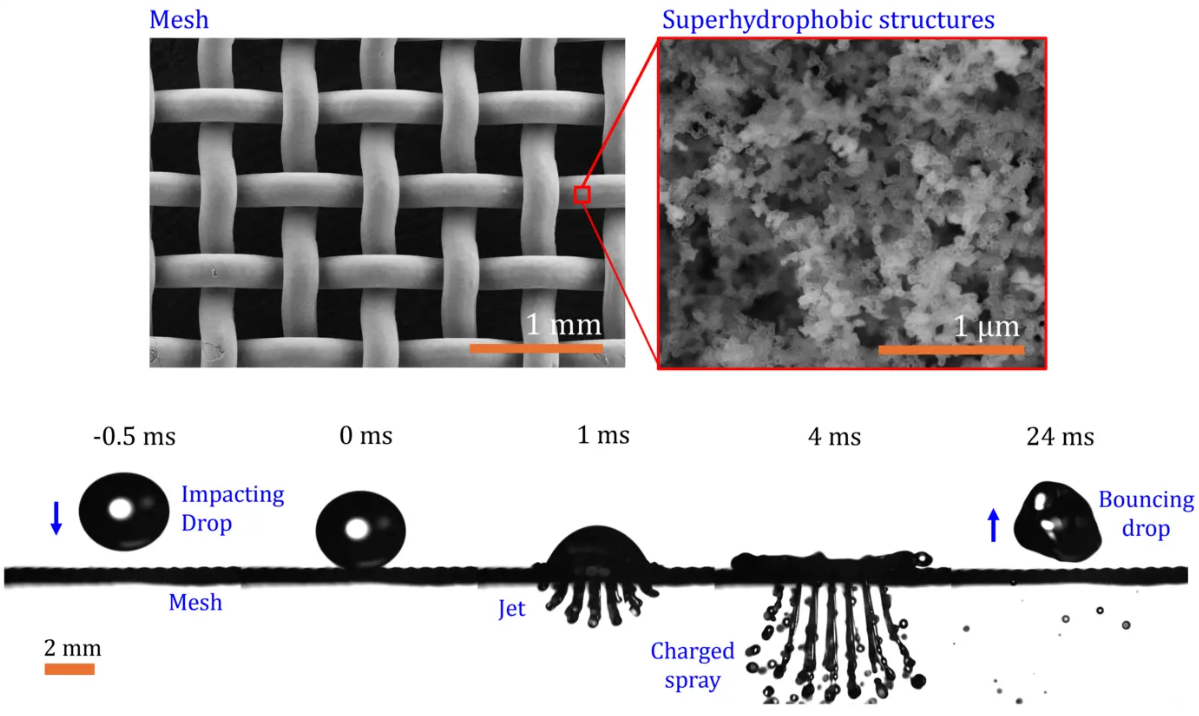
It has long been known that electrical charges are generated when water droplets burst. An international research team from Japan’s Tohoku University and the Max Planck Institute for Polymer Research has now identified a new mechanism that allows this phenomenon to be harnessed particularly efficiently. The focus is on the impact of water droplets on superhydrophobic nets. As a droplet passes through such a mesh, the original droplet is broken up into many small secondary droplets. The researchers were able to demonstrate which factors influence charge separation and how the ratio of electric charge to the mass of the resulting spray can be optimised. The findings provide an important basis for the development of sustainable technologies for generating electricity from rainwater.
Electrical energy can be generated when water droplets impact and shatter. This natural phenomenon is observed, for example, in waterfalls and water mist. An international research team has now investigated how the resulting electrical charges can be harvested in a targeted and highly efficient manner. In the process, the scientists identified a new mechanism of charge separation that utilizes the impact of water droplets on superhydrophobic nets.
The study involved researchers led by Prof. Masaya Toda of the Graduate School of Engineering at Tohoku University in Japan, as well as Prof. Hans-Jürgen Butt and Dr. Rutvik Lathia from the Max Planck Institute for Polymer Research.
The study focused on how water penetrates the pores of a superhydrophobic mesh upon impact and how the droplets dissolve and break up into smaller droplets in the process. To understand the underlying processes, the researchers combined electrical charge measurements with high-speed imaging. This allowed them to track how charge separation changes as a function of the so-called Weber number and the specific conditions under which the spray mist forms.
The results also show that the geometric properties of the net play a decisive role. Comparative experiments with nets of different mesh sizes and wire diameters demonstrated that the ratio of electrical charge to the mass of the resulting spray increases as both the mesh size and the wire diameter decrease.
The research results have now been published in the scientific journal Physics of Fluids.
Reference
Drop spray electrification
Riko Kazama, Masaya Toda, Hans-Jürgen Butt, Rutvik Lathia
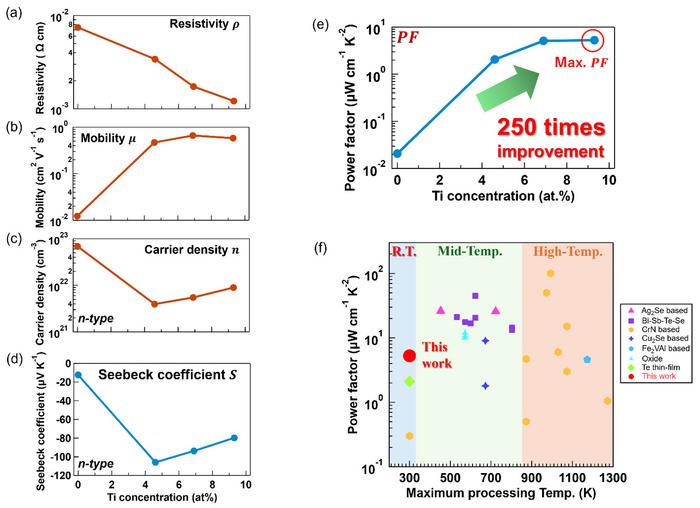
Researchers at Tohoku University have raised the power factor of chromium nitride thin films 250-fold by doping them with small amounts of titanium, reaching 5.26 µW cm⁻¹ K⁻². Titanium's stronger affinity for nitrogen suppresses nitrogen vacancies, cutting carrier concentration while boosting electron mobility by roughly two orders of magnitude.
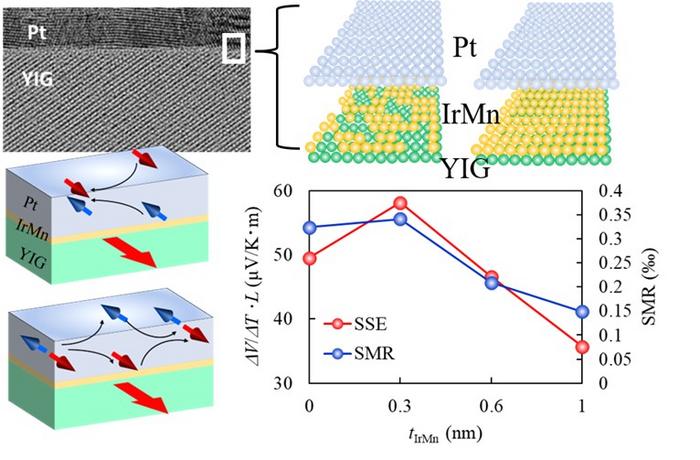
An ultrathin iridium manganese layer between yttrium iron garnet and platinum strengthens two spin-related signals, the spin Seebeck effect and spin Hall magnetoresistance, according to researchers at Kyushu University. A 0.3 nm layer produced the strongest responses, with spin mixing conductance values derived from both effects agreeing closely.
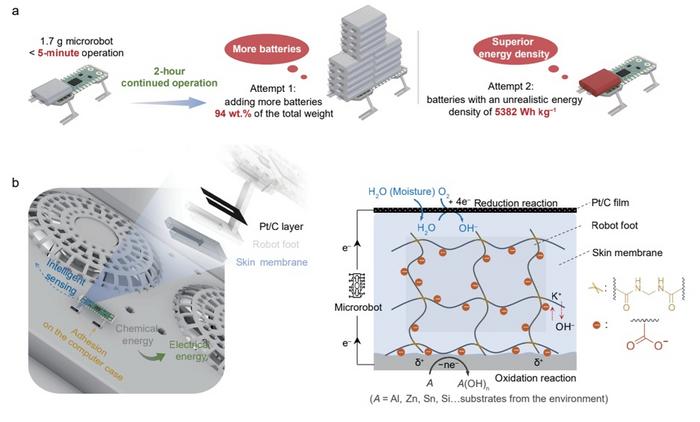
A Fudan University team has built a microrobot skin that generates electricity from the surface it walks on, eliminating onboard batteries. The crosslinked potassium polyacrylate membrane, as thin as 135 micrometres, reacts with aluminum, zinc and other active substrates plus atmospheric moisture and oxygen, reaching 133 mW cm−2 on zinc, roughly ten times typical microbatteries.
This week in nanotech
$18.9M raised
4 funding rounds · 38 deals tracked
New products
 Orion Sputtering Deposition SystemsAJA International Featured
 DLS-1 Mass Spectrometer for Fusion Gas AnalysisHiden Analytical Featured
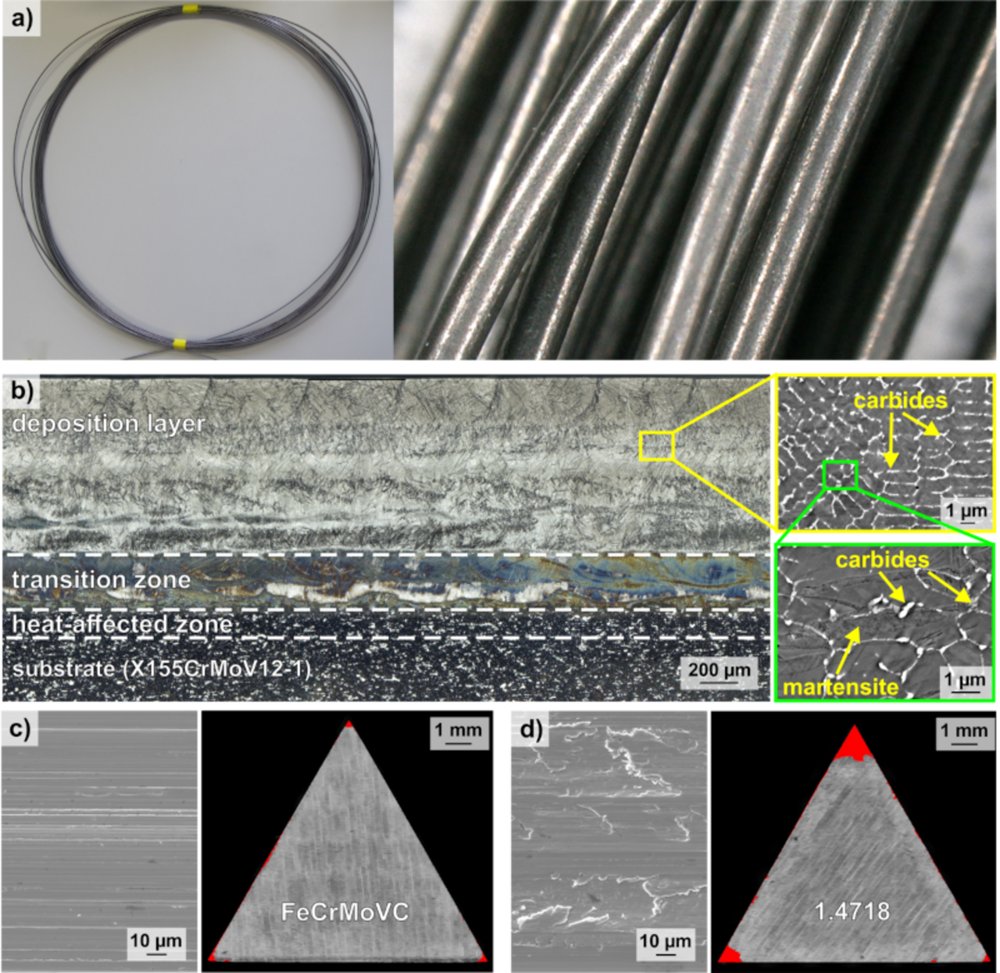 Fe85Cr4Mo8V2C1 wire filler materialLeibniz Institute for Solid State and Materials Research Dresden - IFW Dresden
Market insights
Last 30 days: Semiconductors & Electronics drew the most money: $547.7M.
Money raised per month