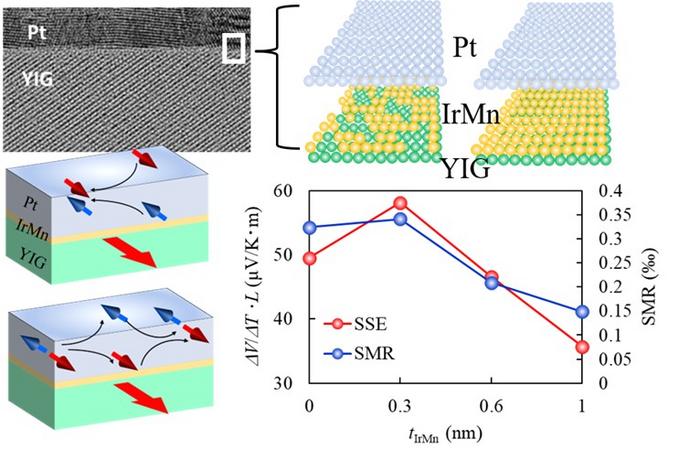
Fukuoka, Japan—Researchers at Kyushu University have found that an ultrathin layer of iridium manganese (IrMn) can improve two spin-related signals in a structure made of a magnetic insulator and a platinum film. By examining how spin currents are generated and absorbed, the team gained key insights into how the intermediate layer improves spin transfer. The findings could inform the development of ultra-low-power devices for computing and energy harvesting.
Spintronics is a more complex approach to conventional electronics that uses electron spin, in addition to electrical charge, to process and transmit information. For decades, researchers have been investigating various ways to use spin-related phenomena in computing, data storage, and energy harvesting.
One such phenomenon is the spin Seebeck effect (SSE), in which a temperature difference across a magnetic material generates a spin current that can be converted into electricity. Another one is spin Hall magnetoresistance (SMR), where a metal’s electrical resistance changes depending on the relative orientation of the electrical current and the magnetization of a neighboring magnetic layer. If harnessed effectively, the SSE could provide a way to recover energy from heat that would otherwise go unused, and SMR could prove useful for data storage and computing.
However, spin currents tend to weaken as they travel through materials, which limits the potential of both effects. The two depend on what’s called spin mixing conductance, which describes how efficiently spin passes across the boundary between a magnetic and a non-magnetic material. Previous studies demonstrated that inserting ultrathin layers at this boundary can improve spin-related signals associated with spin mixing conductance, but the precise underlying mechanisms remained unclear.
To address this, a research team led by Professor Hiromi Yuasa from the Faculty of Information Science and Electrical Engineering at Kyushu University, examined how an IrMn layer influences both SSE and SMR. Their findings were published in the journal Materials Today Physics on September 30, 2026.
The researchers fabricated structures made of yttrium iron garnet (YIG), IrMn, and platinum (Pt), varying the thickness of the intermediate IrMn layer between 0 and 1 nm. In this design, YIG served as the magnetic insulator, while Pt converted spin currents into electrical signals. Measuring both SSE and SMR allowed the team to compare spin pumping, which transfers spin angular momentum from the magnetic YIG layer, and spin absorption, where spin current is absorbed at an interface.
The results showed that the 0.3 nm-thick IrMn layer produced the strongest responses in both the SSE voltage and SMR. The spin mixing conductance calculated from the two effects also agreed well, supporting the conclusion that IrMn enhances spin pumping and spin absorption through related interfacial mechanisms. At this thickness, IrMn is expected to form island-like structures rather than a continuous film. This morphology may influence spin transfer at the interfaces, although further research is needed to determine the contributions of the individual interfaces.
Overall, these findings provide a way to improve spin transfer by controlling the thickness and structure of an intermediate layer. This could help researchers develop spin-based technology to convert heat into electricity. “A potential application of this work is battery-free information devices, which pose no risk of battery explosions. By harnessing spin Seebeck power generation, these ultra-low-power devices could operate without an external power supply or energy storage,” says Yuasa.
In the future, spintronics could pave the way for widespread energy-efficient communications, as Yuasa concludes, “Our research could contribute to sustainable computing technologies based on novel principles, supporting the development of an unprecedentedly advanced information society.”
Reference
Role of ultrathin IrMn layer between Y3Fe5O12 and Pt in enhancement of spin Seebeck effect and spin Hall magnetoresistance
Amirah Zahrin, Shuto Sahara, Yuichiro Kurokawa, Hiroki Hanamoto, Hiromi Yuasa
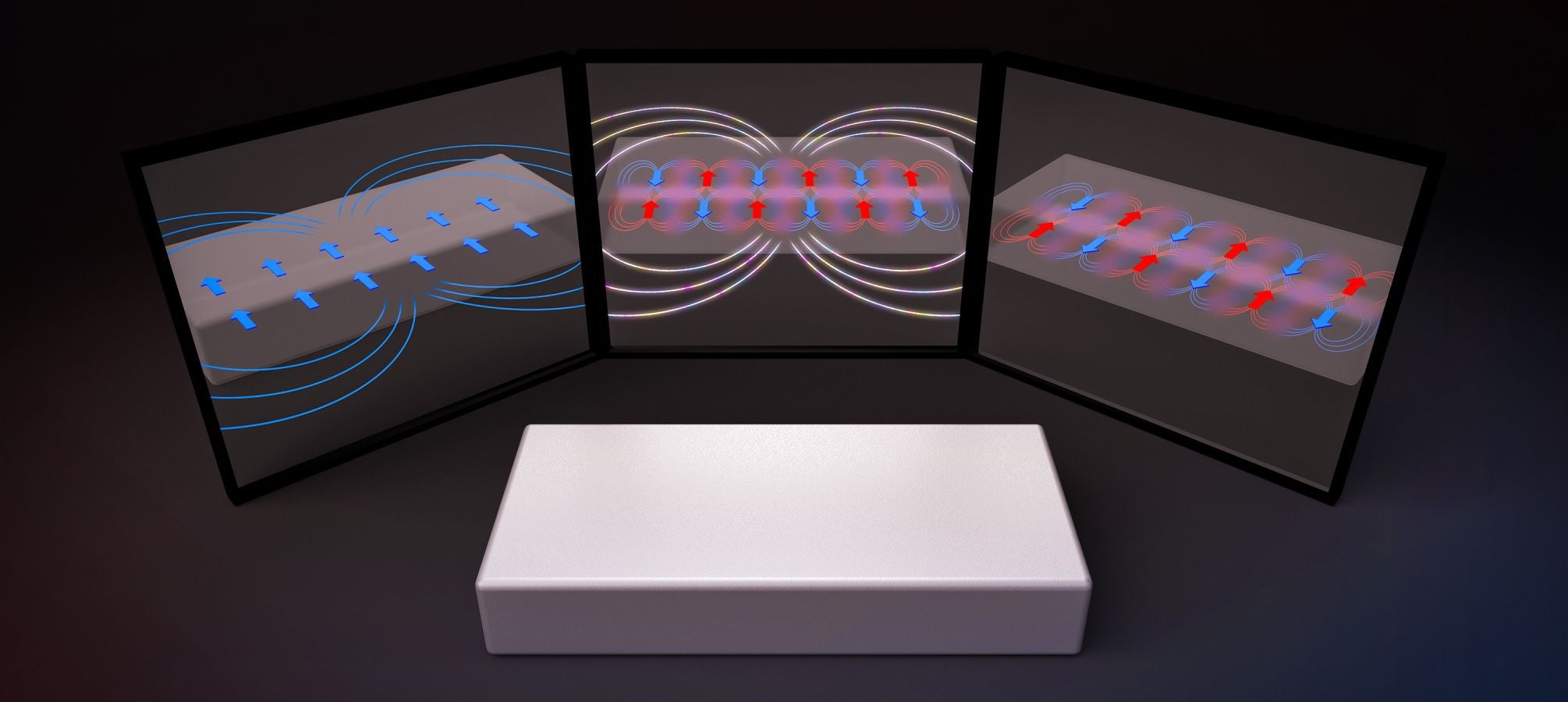
Physicists had long recognized only ferromagnetism and antiferromagnetism, but a SLAC-led team has now delivered conclusive experimental proof of a third phase: altermagnetism. Using circularly polarized X-rays at the European Synchrotron Radiation Facility, the researchers detected chirality in manganese telluride, a signature that conventional antiferromagnets cannot produce.
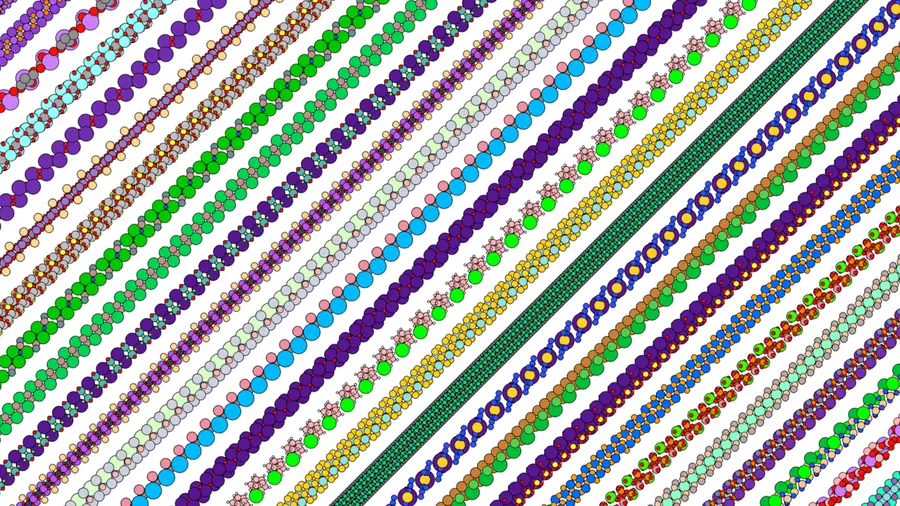
A computational method developed at TU Dresden and HZDR predicts separable atomic layers in any crystal, not just classic van der Waals stacks. Screening more than 24,000 structures, the team flagged 2,531 promising candidates for 2D materials, many with low exfoliation energies and favourable stability.
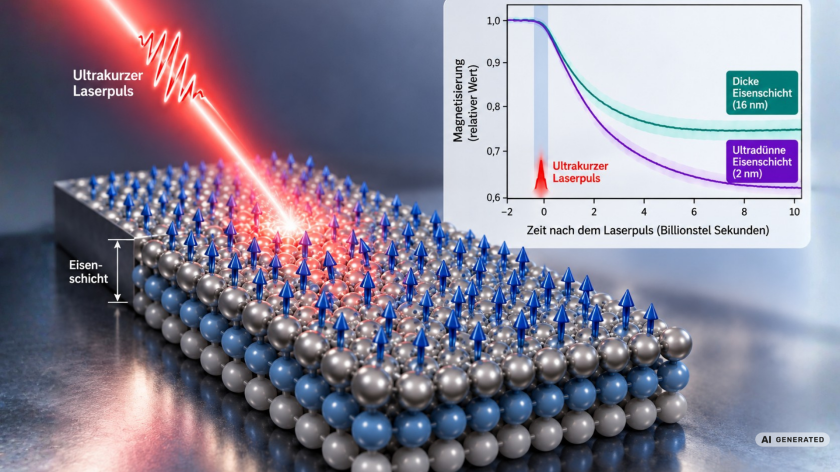
Researchers have found that thinner iron films demagnetise far more readily under laser pulses: a two nanometre layer lost about 75 per cent more magnetic order than a 16 nanometre one at equal excitation. The effect traces to magnetic order at the material interfaces, observed with ultrashort X-ray pulses at the BESSY II source. The work points toward faster magnetic data storage written by laser.
This week in nanotech
$751.8M raised
6 funding rounds · 37 deals tracked
New products
 Nion-compatible In Situ STEM Holders for Electrical BiasingHummingbird Scientific Featured
 DLS-1 Mass Spectrometer for Fusion Gas AnalysisHiden Analytical Featured
 Discover Mapping SuiteOnto Innovation
Market insights
Last 30 days: Quantum Technologies drew the most money: $3.18B.
Money raised per month
Behind the deal
Who invested in Vertical Semiconductor’s $73M Grant?
See the investors with Insights Pro →