They say you are what you wear. New biosensor technology created at the University of Utah’s College of Engineering makes that even more true.
Chemical engineering assistant professor Huanan Zhang has developed a process that turns clothing fabric into biosensors that measure a muscle’s electrical activity as it is worn.
His new technology was recently detailed in a paper published in the science journal, APL Materials. The paper, “Gold and silver nanocomposite-based biostable and biocompatible electronic textile for wearable electromyographic biosensors,” was co-authored by University of Utah chemical engineering graduate student Taehwan Lim and Sohee Lee from the Department of Clothing and Textiles at Gyeongsang National University in South Korea. You can read the paper here.
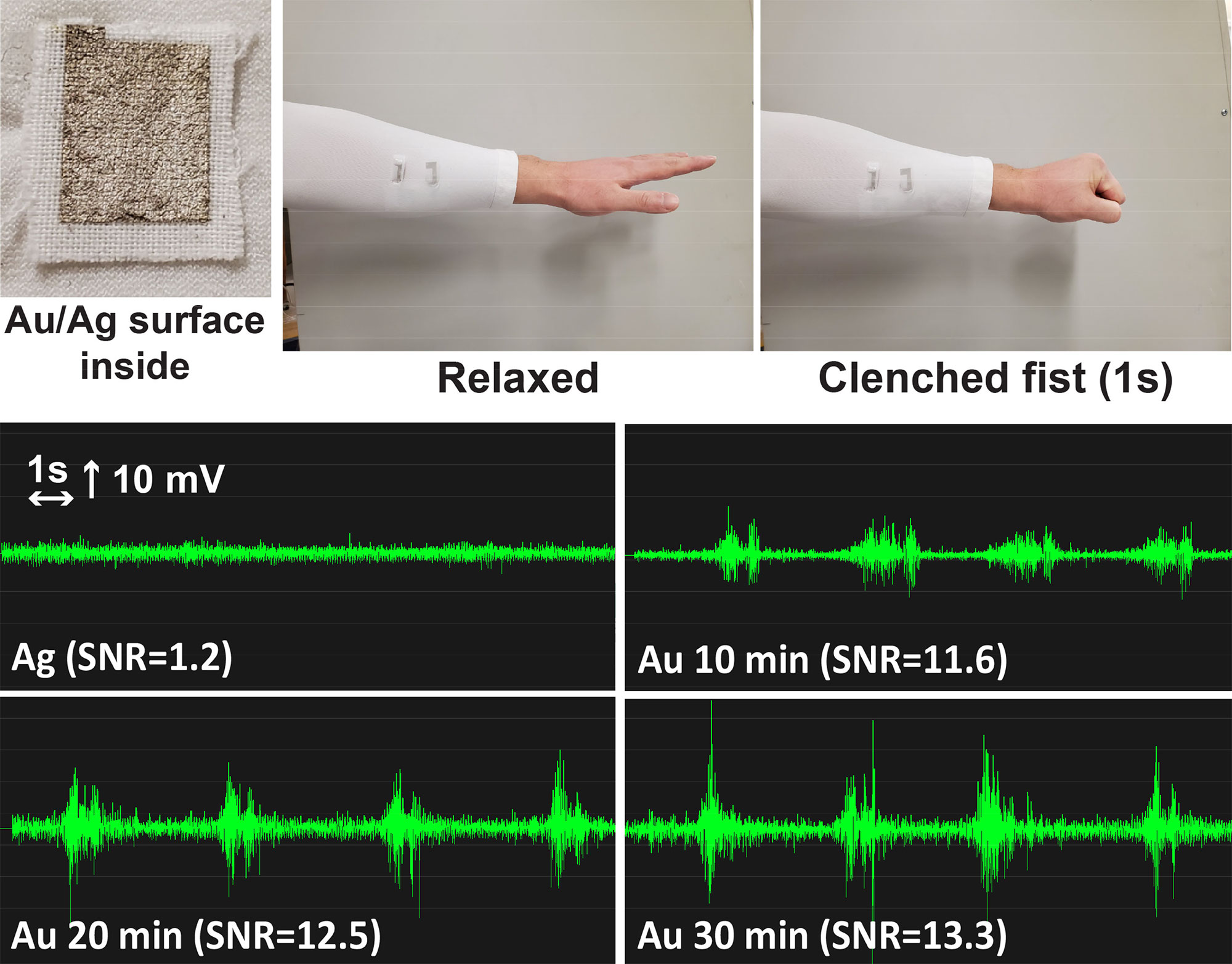
Zhang and his team have devised a method of taking ordinary textile made of a cotton/polyester blend and turning the fabric into sensors that measure electrical impulses generated from muscle movement. This could become a much better solution in measuring muscle activity for physical rehabilitation or for other medical applications. Ordinarily, current bioelectrical sensor technology in which they tape sensors with wires to the skin can sometimes be ineffective, uncomfortable, expensive and costly to manufacture.
“This new method can enable clinicians to collect a muscle’s long-term electrical signals with more precision,” says Zhang. “And we can get a better understanding of a patient’s progress and therefore their therapeutic outcomes over time.”
When human muscle contracts, it emits electrical signals in the form of ions (as opposed to electrons from an electrically powered device). Zhang’s process involves depositing a microscopic layer of silver over a piece of fabric to make the material conductive and therefore receive the electrical signal from the muscle.
But having just a layer of silver is a problem since the metal can be somewhat toxic when in prolonged contact with the skin. So the researchers also deposit a second microscopic layer of gold, which is non-toxic to the touch. The gold not only protects the skin from the silver, but it also enhances the electrical signal, Zhang says.
“The silver layer provides a baseline conductivity, but the gold on top improves the signal and the biocompatibility, and it helps reduce the cost of manufacturing pure gold devices,” he says.
The silver layer is applied to the fabric in a process similar to screen printing a graphic onto a T-shirt, and it’s applied to just the areas of the clothing that touch the muscle being measured. Then the gold layer is deposited by an electrochemical method. The patches of sensors are then attached to wires and a portable electromyography (EMG) device that measures muscle contractions.
Just as important, the process is also resistant to repeated cycles in a washing machine, Zhang says. His team ran a piece of clothing treated with the process through 15 washes, and they didn’t affect the sensors’ efficacy.
Currently, Zhang and his team have tested the method on a compression sleeve for the forearm. While this technology would mostly be used on compression sleeves or socks since it requires the clothing to constantly touch the skin, Zhang imagines it could also be used for other skin-tight clothing such as bicycle pants or athletic tights.
This sensor-equipped clothing is yet another example of the popular trend of wearable technologies that constantly monitor your health throughout the day, such as the Apple Watch. And Zhang even envisions a day when his clothing could interface with a digital watch to provide real-time readings provided EGM monitors become small enough.
Reference
Gold and silver nanocomposite-based biostable and biocompatible electronic textile for wearable electromyographic biosensors featured
Taehwan Lim, Huanan Zhang, and Sohee Lee
