University of California, Berkeley

Just a few years ago, researchers discovered that changing the angle between two layers of graphene, an atom-thick sheet of carbon, also changed the material’s electronic and optical properties. They then learned that a “twist” of 1.1 degrees — dubbed the “magic” angle — could transform this metallic material into an insulator or a superconductor, a finding that ignited excitement about a possible pathway to new quantum technologies.
To study the physics underlying this phenomenon, “twistronics” researchers had to produce tens to hundreds of different configurations of the twisted graphene structures — a costly and labor-intensive process. But a team of researchers led by Yuan Cao, the leading discoverer of the magic angle in 2018 and now an assistant professor of electrical engineering and computer sciences at UC Berkeley, has created a device that can twist a single structure in countless ways.
In a study published in Nature, the researchers demonstrated the world’s first micromachine that can twist 2D materials at will. The fingernail-sized, on-chip platform, called MEGA2D, uses microelectromechanical systems (MEMS) to conduct voltage-controlled manipulation of 2D materials — which are only nanometers thick — with unprecedented flexibility and precision.
“Our work extends the capabilities of existing technologies in manipulating low-dimensional quantum materials,” said Cao. “It also paves the way for novel hybrid 2D and 3D structures, with promising implications in condensed-matter physics, quantum optics and related fields.”
A single structure, numerous configurations
Using the ultra-tunable MEGA2D technology, Cao and his team demonstrated multiple, exotic properties in a single structure made of two pieces of hexagonal boron nitride (a close relative of graphene). Moreover, they required only a handful of samples to study the structure’s nonlinear optical properties and measure the Van der Waals force.
One finding, however, surprised the researchers. They noticed “swirls” in the nonlinear optical properties of hexagonal boron nitride when twisted by MEGA2D.
“The swirls resemble ‘half-skyrmions’ — a type of topological quasiparticle found in some magnetic materials but was never thought of in nonlinear optical systems,” said Haoning Tang, lead author of the paper and a postdoc at Harvard University. “These nonlinear optical properties were not discussed before and would not have been found without the active tuning platform MEGA2D.”
Twisting and tuning
According to the researchers, the MEGA2D platform has several potential applications beyond twistronics, including use as a tunable light source for classic, or standard, light bulbs as well as for quantum versions. The latter are special light sources that use nonlinear optics to convert blue light to red light and are useful for quantum computing using photons.
“Traditionally, these quantum light sources have fixed polarizations, the way light waves oscillate in the space,” said Tang. “With our MEGA2D device, the light source outputs a beam with tunable polarization, and the tuning range is very broad. One highlight is that it can directly generate so-called circular polarized light, which is light that oscillates in a rotating manner and carries angular momentum.”
For now, the team believes that the true power of the MEGA2D technology lies in fundamental research. Cao points out that humankind is still limited in some ways by what we can see and understand about nature.
“By having this new ‘knob’ via our MEGA2D technology, we envision that many underlying puzzles in twisted graphene and other Van der Waals materials could be resolved easily,” said Cao. “It will certainly also bring other new discoveries along the way.”
A collaborative effort
According to Cao, persistence and collaboration were key to the successful development of MEGA2D technology. Tang is largely credited for designing the MEGA platform and for realizing the vision of using MEMS technology to control 2D interfaces in real time.
“This is really teamwork that substantially benefited from a mixed expertise of physics, engineering — and a lot of tinkering and fun!” said Cao.
Reference
On-chip multi-degree-of-freedom control of two-dimensional materials
Haoning Tang, Yiting Wang, Xueqi Ni, Kenji Watanabe, Takashi Taniguchi, Pablo Jarillo-Herrero, Shanhui Fan, Eric Mazur, Amir Yacoby & Yuan Cao
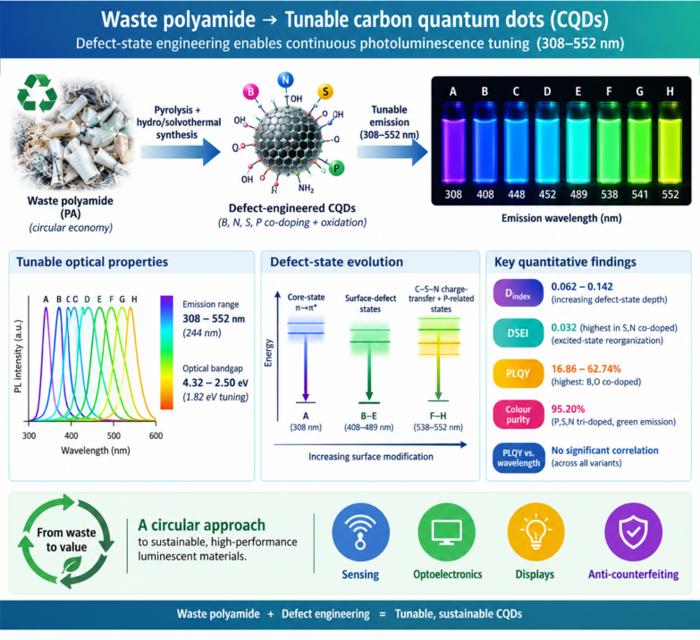
Waste polyamide-derived CQDs show continuous photoluminescence tuning from 308 to 552 nm through sequential defect-state engineering, with optical transition energies decreasing from 4.32 to 2.50 eV. @Christian Ebere Enyoh from Saitama University Carbon quantum dots (CQDs) are fluorescent carbon nanomaterials with potential applications in sensing, optoelectronics, displays, anti-counterfeiting, and environmental technologies. Their optical properties can be adjusted by modifying the carbon...
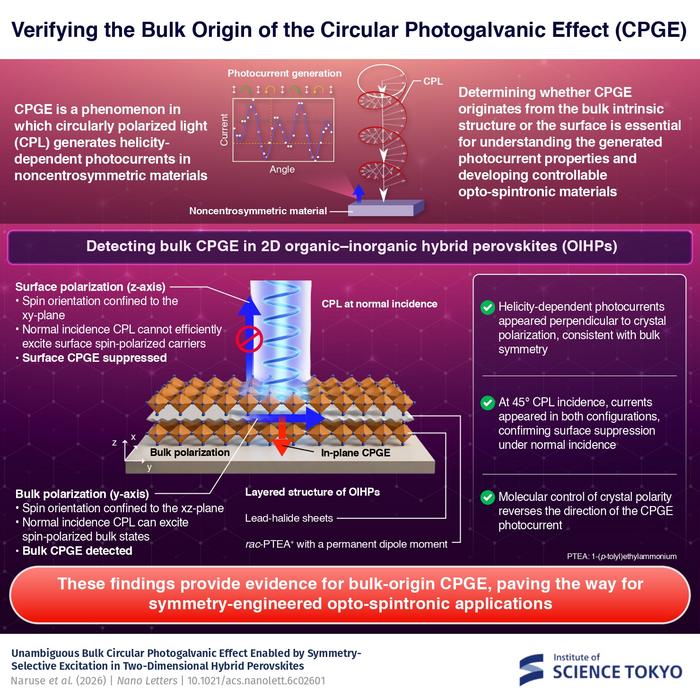
The researchers used circularly polarized light at normal incidence and found that helicity-dependent photocurrents appeared perpendicular to the crystal’s polarization but vanished when measured parallel to it, supporting a bulk origin of CPGE. @Institute of Science Tokyo The circular photogalvanic effect (CPGE), a phenomenon that generates helicity-dependent photocurrents in noncentrosymmetric materials, can originate purely from a crystal's internal structure without contribution from the...
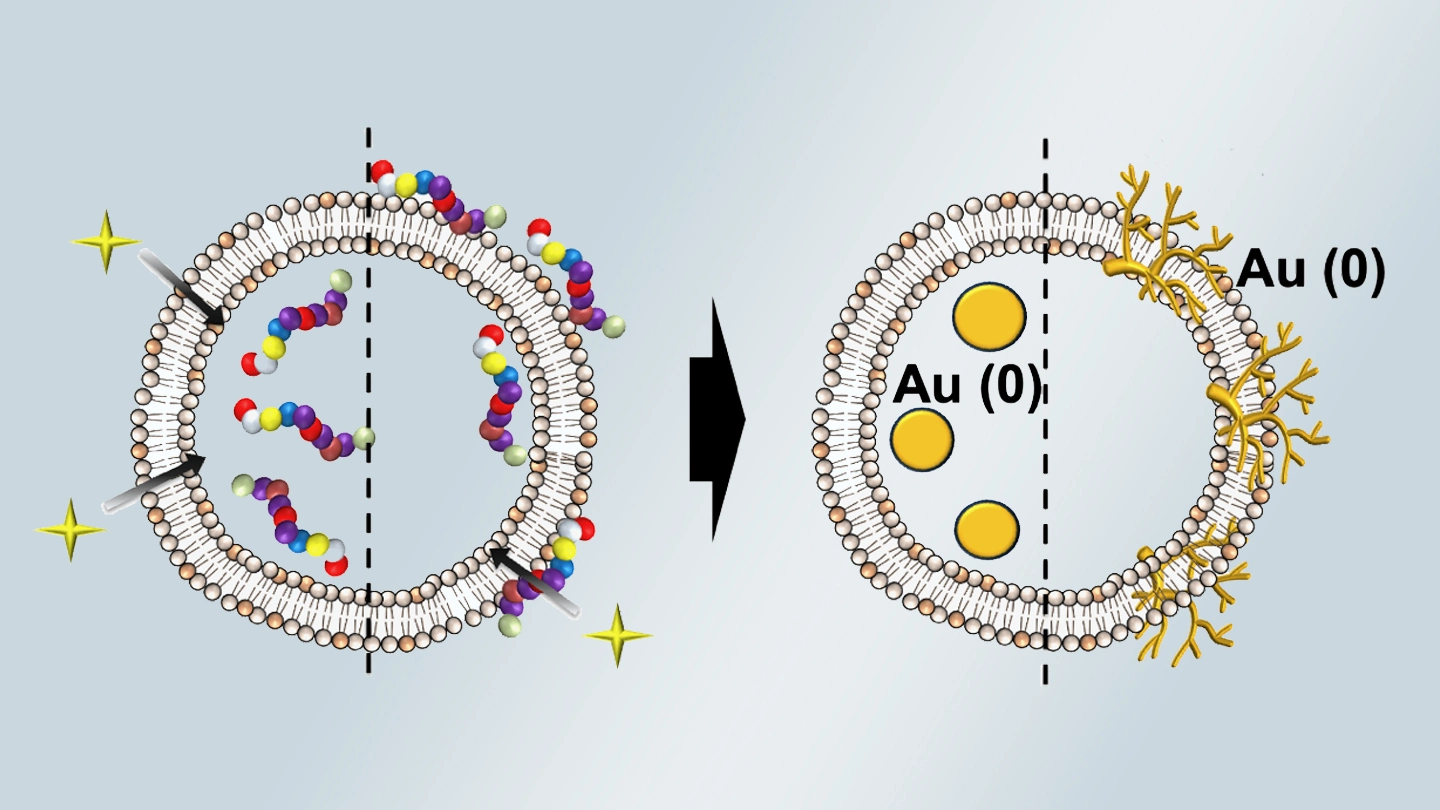
Summary of gold nanoparticle growth programming in liposome based on localization of biomineralization peptide The position of biomineralization peptides within liposomes can influence how gold nanoparticles grow, reports a research team from Institute of Science Tokyo. Peptides localized at the membrane interface promote branched structures, while those confined to the liposome interior favor spherical nanoparticles. The findings offer a new strategy for controlling nanoscale reaction...
