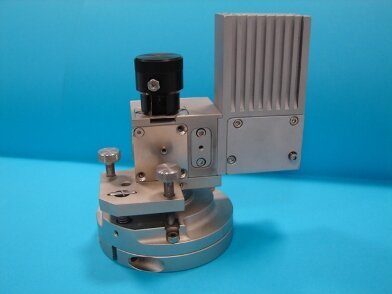
The OS Dual Beam Laser Thickness Monitor (OS-LTM-VIS-IR) is designed for the use with low energy gap materials (Eg < 1.82 eV). The visible 632.8 nm laser is used for optical alignment while the infrared laser (830 nm) is used for measurement. Characteristics Operation: remote and in situ Laser wavelength (nm): IR Laser 830 nm + alignment laser 632.8 nm Port Mount: UHV DN40CF (standard) | other mountings on demand Usage: for low Eg materials (Eg<1.82 eV) Sensitivity (nm): up to a few nm | depending on the refractive index Operating System for measuring Software: Windows XP or more recent | desktop PC with a PCI slot* * An RF noise shielded PC (not included) is recommended for the use in connection with a PPD System.
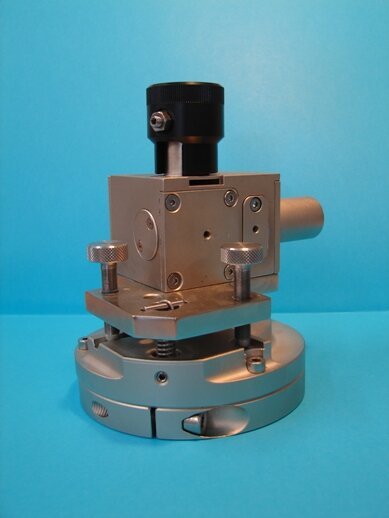
The OS Laser Thickness Monitor (OS-LTM) is designed to perform an in-situ control of thin film growth by a non destructive optical method. LTM measures the interference pattern intensity during film growth as a function of the elapsed deposition time. The laser intensity is measured by a separate detector in order to compensate for laser intensity fluctuations. The reflected intensity, which is modulated by interference between the top and the bottom interface of the thin film, depends on the thickness of the growing film on the substrate. In fact, while the reflection from the substrate is constant, the variation is due to interference of the two interfaces (substrate/sample and sample/vacuum). The signal depends on the refractive index of the sample and, in turn, on the laser wavelength (lambda) and eventually on the refractive index of the material (n). It also depends on the laser beam incidence angle with respect to the normal of the sample plane (alpha). Characteristics Operation: remote and in situ Laser wavelength (nm): 532 (standard), 405, 632.8 Port Mount: UHV DN40CF (standard), other mountings on demand Sensitivity (nm): up to a few nm (for n = 2), depending on the refractive index (n) Operating System for measuring Software: Windows XP or more recent, desktop PC with a PCI slot An RF noise shielded PC is recommended for the use in connection with a PPD System. Compared to ordinary thickness monitors (i.e. quartz balance thickness monitors) the OS LTM provides the following advantages: - in-situ measurement system - real optical thickness measurement during film growth - installation outside the vacuum chamber - insensitive to electromagnetic radiation (plasma, RF noise, etc.) - extremely sensitive to thickness growth (depending on the refractive index; few nm for n=2). - can be set at any distance from the film (remote) - no part substitution required. The features are: - Excellent stability due to the dual beam detection - Fully proprietary control system software - Available with different laser wavelength for refractive response optimization The OS LTM may be fitted directly onto a CF UHV flange glass window provided by AR coating. OS may provide the window as an option. Other mounting is possible upon demand. An optical adjustment allows perpendicular positioning against the substrate surface by means of a optical Kelvin mount. The OS LTM can be set at any distance from the film to be measured. OS LTM with CF UHV mount (at the bottom). The Kelvin adjusting screws are shown in blu. The laser is on the right hand side (Fig.2a). The laser intensity detector is at the top. A side port on the detector cabinet allows to align the reflected beam on the detector. The system may be quickly detached from the vacuum system.
CATEGORY
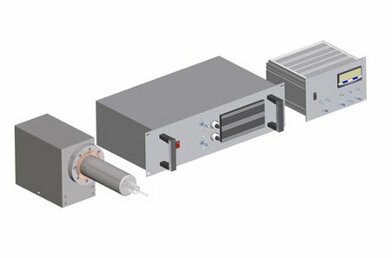
The OS PPD Gen III standard Gun (PPD-III) is a rugged pulsed electron/plasma source in operation since 2007. It is mounted on a variety of systems with one and more sources. It allows simple operation and requires low maintenance costs. Max rep. rate 15Hz. Characteristics: - Rugged construction: stainless steel (SS304) and glass - Small geometrical form factor: 63mm diameter, (DN63CF) suitable for parallel close packing of PPD sources - Adjustable cathode gas inlet flow: permits variable operating pressures (see below) - Replaceable capillary for extended lifetime: PPD-CT series (available from stock) - z-adjustable position in the deposition chamber: 50mm - Compact electronic design - Indipendent triggering system - Bakeable: up to 150°C in the deposition chamber - Low electromagnetic noise - Two or more PPD Guns can be syncronized Specifications: - Max. rep. rate: 15 Hz - Beam cross section: 3÷12 mm2 according to capillary dimension - Mean electron energy: 2KeV - Max. electron energy: 20 KeV - Pulse power density: 4÷300 MW/cm2 - Max. pulse energy: 2 J - Min. Pulse energy: < 0.1 J - Cathode lifetime: 5x10^9 shots - Operating voltage: 8÷25 KV - HV power supply: 0÷25 KV, 10mA - Ablation depth: 0.5÷2 µm, depending on the material - Deposition rate: 100÷1000 angstrom/minute, depending on the material - Efficiency: 30%, input power (capacitors) vs output power (beam) - Input voltage: 115÷230 VAC, 50/60 Hz, single phase - Deposition operating pressure: 5X10⁻³ ÷ 2x10⁻⁵ mbar - Mounting: UHV DN63CF flange - z alignement range: 50 mm, optional - Data logger: Y (voltage, pressure) - in-situ Deposition rate: Y, LTM-XXX (optional) - in-situ Spectrum analyzer: Y, PLSP (optional)
CATEGORY
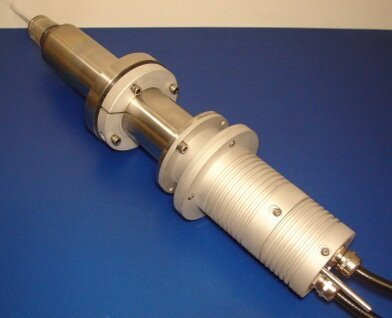
The OS PPD GEN SERIES 3000 Electron/Plasma Source is the fourth generation of sources designed by OS with improved performances in terms of repetition rate, efficiency, roughness. Characteristics: - Rugged construction: stainless steel (SS304) and glass - Small geometrical form factor: 63mm diameter, suitable for parallel close packing PPD sources - Adjustable cathode gas inlet flow: permits variable operating pressures (see below) - Replaceable capillary for extended lifetime: PPD-CT series (available from stock) - z-adjustable position in the deposition chamber: 250mm - Compact electronic design - Indipendent triggering system - Bakeable: up to 200°C - Low electromagnetic noise - Two or more PPD Guns can be syncronized - No moving parts Specifications: - Max. rep. rate: 100 Hz - Beam cross section: 3÷12 mm2 according to capillary dimension - Mean electron energy: 2KeV - Max. electron energy: 20 KeV - Pulse power density: 4÷600 MW/cm2 - Max. pulse energy: 4 J - Min. Pulse energy: < 0.1 J - Cathode lifetime: 5x10 9 shots - Operating voltage: 8÷25 KV - HV power supply: 0÷25 KV, 50mA - Ablation depth: 0.5÷2 µm depending on the material - Deposition rate: 100÷2000 angstrom/minute depending on the material - Efficiency: 60% input power (capacitors) vs output power (beam) - Input voltage: 115÷230 VAC, 50/60 Hz single phase - Deposition operating pressure: 2X10⁻² ÷ 2x10⁻⁵ mbar - Mounting: UHV DN63CF flange - z alignement range: 250 mm optional - Data logger: Y (voltage, pressure) - in-situ Deposition rate: Y LTM-XXX (optional) - in-situ Spectrum analyzer: Y PLSP (optional)
CATEGORY
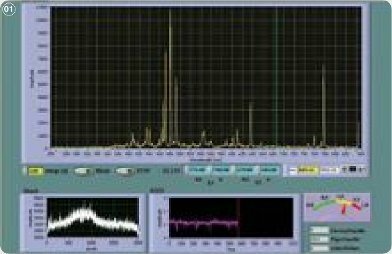
The PPD deposition is characterized by a dense plasma ejected from the target. The relative intensity of the lines are a fingerprint of the deposition process. The OS Plasma Spectrometer (OS-PLSP1) is designed to take the c.w. in-situ spectrum during deposition. The OS-PLSP1 is based on a OEM CCD spectrometer with a sufficient resolution vs sensitivity for the monitoring of the plasma composition during growth. The proprietary software allows to monitor the time evolution of the plasma intensity and composition during growth by monitoring the relative intensities of selected emission lines. Relative intensities of chosen plasma emission lines is performed continuously. Data are automatically stored in a data logger for subsequent deposition conditions inspection. The laser wavelenght may be chosen among 405, 632.8 and 530 nm for convenience depending on the materials to be grown. The OS-PLSP1 is also suitable for plasma based growth techniques (i.e. sputtering, plasma spray, and particularly for pulsed laser deposition - PLD). Characteristics Operation: in situ Port Mount: UHV DN40CF Resolution: 0.8nm Spectral Range (nm): 200-800 Operating Software: Windows XP or more recent
CATEGORY
