An innovative method for purifying perfusion fluid from inflammatory factors (cytokines) – currently being developed by NanoGroup as part of the NanoSanguis company. One of the fundamental factors contributing to the deterioration of kidney function prior to transplantation is the development of inflammation in stressed kidney tissue. Therapeutic strategies that inhibit inflammation are based, for example, on blocking the activity of pro-inflammatory cytokines TNFa and IL-6, which prolongs kidney activity in experimental animal models [doi:10.1038/s41598-021-02864-1]. In this regard, using the acquired aptamer platform, NanoSanguis will develop and test a proprietary biomolecular filter as an additional element of the extracorporeal kidney perfusion dialysis system, which will effectively and safely remove selected pro-inflammatory cytokines, e.g., TNFa and IL-6. The design of the filter selectively capturing pro-inflammatory cytokines will include the development of previously identified aptamers (oligonucleotides) targeting cytokines (e.g., IL-6 and TNFa). Aptamers are a relatively new class of biological molecules for biomedical applications. Aptamers obtained by the SELEX method using oligonucleotide libraries enriched with modified nucleotides are characterized by increased binding strength to specific molecular targets and increased stability required for medical devices. The production of aptamers that selectively capture selected cytokines will be possible thanks to technology developed on the basis of patents PL239946B1, EP3350195B1, and US10450673, which NanoGroup S.A. acquired as part of the transaction. The aptamers obtained so far and those identified in the course of R&D work will be optimized, produced on a semi-technical scale, immobilized on a biocompatible solid bed, and used to manufacture a filter. ‘s work will include biochemical functional tests, i.e., the efficiency of the process of capturing selected pro-inflammatory cytokines from the perfusion fluid will be determined. In addition, thanks to the use of a filter device in the dialysis system that selectively captures selected pro-inflammatory cytokines, it will be possible to remove molecules that are not effectively removed during conventional hemodialysis and that play a key role in progressive kidney degradation. None of the dialysis products currently available on the market offer the possibility of selectively capturing a specific molecule. Thus, the innovation of the product planned for development will be characterized by a significant novelty in relation to available dialysis products. The complementary action of the filter to the dialysis system developed as part of NanOX will increase the effectiveness of removing specific toxins that play a key role in the process of kidney tissue degradation. The aptamers present in the filter bind and remove only specific molecular targets, leaving other components intact (without affecting their function).
development of dialysis support filtration – expansion of specialization in the field of kidney disease treatment – nephrology – currently being developed by DOTO Medical As part of this activity, NanoGroup plans to continue the Pure Biologics/Doto Medical project in the future, which aims to develop an innovative medical device based on the developed aptamer technology. According to the adopted assumptions, the medical device under development (selective biomolecular filter) should significantly improve the effectiveness of removing toxins from the body during hemodialysis performed on patients suffering from, for example, chronic kidney disease (CKD). The project has been divided into subprojects (A) and (B), each of which will develop an adsorber (filter) targeting different molecular targets. The effect of toxin capture by the adsorbent (A) will be to preserve residual kidney function, while the use of the adsorbent developed in project (B) will reduce the risk of cardiovascular disease and mortality in patients with CKD.
CATEGORY
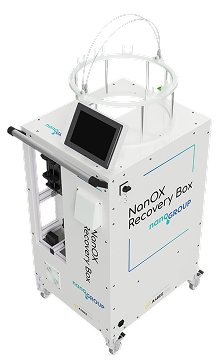
The NanOX system is the first complete solution on the market dedicated to warm kidney perfusion before transplantation. It allows for keeping the kidney alive outside the body, supporting metabolic processes. It enables the use of organs with higher risk, particularly from donors after circulatory arrest (DCD). It doubles the potential transplant market, reducing healthcare and social costs for long-term dialysis patients. It consists of the NanOX 4 Kidney perfusion fluid, based on our respiratory gas transfer technology, the NanOX Recovery Box perfusion device, and a single-use perfusion kit. NanOX 4 Kidney Perfusion Device - Defined fluid temperature range from 4°C to 37°C - Circulation condition simulation - Continuous data registration - Emergency power supply - Development platform for additional organs
CATEGORY
This allows for improving their efficiency and safety. FLEXIBILITY Enables quick initiation of new projects, leading to the creation of derivative patents based on the core technology. LIMITED RISK Uses known and well-researched active substances with established therapeutic profiles and side effects, reducing developmental risks. REPEATABILITY OF THE PROJECT The polysaccharide nanoparticle technology accelerates project execution by leveraging the effects of previous studies. STRONG SCIENTIFIC FOUNDATION Research conducted in international centers forms the foundation for derivative projects.
CATEGORY
NanOX 4 Kidney Perfusion Fluid Successful Autotransplantation After a 30-minute ischemia simulation, a pig kidney was removed and subjected to a 12-hour ex vivo perfusion at 25°C using the NanOX fluid and device, followed by a successful autotransplantation back into the donor. A 14-day observation period ended successfully. 147 Hours of Ex-Vivo Storage We achieved a breakthrough in organ storage research, maintaining an organ in a viable state outside the body for 147 hours – longer than any existing solution on the market.
CATEGORY
