By Gencoa Ltd
Magnetics High Yield (HY) range achieve 40% target utilization and are recommended for applications where increased machine up-time or reduced material costs are required.
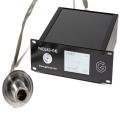
The Gencoa VACGAS-G16 sensing unit provides an industrially robust means to sense elements of group 16 - The Chalcogens. The important species in group 16 from a vacuum processing point of view are oxygen, sulphur and selenium. The sensing method uses a zirconium oxide ceramic (zirconia - lambda sensor) and is based on a solid-state electrochemical fuel cell called the Nernst cell. Its two electrodes provide an output voltage corresponding to the quantity of gas in the vacuum. The VACGAS-G16 combines feedback control of the sensor temperature with gas correction to provide the O2 level as a precise partial pressure. The basic technique is used in automotive engines to sample oxygen levels and ensure efficient combustion. Whilst Lambda sensors have been employed for many years to sense oxygen in vacuum, the speed and accuracy of the signal has not been as good as optical and mass spectrometry methods. The Gencoa VACGAS-G16 matches the gas outputs from RGA and optical spectrum methods with better sensitivity compared to differentially pumped RGA’s (less noise). This signal accuracy is combined with the inherent robustness and low cost of the method when compared with other vacuum gas sensors. The sensor head has an infinite life and the control ensures signal stability and accuracy. The sensor can be located on the chamber wall (KF40 as standard), or inserted into the vacuum chamber as part of a sealed assembly. There are no sensitive electronics, hence the sensor won’t fail. The limitations of the Nernst Cell means that for a large gas change, it can take 5 seconds to respond to the ultimate signal level, which compares to 3 seconds for a differentially pumped RGA. Optical methods based upon OPTIX are much faster (see below), 0.1 to 2 sec depending upon integration time. VACGAS-G16: a key addition to vacuum system data tracking A vacuum gauge provides essential system information and knowing the level of oxygen in a vacuum chamber has multiple other uses: - Basic health of the vacuum chamber and process – identify contamination or problems - Quality control data for each process cycle – track product & process quality - Monitor pump-down and system process readiness - Use the oxygen signal to adjust mass flow control of O2 entering the chamber - Fast feedback control to increase deposition rates – combine the VACGAS-G16 with a speedflo controller - Control uniformity by local sensing and adjust of O2 levels in the process zone Potential process types - Sputtering, electron beam and thermal vacuum coating methods - Plasma and thermally based oxidation / surface treatment - Solar cell manufacturing involving sulphur or selenium gases - Nitriding plants during pre-oxidation, post-oxidation, oxynitriding - On-line oxygen monitor for use with vacuum packaging systems Specifications - Display 24 x 32mm touch screen - Warm-up time, 20 mins - Max pressure: 1 mbar - Min. measuring pressure: 10 -7 mbar - Helium leak rate < 10 -8 mbar l/s - Reaction time: 5 sec zero to full scale - Measuring sensitivity: <5 ppm - Temperature at KF flange: max. 185 °C - Power supply: 24 V DC / 1.5 A - Mechanical connection: KF40 vacuum-flange – internal or external with variable connection cables lengths - Output: DB9 connector, RS 232 communication (0-10V or partial pressure (Pa, mbar or mTorr)) Accessories - different KF or CF vacuum flange sizes - speedflo reactive gas controllers (3 and 8 channel) - pulsed S and Se effusion cells
CATEGORY
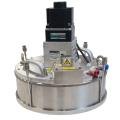
Gencoa full face erosion (FFE) magnetics combine ultra-uniform films with clean target erosion by a scanning of the plasma over the target surface. Two versions of the circular FFE are offered, with a unique design for target diameters of 75-200mm (3-8”) that is ideally suited to R&D and optics and can be ordered for internal of external mount. For larger substrates, cathodes fitted with target diameters of 250mm (10") and above deliver superior uniformity control at low target-to-substrate separations – typically 50-70mm – to ensure a high rate of material transfer from the target to the substrate for rapid wafer metallizing. Gencoa's range of FFE magnetrons overcome many of the traditional difficulties experienced when performing high-rate reactive deposition, such as nodule growth rates, whilst increasing the total target surface sputtering area. High target use Target use is high (50% on a 6mm target), with a clean target even when reactive sputtering, and no redeposition areas on the target surface, fewer arcs and a lower number of coating defects. Target use of up to 70% can be achieved using the 6" circular FFE magnetron (FFE150). Uniformity A high rate of uniformity is achieved through motor driven dynamic plasma scanning to sputter the whole target surface, and maximum erosion at the outer edge of the target. There is no uniformity drift with target life. The uniformity will vary with target-to-substrate separation. This can also be used to correct the uniformity as the target erodes and wafer size. The 12" circular FFE magnetron (FFE300) can deposit layers with 1-3% uniformity onto 200mm wafers. Options Gencoa circular FFE magnetrons are available from 3" to 18" OD targets, with a range of mechanical options available. - Internal or External Mounting - Tilting shaft mount - Gas Injection - RF Power Option - Anode Cooling - Choice of motor and controller - Shutter (manual or automatic) - Sputter Chimney - Wall Mount Feedthrough - Hidden Anode
CATEGORY
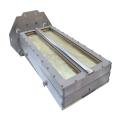
Gencoa double (or dual) magnetons combine all the process and design expertise to realise an integrated package that ensures 'drop-in' optimum operation. A typical integrated dual sputter cathode assembly has the following features: - Two magnetrons with an asymmetric magnetic design - Integral dark space shield (with dual cathodes the target alternate and act as the anode and cathode) - Water cooled dark space shield and rear mounting plate (cooling of the shield is recommended when AC power is applied in double configuration - especially important when coating plastic web) - Integrated gas bars (number of sectors and design depends upon cathode size) - Fibre-optic monitoring of the plasma discharge (1 or 3 zone or can be excluded if target voltage feedback gas control is used) - Speedflo reactive gas controller All of the above are essential for trouble free high rate reactive deposition of dielectric materials. Double cathodes can also be used for reactive or non-reactive deposition of conducting materials - in this case the electrically floating dark space is not essential. Mounting styles for double sputter cathodes are flexible with the most common type cantilever mounted for web coating or drop-in, sputter-down for architectural glass coating. Gencoa will provide a custom 3D model of the entire assembly for easy integration into the customers overall system scheme. Mounting options - Internal - External - Spacer - Cantilever Double cathodes are ideally suited for high rate deposition using reactive processes and Gencoa can provide onsite or remote process tuning for reactive processes using Gencoa's Speedflo reactive gas controller. This ensures robust control of the process high on the hysteresis curve for your materials and the highest deposition rates. To understand Gencoa's Speedflo range of products see the Speedflo page.
CATEGORY
