LamdaGen’s continuous nanostructured Au thin-film biosensors are a formidable alternative that alleviates the shortcomings of gold colloids. The plasmonic films are made of a thin gold film with surface patterns defined at the nanoscale level via a proprietary manufacturing technique. LamdaGen’s continuous nano-structured films can be pictured as an array of small antenna located at the surface of the metal. The antenna field is not confined at the interface, but can extend up to a certain distance into the solution. LamdaGen’s plasmonic films are characterized by much narrower and intense plasmon resonances compared to solutions of Au nanoparticles and single Au nanospheres. These phenomena results in a far higher Q factor and shorter sensing field that negates spurious artifacts often referred to as bulk effect. Structurally, the plasmonic thin-films integrate billions of Au nanostructures in an area of ~ 10 mm 2. The quality factor of LamdaGen films are in the 13-15 range, i.e. 2.5 to 3 times higher than those of colloidal solutions. As a consequence, the plasmon dephasing time is 3 times larger in films than in solutions. Spectra similar to the ones shown in Fig.1 have been measured for multiple biochips as part of the company’s QC process, each biochip consisting of eight plasmonic spots. LamdaGen’s plasmonic Au films have the highest Q factors in the visible range of any plasmonic platform developed in academia or commercially. The higher Q factor of films vs colloidal solutions translates into increased sensitivity for biosensing as the change in plasmon resonance frequency is proportional to the Q factor. LamdaGen’s proprietary process yields homogenous films of macroscopic dimensions (0.1 – 3 mm) that are highly reproducible, scalable and economical.
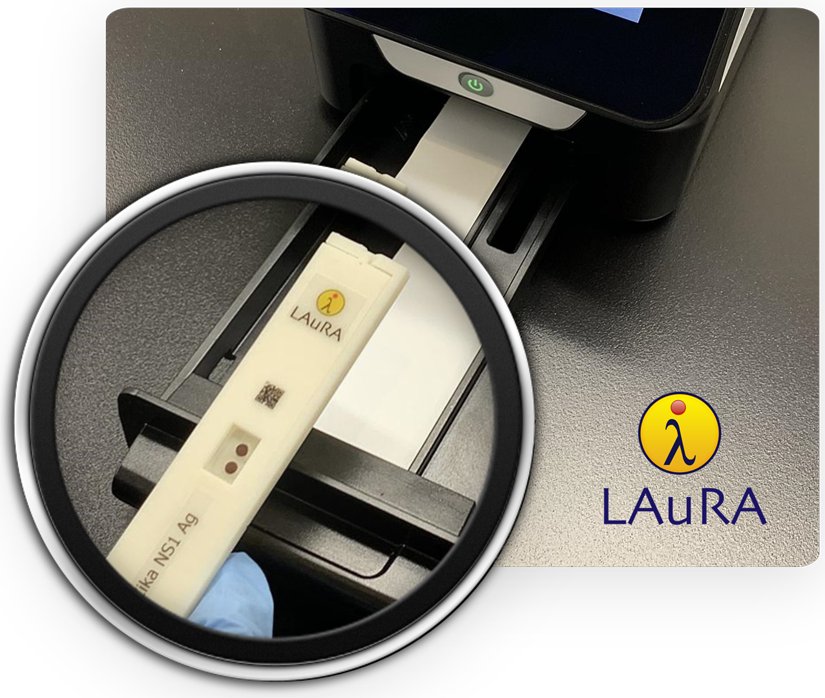
LAuRA (LamdaGen Au (gold) Rapid Assay) offers a turnkey plasmonic biosensing solution, combining the speed and convenience of lateral flow assays with the high sensitivity and quantitation of ELISA tests. The LAuRA Rapid Test System delivers laboratory quality results equivalent to gold standard ELISA’s in minutes rather than hours. LAuRA’s test procedure is simple and easy to use. Disposable cartridges can be designed to run single or multi-target tests and deliver results 15 minutes or less. Leveraging the inherent properties of advanced nano-based plasmonics, the LAuRA immuno-based platform provides high sensitivity detection capabilities far exceeding those of existing rapid assays. The patented platform is flexible and scalable, enabling uniquely powerful detection systems ranging from small benchtops to handhelds to throughput. Innovative LAuRA systems are being developed for applications in Human Health, Food & Water Safety, Biothreat Detection, and Animal Health.
CATEGORY
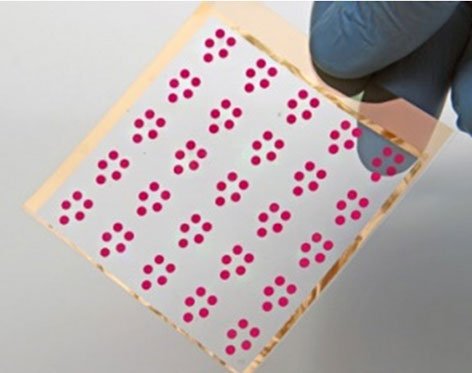
Continuous metallic thin-film plasmonic sensors LamdaGen's patented nano-structured thin-film sensors are made using pure gold. The sensors are grown at the angstrom level allowing exquisite control over their architecture and reproducibility. This nano-process produces plasmonic sensors that are burgundy in color. The sensor acts as a smart signal transducer, possessing significant amplification properties.A robust surface color change occurs when a target biomolecule binds to the sensor surface. The sensor surface has an extremely short sensing range (~30nm) which makes it blind to molecules outside of the range. This remarkably short sensing range makes the system highly amenable to a variety of complex media including biological fluids. Easily manufactured and scalable Highly reproducible and stable Grown at ambient temperature Compatible with a wide range of surfaces Adaptable to many form factors Easily multiplexed for multiple targets Low cost
CATEGORY
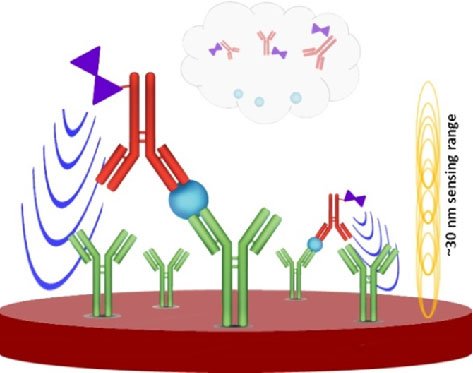
What is PAT? Plasmonic Amplification Technology™ (PAT™) is a “double amplification system” that leverages the inherent properties of nano-based plasmonics enabling quantitative limits of detection and quantitation far lower than those achievable with current lateral flow based systems. LamdaGen’s nano-structured thin-film sensors have a plasmonically active surface with an extremely short sensing range. When targets bind to the sensor surface, the surface changes color, greatly amplifying the signal. In an immunoassay, a proprietary moiety-conjugate interacts with the sensor surface creating a powerful SECOND amplification. This “double amplification” is called PAT – Plasmonic Amplification Technology. PAT enables high sensitivity detection and is applicable to sandwich, competitive and other assay configurations. In addition, the sensor’s short plasmonic sensing range eliminates the need for a wash step, greatly simplifying assay workflow.
CATEGORY
A high-sensitivity rapid detection platform powered by PAT The LAuRA (LamdaGen Au (gold) Rapid Assay) Plasmonic Sensing Platform is an advanced high-sensitivity rapid detection platform developed by LamdaGen. It harnesses the power of Plasmonic Amplification Technology (PAT) to deliver exceptional detection capabilities. The platform combines the speed and simplicity of current rapid lateral flow assays with the sensitivity and quantitation traditionally associated with microtiter plate assays. It offers laboratory-quality results that are equivalent to gold standard enzyme-linked immunosorbent assays (ELISAs), but in a fraction of the time. Characterized by its simplicity, compactness and user-friendly nature, the platform is designed to be amenable for operators with minimal training. Furthermore, LAuRA offers opportunities for enhanced sensor design, connectivity, miniaturization, multiplexing and seamless integration with other detection platforms, including smartphones. This flexibility and adaptability ensures that the LAuRA platform can meet the specific needs of various testing environments and be quite suitable for global adoption. High Sensitivity Rapid Results Easy to Integrate Multiplexed Easy to Use
CATEGORY
