AJA International Orion Series Sputtering Systems are compact versions of the popular ATC Flagship Series physical vapor deposition tools designed to deliver maximum performance for limited budgets. These HV and UHV systems inherit many design features and common parts from the highly evolved ATC sputtering tools. The standard Orion modules (chambers, frames, cluster flanges, etc.) are generally in stock at AJA thereby reducing delivery times. These popular systems use AJA’s exclusive Stiletto (HV) and A300-XP (UHV) magnetron sputtering sources (2” and 3”) and can be fitted with heating and cooling stages to accommodate substrates up to 6” Ø. Substrate temperature ranges from cooled LN2 to 1000°C are available depending on size and configuration. Orion Systems feature a number of source configurations capable of accommodating up to (8) 2” sputter sources, (5) 3” sputter sources, and (4) 2” magnetron sputtering sources with in-situ tilt capability. Custom configurations are also available combining sputtering (con-focal or direct), thermal, ion sources, and in-situ analytics all on a single cluster flange. Orion Systems can also be easily connected to each other or to other ATC Systems for multi-chamber (e.g. metal/oxide) or multi-technique (e.g. sputter/evaporation/PLD/ion milling) configurations. Typical Rate/Uniformity Data: The Orion Series Sputtering Systems feature a con-focal sputter source flange oriented at specific angles determined from many decades of experience with the in-situ tilt sources found on the flagship ATC systems. The specially designed chimney/ground shield/shutter system allows a high degree of deposition uniformity over substrates more than twice the target diameter. A typical deposition profile with SiO2 on a 4” diameter Si wafer is shown. Deposition rate is a function of sputter yield of the material, maximum allowable power density into the target (depends on heat transfer capability of target material), and type of power used (e.g. RF, DC, pulsed DC, and HiPIMS). Maximum deposition rates are achieved with materials such as Au, as this material has a high sputter yield, excellent heat transfer, and can be sputtered with DC (most efficient). Slow deposition rates can be expected with materials such as Al2O3, as this material has a very low sputter yield, poor heat transfer, and must be sputtered with RF (1/2 the efficiency of DC). Typical rates are 0-18 Å/sec with Au, 0-9 Å/sec with Cu and 0-0.16 Å/sec with Al2O3 in a confocal configuration with 2” sources on a 100 mm Ø substrate. Direct deposition at short working distances (50-100 mm) can achieve higher rates. However, con-focal geometry results in much better uniformity, the ability to co-deposit alloy films, and the ability to grow better ultra-thin film multilayers, since the substrate is always “in the plasma.” The cost of the smaller targets employed in con-focal configurations can also significantly reduce operating costs.
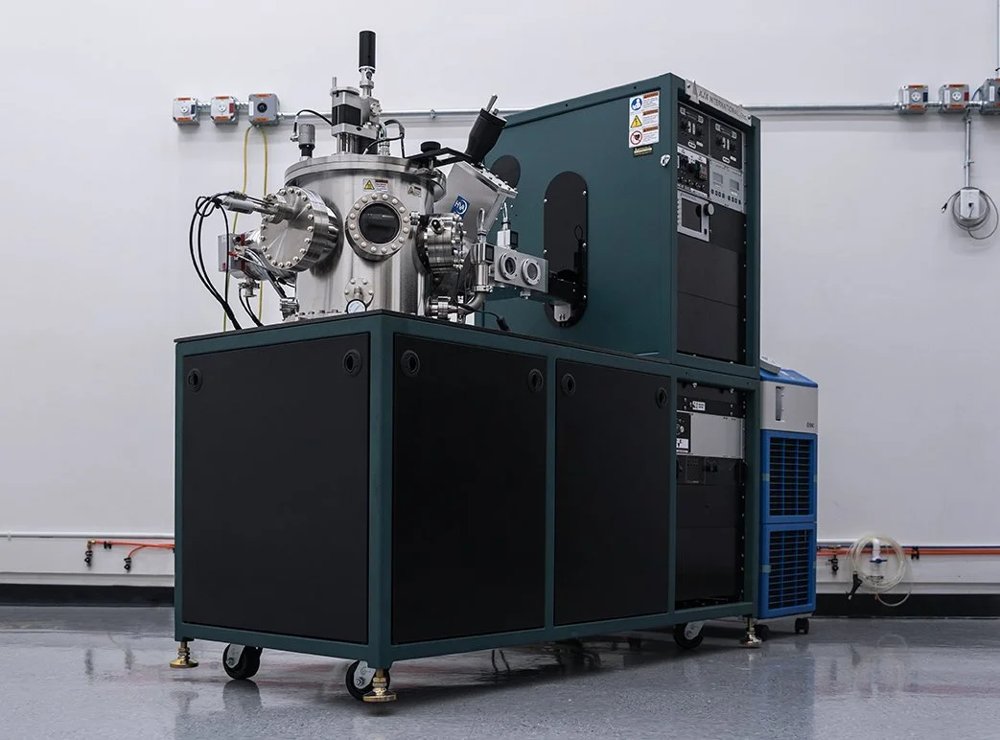
Orion and ATC Sputtering Deposition Systems Key Features of the Orion and ATC Sputtering Systems For Spintronics Magnetron Sputtering Sources: AJA International offers the best sputtering performance in the industry for magnetic materials used in spintronics devices. Each system offers configurations for mounting several magnetrons, in either sputter up or sputter down configurations. The ATC Series can support up to 13 guns in combinations of confocal, direct, and off-axis sputtering geometries for exploring large material spaces. The guns feature integral gas injection rings for local process gas delivery. Ultra-High Vacuum (UHV) Design: As film purity is critical in this application, the systems are engineered to achieve base pressures ranging from the low 10⁻⁷ Torr to the low 10⁻¹⁰ Torr regime. Systems can be constructed using all-metal seal vacuum chambers, and in-house manufactured bakeout jackets are available for thorough vacuum conditioning and system degassing. Power Supply Options: DC, pulsed DC, RF and HiPIMS supplies can all be configured into the system. AJA's standard Phase II-Au control system will accommodate up to (5) DC power supplies with integral 4-way switchboxes, (4) RF power supplies, and (1) 4-way RF switchbox. This allows maximum flexibility for sequential or co-deposition from a large selection of sputter guns so that new material systems can be rapidly developed. Substrate Holder: The substrate holder is highly configurable, supporting sample sizes ranging from small coupons to full wafers up to 6" (Orion) or 12" (ATC) diameter with excellent film thickness uniformity. Available functionalities include high-temperature substrate heating (up to 800–1,000 °C), cryogenic or water-based cooling (LN₂ or H₂O), azimuthal rotation for uniform film growth, motorized Z-axis motion, and RF/DC substrate biasing for advanced process control. Process Gas Delivery: The system supports up to four mass flow controllers (MFCs) for precise regulation of process gases. Typical gases used in epitaxial deposition include Ar, O₂, and N₂, allowing for a wide range of reactive and inert sputtering processes. A gas ring can be provided at the substrate for reactive deposition of oxides and nitrides. Deposition Recipe Generator: The software makes it simple to create and store up to 100+ recipes for depositing layer stacks. It is easy to write extensive recipes, and the Excel spreadsheet layout allows line by line layer stacking and review of recipes for accuracy and data extraction if needed. Recipe operation automates the entire deposition process, with auto-abort in case setpoints fail to be reached. Our AJA Excel Spread Sheet Software Emulator makes possible remote recipe creation offline from the system for later import and execution. Nanometer-Precision Film Thickness Control: An optional quartz crystal monitor and controller allows calibration of deposition rates. High-stability power supplies provide precise, repeatable deposition rates, while recipe-driven automation ensures accurate, repeatable process execution. Vertically Integrated System Design: AJA International manufactures many of the components in the systems. This ensures compatibility and quality, while controlling tool costs. This also speeds up service and provides long service life for the systems.
CATEGORY
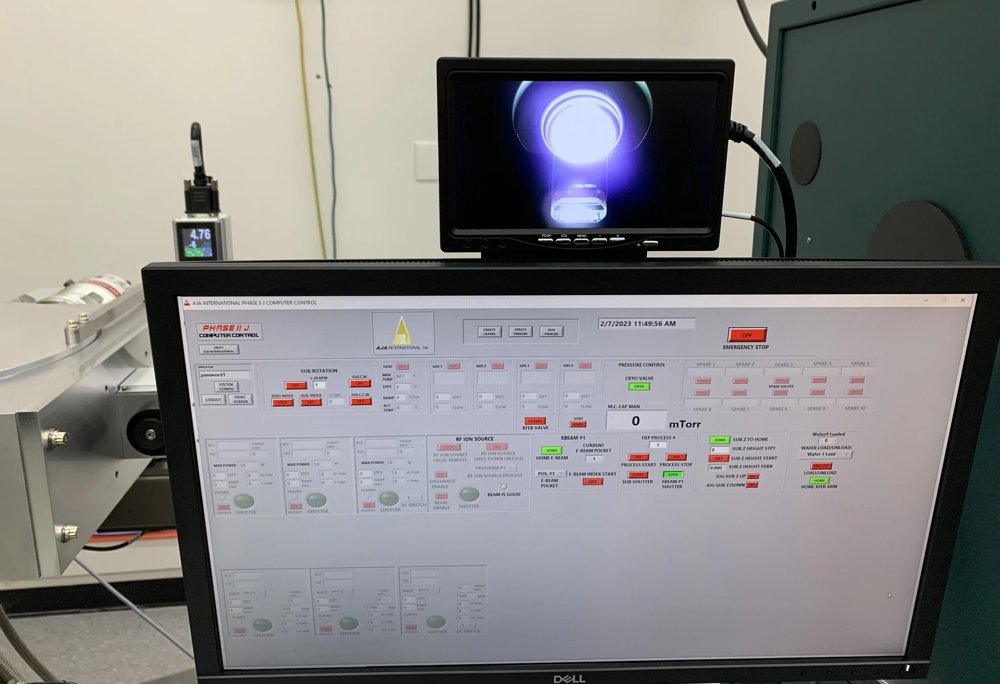
Phase II-Au Computer Control The AJA LabVIEW based Phase II-Au computer control system is used on all Evaporation Systems.This straightforward, user friendly control system utilizes a large 22” articulating screen with wireless keyboard and mouse. The back panel of the hardware module is populated with connectors to interface to all aspects of the sputtering system and to allow for easy future "plug and play" upgrades/expansions. The Phase II-Au control system allows the user to operate in either the “manual mode” or the “automated processing mode.” In the, “automated processing mode” the user designs "process layers” which are then compiled and saved as a “process” to be executed with a single command. The system allows up to 104 unique user entry points which are accessible only by password, limiting access to a user’s process layers and thereby preventing unexpected corruption of a user’s saved processes.Special “soak layers” can be easily incorporated into the process. Adjustable time base Data-logging to a Microsoft Excel spreadsheet is standard.Remote preparation of new processes in a Microsoft Excel spreadsheet emulator format is available as an option. The standard Phase II-Au control system will accommodate up to (3) DC power supplies, (3) RF power supplies, (1) 4-way DC switchbox, (1) 4-way RF switchbox,(1) DC Ion Source, (1) RF Ion Source, (1) Linear or Rotary Ebeam, (1) Deposition Controller,automatic selection of sweep pattern based on material, (4) process gases,(24) Valves/shutters, down stream closed loop automatic pressure control, substrate rotation,substrate tilting and indexing and substrate temperature control. Processes are aborted if plasma is not detected,substrate temperature, process gas or chamber pressure is out of range.
CATEGORY
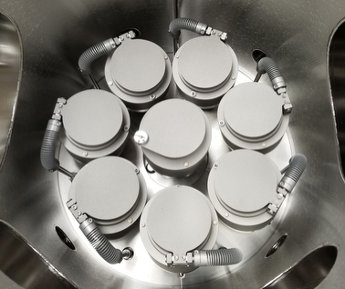
AJA International systems offer configurations for mounting several magnetrons, in either sputter up or sputter down orientation. The Orion series can mount up to 8 guns. Co-deposition with up to 9 power supplies gives access to an extensive compositional space in creating alloys. A central substrate-facing port can also house in-situ probes for real-time monitoring and analysis. Our guns feature integral gas injection rings for local process gas delivery. The substrate holder is highly configurable, supporting sample sizes ranging from small coupons to full wafers up to 6” (Orion) or 12” (ATC) diameter with excellent film thickness uniformity. Available functionalities include high-temperature substrate heating (up to 800–1,000° C), cryogenic or water-based cooling (LN₂ or H₂O), substrate rotation for uniform film growth, motorized Z-axis motion, and RF/DC substrate biasing for advanced process control. We also offer a combinatorial chemistry deposition retrofit for Orion systems, which mounts on the central sample-facing port of the gun flange. The upgrade adds high-throughput experimentation capability to existing tools. Our systems are engineered to achieve base pressures ranging from the low 10⁻⁷ Torr to the low 10⁻¹⁰ Torr regime. Systems can be constructed using all-metal seal vacuum chambers, and in-house manufactured bakeout jackets are available for thorough vacuum conditioning and system degassing.
CATEGORY
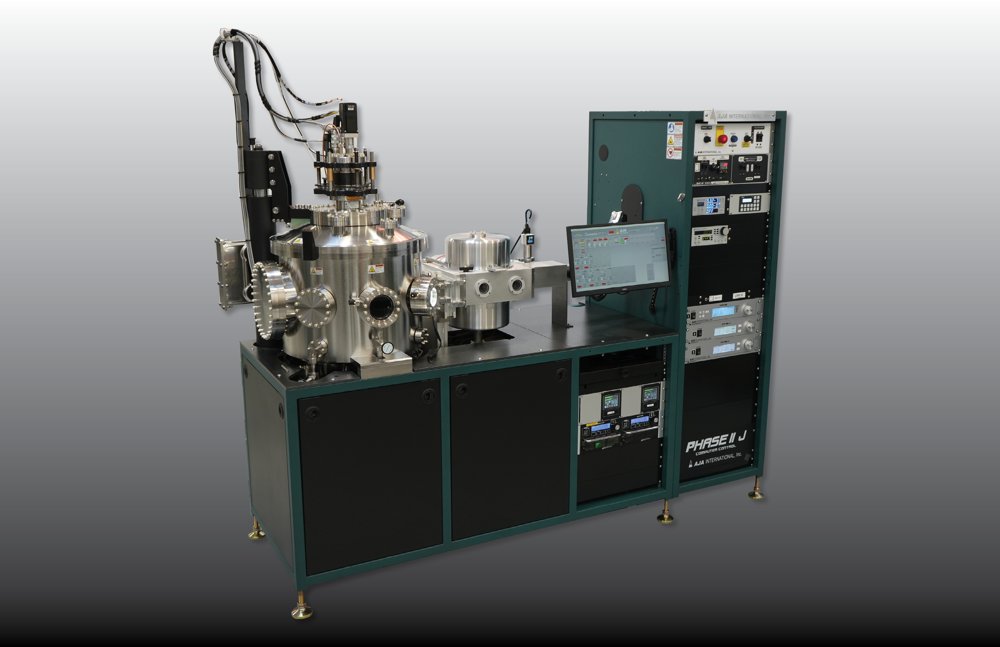
AJA International systems offer configurations for mounting several magnetrons, in either sputter up or sputter down orientation. The ATC Series can support up to 13 guns in combinations of confocal, direct, and off-axis sputtering geometries for exploring large material spaces. Co-deposition with up to 9 power supplies gives access to an extensive compositional space in creating alloys. A central substrate-facing port can also house in-situ probes for real-time monitoring and analysis. Our guns feature integral gas injection rings for local process gas delivery. The substrate holder is highly configurable, supporting sample sizes ranging from small coupons to full wafers up to 6” (Orion) or 12” (ATC) diameter with excellent film thickness uniformity. Available functionalities include high-temperature substrate heating (up to 800–1,000° C), cryogenic or water-based cooling (LN₂ or H₂O), substrate rotation for uniform film growth, motorized Z-axis motion, and RF/DC substrate biasing for advanced process control. Our systems are engineered to achieve base pressures ranging from the low 10⁻⁷ Torr to the low 10⁻¹⁰ Torr regime. Systems can be constructed using all-metal seal vacuum chambers, and in-house manufactured bakeout jackets are available for thorough vacuum conditioning and system degassing.
CATEGORY
