By Nanovac AB
The BVO500 system is a compact versatile vacuum bakeout chamber with an easy-access chamber equipped with a thermal table (standard resistive heated). The compact chamber design allows for easy access to the thermal test table making it easy for the test engineer to mount the test object and attached any diagnostic/control cabling that is required. The access ports can be customized to customer requirements. Description Data Chamber volume 110 l (can be equipped with active/passive shelfs) Max DUT dimensions 1 500 (W) x 500 (D) x 360 (H) Base pressure <1x10 -2 torr Thermal range (standard 2) 15°C to 120°C Thermal range (extended) -40°C to +120°C Pump speed 6 m 3/h Rough vacuum pump type Dry Dimensions (L x W x H) 720 mm x 1050 mm x 700mm 3 Voltage 3φ 380-415V 50Hz or 3φ 190-230V 60Hz 1 Alternative chamber sizes are available 2 Other temperature ranges are available, this is a demonstration of standard capability. 3 Without status light tower mounted
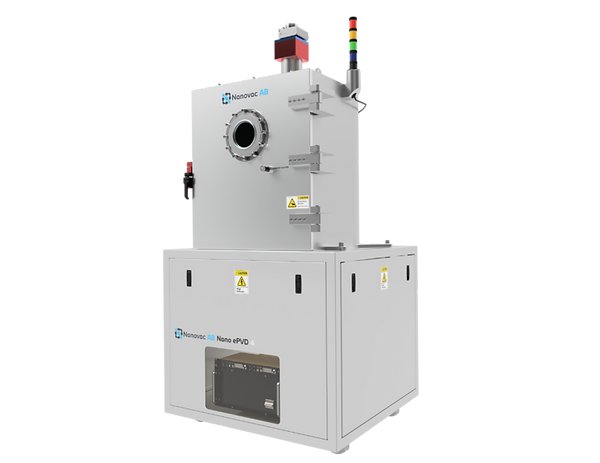
The R&D system, PVD-2-RS is our low cost PVD system, utilizing two resistive sources for deposition.
CATEGORY
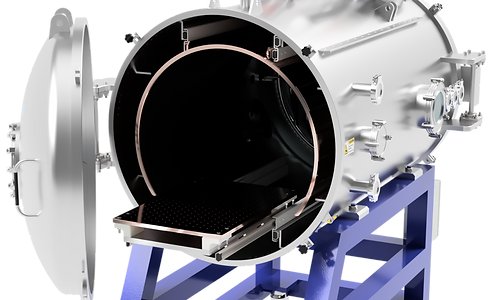
We also manufacture and design custom PVD (physical vapor deposition) systems for demanding thinfilm R&D applications.
CATEGORY
We are also manufacturing reverse engineered consumable parts for plasma etch and deposition systems.
CATEGORY
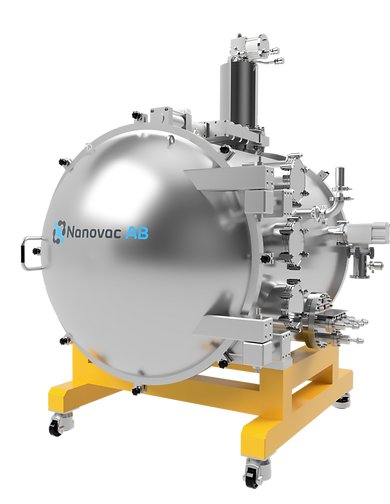
Horizontally loaded thermal vacuum test chambers allows for horizontal loading of the DUT (device under test). Our solutions are to a large extent custom designed, as dimensions of the DUT many times drive the size of the chambers. Inner diameters typically range from 500mm in diameter up to several meters depending on the enduser test requirements. We can deliver with hinged doors in both the front and rear of the chamber, alternatively having only one end with a door. The door can be left or right hinged, or mounted on a sliding mechanism. By default the thermal test plate is installed on a sliding rail mechanism to simplify loading/unloading and setup of the test campaign.
CATEGORY
