The Minilock-Phantom III is the first plasma RIE system in the industry to incorporate a vacuum loadlock on a compact platform. The system meets all the safety and equipment needs for the most challenging etch processes including applications that require corrosive chemistries. Applications Because metal and compound semiconductor etch processes use corrosive chemistries and are often sensitive to atmospheric moisture, consistent results as well as safety depend upon isolating the reaction chamber from the atmosphere. In addition, when operating at lower pressure, maintaining reproducible results from run to run is impacted when the chamber is exposed to the atmosphere between each run. The Minilock-Phantom III solves these issues with its fully integrated loadlocked delivery system. The Minilock-Phantom III comes with full process support both prior to and subsequent to purchase. For a more detailed discussion of applications and processes, please visit www.triontech.com. Tool Features Reactor: The cathode and anode are each machined out of single blocks of aluminum. After critical inspection they are hard anodized for protection from process chemistries. The bottom electrode is available in either 200mm or 300mm sizes and depending on electrode configuration, can process single wafers or mounted parts (3” - 300mm). It also has multiple size batch capability (4x3”; 3x4”; 7x2”). Process gases are introduced into the chamber either by an annular ring or a showerhead manifold. Automatic Matching Network: The uniquely designed network is built in as an integral part of the bottom electrode assembly to ensure accurate tuning, low transmission loss and virtually no RF radiation outside the network itself. The network uses a phase magnitude sensor and amplifiers to provide instantaneous feedback for quick precise tuning. Vacuum Loadlock: Trion’s vacuum loadlocked system includes compatible robotic arm, reactor isolation valve and locked chamber. The robotic arm has a direct drive pick and place mechanism that provides high reliability. RF Generator: The system comes with a 600 watt, 13.56 MHz solid state RF generator. Touch Screen Operator Interface: A color flat panel display with touch screen interface provides the operator with full process information at all times. The software interface guides the operator through each sequence in a logical fashion and gives fingertip control of all process parameters. PC Process Controller: The PC process controller provides simple and reliable system control. The graphical software package creates programs in block diagram form. Process recipes are stored on the hard drive or can be stored on USB flash drives allowing each operator to maintain individual recipes. AC Distribution Module: The AC distribution module automatically distributes predefined power quantities to the various internal components. When the Emergency Power Off button is tripped, the RF power is shut off and all valves involved with gas delivery are automatically closed and the machine powers down to a safe standby mode. This system includes separate power controls for the main AC and peripherals. Automatic Pressure Control: The system includes a butterfly pressure control valve operated directly by the process controller. This provides independent pressure control separate from all other process parameters. Gas Delivery System: State-of-the-art technology is utilized to ensure the utmost integrity and purity. Each reaction chamber accommodates up to eight mass flow controllers and all plumbing utilizes surface mount, C-seal technology or orbital welded VCR fittings. Safety: The system meets SEMI S2-93 safety requirements. The system is CE compliant with Machinery Directive 98/37/EC, the Low Voltage Directive 73/23/EEC and the Electro-magnetic Compatibility Directive 89/336/EEC for CE Marking requirements. A third party safety review is available upon request. Facilities: Facility schematics can be provided upon request. Advanced Options Custom Gas Cabinets: Trion provides remote gas cabinets with self-closing doors which house gas delivery and nitrogen purging for toxic or corrosive gases controlled by the on-board computer. The system automatically purges the process supply lines with nitrogen when the system is placed in standby mode. This extends the life of the mfc’s, regulators, valves and associated plumbing. The gas cabinets include regulators for toxic or dangerous gases such as chlorine, silane and ammonia. Included are automatic “at-the-bottle” shut off valves and stainless steel lecture bottle holders. Pumping Systems: Each reaction chamber requires it’s own pump. Trion can supply these as needed according to your requirements. There are mechanical, dry and turbo pump options available. You may choose to provide your own pump(s) or they can be purchased directly from Trion. All pump options provided by Trion are proven systems chosen to best meet your specific process needs Temperature Control: An external chiller or heater/chiller may be recommended. By controlling the reactor temperature (bottom electrode), process reproducibility is greatly enhanced and the etch by-products are more readily volatilized. Endpoint Detection Systems: Trion offers both optical and laser endpoint detection options which allows the user to measure film thickness changes in-situ during the etch process. These systems are integrated into and controlled by Trion software. Inductively Coupled Plasma: Trion’s carefully engineered ICP is a proven option for applications requiring a downstream, high-density plasma source. It dramatically reduces radiation damage and contamination from RIE sputtering and greatly increases selectivity to other films. It allows for higher plasma densities as power is transferred into the bulk plasma via the magnetic field resultant from inductive coupling. This enables processing at lower pressure, which has a number of significant benefits. It allows for tight anisotropy in high aspect ratio structures and reduces microloading effect. Trion’s ICP source will result in improved etch rates, profile control, uniformity and selectivity with a dramatic reduction in RIE radiation damage. The ICP comes with a 600 or 1250 watt, 13.56 MHz power supply and a built in automatic matching network. Electrostatic Chuck: Maintaining cooler substrate temperatures during etching is often critical. Trion’s electrostatic chuck holds the wafer securely to the chuck by electrostatic forces while flowing a small quantity of helium onto the backside of the wafer, providing significant cooling.
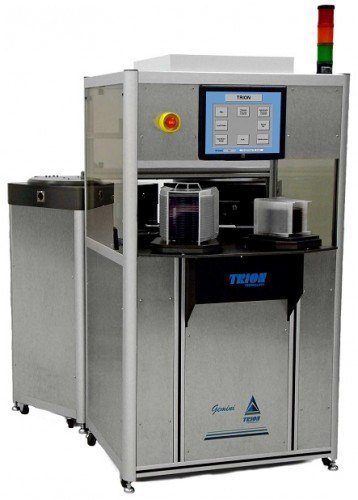
Gemini Multi-Chamber Photoresist Stripper The Gemini is a compact multi-chamber, high throughput photoresist stripping system that is designed specifically for the demands of today’s production fabs.This versatile and affordable system can be configured with a 200mm or 300mm chuck. As required by application, this system can incorporate a microwave source (which is both reliable and free from typical microwave tuning problems) or ICP technology. By employing ICP, microwave and RF bias power difficult to remove layers of resist can be removed at low temperatures. - Etch rates up to 6um/min - High throughput - Low plasma damage - Automatic tuning - 100mm to 300mm wafers - Small footprint - Competitively priced Inductively Coupled Plasma (ICP) Option: High Rate and Low Damage Photoresist Stripping is a critical necessity in modern semiconductor manufacture. As more and more masking steps and more sensitive devices have come into use, “plasma downstream ashing” has become the primary method of resist removal. The Trion Gemini Photoresist Stripper incorporates a downstream Inductively Coupled Plasma (ICP) to provide the high rate and uniform removal this application requires. The Trion Gemini system was specifically designed for production Photoresist Descum and Stripping. This extremely reliable system provides a compact and inexpensive solution to this application. Single-Chamber Option Applications: MEMS, Compound Semiconductor, Advanced Packaging.
CATEGORY
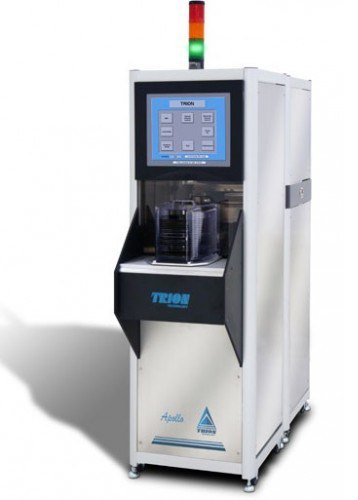
The cost of new photoresist stripping systems has escalated to unreasonable levels. Trion has solved this critical problem. The Apollo Stripper is a compact, inexpensive, and versatile system which can be configured for a 200mm or 300mm Chuck. By employing RF bias power, difficult to remove layers of resist can be removed at low temperatures. As required by application, this system can incorporate a microwave source (which is both reliable and free from typical microwave tuning problems) or ICP technology. - Etch rates up to 6um/min - High throughput - Low plasma damage - Automatic tuning - 100mm to 300mm wafers - Small footprint - Competitively priced Inductively Coupled Plasma (ICP) Option: High Rate and Low Damage Photoresist Stripping is a critical necessity in modern semiconductor manufacture. As more and more masking steps and more sensitive devices have come into use, "plasma downstream ashing" has become the primary method of resist removal. The Trion Apollo Photoresist Stripper incorporates a downstream Inductively Coupled Plasma (ICP) to provide the high rate and uniform removal this application requires. The Trion Apollo system was specifically designed for production Photoresist Descum and Stripping. This extremely reliable system provides a compact and inexpensive solution to this application. Applications: MEMS, Compound Semiconductor, Pilot Line Production.
CATEGORY
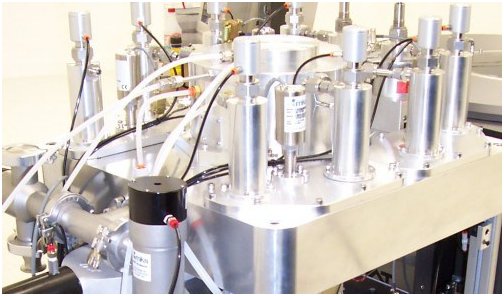
Atomic Layer Deposition (ALD) is a new cutting edge technology for the Semiconductor Industry. It provides super high-density films that are extremely uniform with exceptional step coverage. The Minilock ALD system has the capability to grow Atomic Layer Deposition films in Thermal and Plasma Enhanced modes (PEALD). It has the industry's smallest footprint and lowest cost of ownership.The system is available for wafers up to 300mm in diameter. ALD is a thin-film deposition technique based on the sequential use of a gas-phase chemical process and/or plasma processes (PEALD). The majority of ALD reactions use two chemicals called precursors and reactants. The precursor adsorbs onto the surface of the material and the reactant is added thereafter, one at a time in a sequential, self-limiting, manner. By keeping our core components the same, it is very easy to scale to a production cluster platform. Standard processes have been developed for various materials. This is backed by over 25 years' experience in rapid process development. Features: - Inductively Coupled Plasma Source (ICP, PEALD) - Biased electrode - Vacuum loadlock - 4 Precursor entry points - Turbo pump - Programmable Logic Controller (PLC) and touch screen control - SEMI S2 and CE compliant
CATEGORY
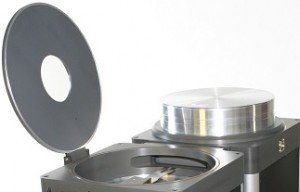
The Minilock-Orion is a Plasma Enhanced Chemical Vapor Deposition system with a vacuum loadlock that produces production-quality films on a compact platform. By adding a loadlock, dopants can be used on the PECVD films. The unique reactor design produces low stress films with excellent step coverage at extremely low power levels. The system meets all safety, facility and process requirements within the laboratory and pilot line production environments. The Minilock-Orion has many standard features not typically found on a system so reasonably priced, which is why many users worldwide have made it their PECVD system of choice. Applications: MEMS, Solid State Lighting, Failure Analysis, Research & Development, Pilot Line. Toxic/Pyrophoric PECVD Processes Films Deposited: - Oxides - Oxynitrides - Nitrides - Amorphous Silicon - Silicon Carbide Process Gases: - 100% Silane - Ammonia - TEOS - Diethylsilane - Nitrous Oxide - Oxygen, Nitrogen - Trimethylsilane - Methane
CATEGORY
