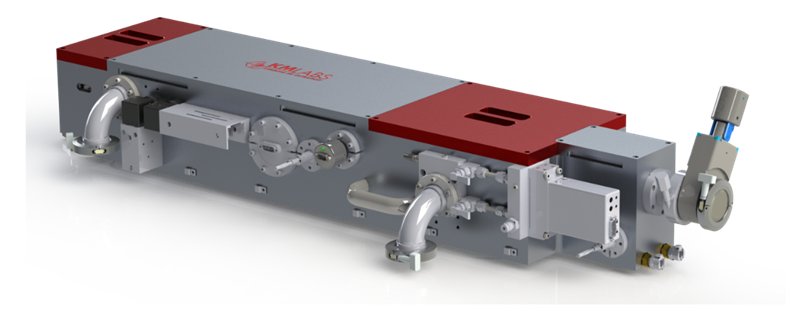
By KMLabs
Probe material and molecular properties with unprecedented flexibility on ultrafast time scales KMLabs Hyperion VUV, a 2019 Laser Focus World Platinum-level Innovators Award and an R&D 100 Awards Finalist, provides bright femtosecond pulses at numerous wavelengths across the vacuum ultraviolet (VUV) region, from 6.0 eV (205 nm) to 10.8 eV (115 nm). The discrete tunability of the KMLabs Hyperion VUV TM vacuum ultraviolet source enables researchers to study a wide range of materials and materials properties. A simple computer-selected change of photon energy provides a powerful capability, previously only available at a synchrotron; this ability to easily change the laser wavelength can enhance many experiments. For example, in angle-resolved photoemission (ARPES) experiments, this tunability allows researchers to distinguish surface effects from bulk effects. For time-of-flight (ToF) studies of molecules, the tunability can distinguish otherwise identical isomers. Hyperion VUV is also highly focusable, and the appropriate optics can be used to reach spot sizes below 10 microns. This ability will allow researchers to examine new types of samples, including materials that are polycrystalline, spatially inhomogeneous, faceted, or simply very small. Hyperion VUV produces pulses with durations below 250 femtoseconds, enabling scientists to probe ultrafast dynamics of molecules and materials. The 1 MHz repetition rate enables rapid data collection and avoids space-charge effects. Additionally, Hyperion VUV is "application ready," including the appropriate focusing and beam-steering elements to enable fast integration with experimental apparatus. Importantly, Hyperion VUV can be used with a window between the source and the experimental chamber, guaranteeing that applications demanding ultrahigh vacuum (such as ARPES) will remain contamination-free. In addition to ARPES, Hyperion VUV will enable breakthrough research in photoemission electron microscopy (PEEM), photoionization mass spectroscopy (PIMS) for combustion research, and other studies of next-generation materials and molecular systems. Hyperion VUV - Is discretely tunable - Provides high energy resolution - Enables femtosecond time-resolved experiments - Allows high spatial resolution - Provides synchrotron-quality VUV in your lab Applications: - Angle-resolved photoemission spectroscopy (ARPES) - Time-resolved ARPES - Photoemission electron microscopy (PEEM) - Photo-ionization mass spectroscopy (PIMS) - Molecular time-of-flight (ToF) studies - Applications that require tunable VUV light - Applications that require femtosecond pulses of VUV light Features that lead to significant benefits: - Tunable (computer-selected) photon energy between 6–10.8 eV enhances capabilities for laser ARPES experiments: - Achieve high momentum resolution using low energy photons (< 7 eV) and still cover higher momentum range using higher energy photons (> 10 eV) - Obtain surface vs. bulk information - Reveal "hidden bands" by changing wavelength - Bandwidth is adjustable to optimize data collection - Tight focal spot provides greater sample flexibility, allowing the study of - Extremely small samples - Spatially heterogeneous samples - Polycrystalline materials - A window provides complete isolation between Hyperion VUV and the experimental chamber, maintaining high vacuum - Femtosecond pulses enable time-resolved experiments - Hyperion VUV measures only 1500 L x 750 W x 340 H, bringing the power of the synchrotron to your lab
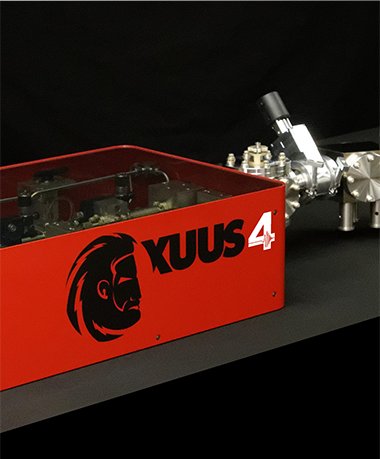
XUUS 5 upconverts ultrafast laser pulses into the Extreme UV(EUV or XUV) or soft X-ray regions of the spectrum. Employing HHG processes, the output beam inherits the coherent properties of a driving laser such as the KMLabsRAEAwith wavelengths that can be tuned from ~10 to 50 nm. Moreover, customized systems can generate coherent beams with wavelengths as short as 6 nm. The XUUS 5 employs KMLabs' patented hollow waveguide for the high harmonic up-conversion process. Salient Features: Photon Energy Range 20 - 1,600 eV Flux Up to 10 12 ph/s/h at source Pulse Duration Femto- to attoseconds
CATEGORY
The KMLabs Eclipse TM is a high repetition rate, half wave Pockels cell and driver unit, designed for laser pulse picking at up to 20kHz. The Eclipse has a minimum window of 10ns, and 90% throughput between 750-850nm. KMLabs' compact design allows the driver to be packaged in with the optical unit, thus minimizing the high voltage line-length, and thereby maximizing the switching speed. The high voltage source for the Eclipse is an external, 19"w x 13"d x 3.5"h unit. Salient Features: Minimum Switching Window 10 ns Switching Efficiency 90 % for 750 - 850 nm Driver/Cell Aperture Diameter 9 mm Monochromator Single harmonic selector
CATEGORY
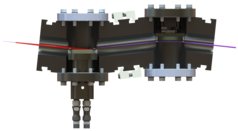
The Arterium beamline modules are designed with flexibility in mind. Various modules are available for for different functions such as removing the high power IR that is used for driving harmonics, steering, focusing, and filtering. Please contact us to discuss your specific beamline requirements. Salient Features: Rejector Module Removes 99.8% of IR Filter Wheel Module Up to 4 filters in series with a 28-filter capacity SwitchYard Module Three-way splitter for flexibility Focusing Module Spot sizes down to ~ 1 m m Monochromator Single harmonic selector EUV Diagnostics Spectral content and flux
CATEGORY