Many application fields of nanoimprint technology involve cutting-edge research elements while also requiring a seamless transition from development to pilot production to bring products to market quickly. For high-uncertainty R, customers want flexible equipment with a wide range of technical options, while also desiring highly refined equipment that allows development results to directly translate into product manufacturing. To address these concerns of customers engaged in technology development, we introduce the nanoimprint system RubiQ®, developed to cover everything from research and development to pilot production.
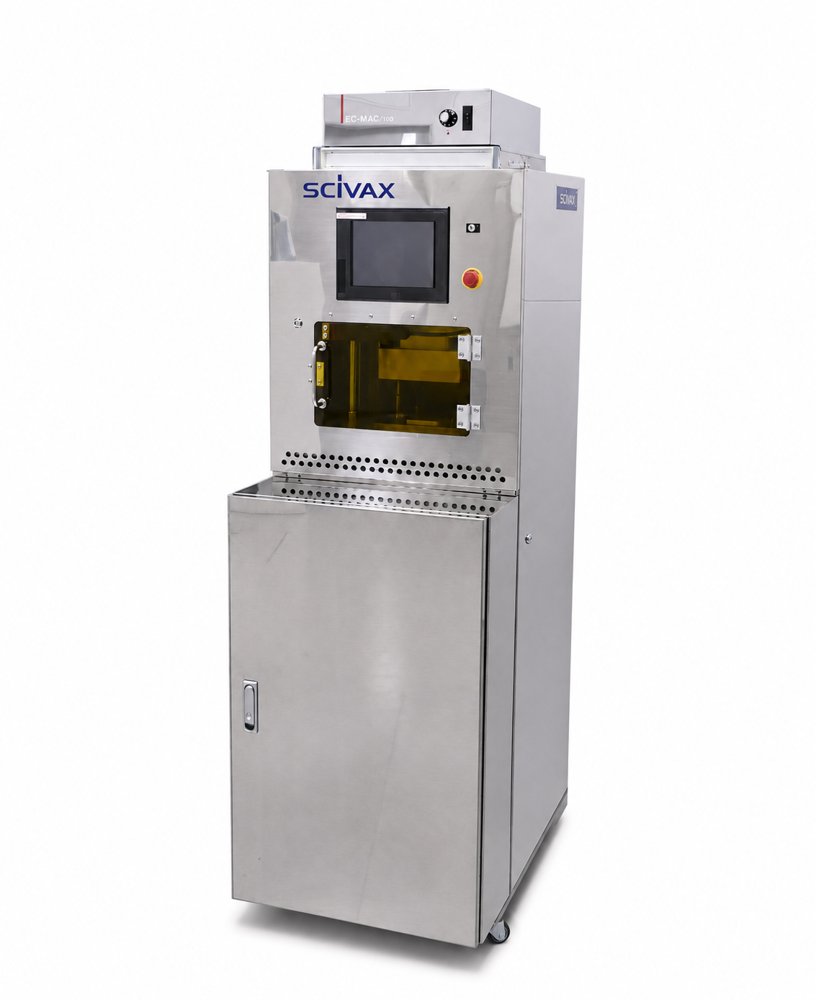
R&D NIL Equipment R&D Nanoimprint Equipment RubiQ® RD-100 / RD-200 SCIVAX proprietary development — Modular configuration supports a wide range of processes A next-generation concept system developed by SCIVAX to meet demand for nanoimprint equipment from corporate R&D departments, universities, and research institutes. Leveraging our strengths as an equipment manufacturer and process expertise cultivated through our track record of contract projects, the system supports various process requirements by combining curing and pressing methods at the module level. From research to pilot production, we can propose optimal configurations aligned with each customer’s development phase. Key Features Why RubiQ® Is Chosen Highly Scalable System Design RD-100 Freely combine curing methods (UV / thermal / UV+thermal assist) and pressing methods (parallel plate / FLAN air pressure). Options can also be added or changed on-site after installation (RD-100). 8-inch Wafer Support for Mass Production RD-200 Supporting 8-inch wafers for everything from pilot to mass production, the RD-200 comes standard with the FLAN air pressure system and high-output UV-LEDs. For production phases requiring high tact time, automatic processing functions can also be installed. Process Expertise from Contract Projects Condensed into Equipment Our track record of handling a wide variety of materials and patterns through our foundry business is reflected in our equipment design. Press Methods Two Pressing Methods Patented FLAN method (air pressure): - Flexible molds follow workpiece tilt and waviness - Potting molding supports resins that are difficult to spin-coat - Excellent pressure uniformity, advantageous for large-area imprinting - Selectable on both RD-100 / RD-200 models Standard Parallel plate method: - Robust design that readily accommodates unknown resin properties - Selectable only on RD-100 Specifications Key Specifications (RD-100 / RD-200) RubiQ® RD-100: - Curing method: UV / thermal / UV+thermal assist - Pressing method: Parallel plate / FLAN (air pressure, patented) - Max work size: Φ100mm - Max pressing force: 0.7MPa - Heating temperature: Up to 200℃ (supports thermoplastic and thermosetting resins) - UV Specifications: Wavelength 365nm / Irradiance 200mW/cm² - Vacuum bonding: Supported - Overall dimensions: W540 × D790 × H1,790 (mm) - Weight: 300kg RubiQ® RD-200: - Curing method: UV / UV+thermal assist - Pressing method: FLAN (air pressure, patented) - Max work size: Φ200mm - Max pressing force: 0.7MPa - Heating temperature: Up to 100℃ (for thermoplastic resins) - UV Specifications: Wavelength 365nm / Irradiance 400mW/cm² - Vacuum bonding: Supported - Overall dimensions: W700 × D980 × H2,100 (mm) - Weight: 700kg The RD-200’s automated processing, high-intensity UV-LED, and precision vacuum control are standard. The RD-100 supports on-site retrofits as options. Options & Retrofits Optional configurations (can be added after installation) - HEPA filter unit - Ionizer - High Irradiance 400mW/cm² - Automated processing - High-intensity UV-LED unit - Precision vacuum control - High-temperature imprint support All of the above options can be retrofitted on-site after installation.
CATEGORY
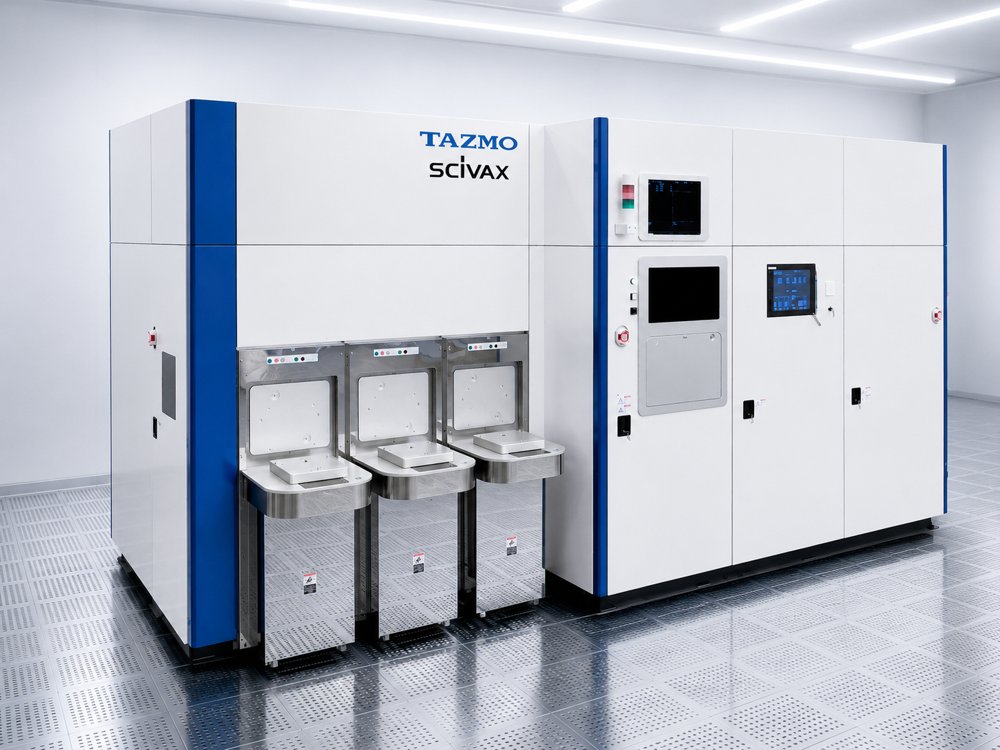
Fully Automated UV Nanoimprint System Developed by SCIVAX × Tazmo Co., Ltd. A production UV imprint system jointly designed and developed with Tazmo Co., Ltd., a semiconductor manufacturing equipment manufacturer, integrating SCIVAX’s diverse imprint mechanisms into a single platform. The Hard-to-Hard imprint method, which uses a rigid substrate as the replica stamp base material, enables high-precision, high-yield mass production. Key Features Challenges Solved by the Hard-to-Hard Method Improved Uniformity for AR Glass Waveguides Compared with flex-substrate replicas, imprint distortion across the wafer is significantly reduced. Improved uniformity and image quality have been demonstrated in waveguide molding for AR glasses. Overlay Alignment ≤±1μm Achieves ≤±1μm with an optional alignment mechanism at mass-production level. Supports device manufacturing that requires precise pattern alignment. Improved Release Performance for High-Aspect-Ratio Structures Mitigates replica damage that can occur during demolding of high-aspect-ratio structures such as pillar and hole shapes. Improves yield and productivity simultaneously. Technology Comparison Hard-to-Hard vs. Conventional (Flex Substrate) Dyad® Method: Hard-to-Hard Imprint Conventional Method: Flex-Substrate Replica - In-plane distortion is dramatically reduced - Distortion occurs due to the flex substrate - Improved uniformity and image quality for AR glasses applications - Yield loss due to image quality in AR glass applications - Reduced pillar breakage in high-aspect-ratio structures - High risk of structural damage during demolding - Mass-production-level overlay ≤±1μm - Difficult to maintain stable high-precision alignment Standard NIL Tool(PET Soft Mold) vs SCIVAX Dyad®(Glass Replica Mold) Distortion Comparison Dyad® Hard-to-Hard Imprinting Yield Comparison Measured data — Max distortion: Standard NIL tool 40pm/pitch → Dyad® 2pm/pitch (approx. 1/20) System Configuration System Modules - Spin coater ×2 - Bake & cool plate - Vacuum bonding - Alignment (optional) - Imprint molding - Automatic demolding - Transfer robot ×3 - Load port ×4 - Load port breakdown: 2 for imprint substrates / 1 for master molds / 1 for replica molds Specifications Key Specifications - Molding method: UV nanoimprint (UV-LED λ=365nm) - Wafer handling: FOUP to FOUP - Work size: Φ200mm (0.3mm ≤ t ≤ 1mm) - Mold size: Φ200mm (0.3mm ≤ t ≤ 1mm) / Φ300mm (0.7mm) - Pressing force: ≤ 0.90MPa - Vacuum level: ≤ 50Pa - Demolding mechanism: Vertical demolding - Alignment accuracy: ≤ ±1μm (optional) - Throughput: 20 wafers/hour (process-dependent) - Overall dimensions: W5,460 × D2,560 × H2,500 (mm) For the Dyad® 300 model compatible with Φ300mm wafers, please contact us separately.
CATEGORY
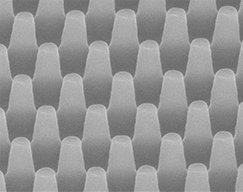
Stock Mold Sales We offer Si substrate molds manufactured using state-of-the-art semiconductor processes at competitive prices. Mold sizes range from □10 mm to φ300 mm. The molds listed are available while supplies last. Line & Space (L & S) Example listing rows (Commodity Code, Material, Width, Height, Pitch, Stamp, Eff. Area): - MTLS1/1/2-10x10, Si, 1000, 1000, 2000, □10, — - MTLS1/1/2-300, Si, 1000, 1000, 2000, φ300, □200 - MTLS1/2/2-100x100, Si, 1000, 2000, 2000, □100, □80 - MRLS50/130/100-30x30, Si, 50, 130, 100, □30, — - MRLS50/130/100-100x100, Si, 50, 130, 100, □100, □80 - MRLS50/130/100-300, Si, 50, 130, 100, φ300, φ280 - MRLS70/150/140-10x10, Si, 70, 150, 140, □10, — - MRLS70/150/140-52x48, Si, 70, 150, 140, 52x48, — - MRLS70/150/140-300, Si, 70, 150, 140, φ300, φ280 - NALS500/250/1000, Ni, 200, 250, 1000, □30, □20 - NALS520/1000/300, Ni, 520, 1000, 820, □30, □20 - NALS870/1500/300, Ni, 870, 1500, 1170, □30, □20 Hole - MLH230/200/460-10x10, Si, 230, 200, 460, Hex, □10, — - MLH230/200/460-15x15, Si, 230, 200, 460, Hex, □15, — - MLH230/200/460-20x20, Si, 230, 200, 460, Hex, □20, — - MLH230/200/460-30x30, Si, 230, 200, 460, Hex, □30, — - MLH230/200/460-50x50, Si, 230, 200, 460, Hex, □50, — - MLH230/200/460-4, Si, 230, 200, 460, Hex, φ105, φ85 - MLH230/200/460-300, Si, 230, 200, 460, Hex, φ300, φ280 - MTH-500/500/1000-10×10, Si, 500, 500, 1000, Hex, □10, — - MTH-500/500/1000-30×30, Si, 500, 500, 1000, Hex, □30, — - MTH-500/500/1000-50×50, Si, 500, 500, 1000, Hex, □50, — - MTH-500/500/1000-200, Si, 500, 500, 1000, Hex, φ300, □200 Pillar - MLP230/500/460-10x10, Si, 230, 500, 460, Hex, □10, — - MLP230/500/460-15x15, Si, 230, 500, 460, Hex, □15, — - MLP230/500/460-20x20, Si, 230, 500, 460, Hex, □20, — - MLP230/500/460-25x25, Si, 230, 500, 460, Hex, □25, — - MLP230/500/460-30x30, Si, 230, 500, 460, Hex, □30, — - MLP230/500/460-35x35, Si, 230, 500, 460, Hex, □35, — - MLP230/500/460-40x40, Si, 230, 500, 460, Hex, □40, — - MLP230/500/460-60x60, Si, 230, 500, 460, Hex, □60, — - MLP230/500/460-120, Si, 230, 500, 460, Hex, φ120, φ100 - MLP230/500/460-200x200, Si, 230, 500, 460, Hex, □200, □180 - MLP230/200/460-10x10, Si, 230, 200, 460, Hex, □10, — - MLP230/200/460-15x15, Si, 230, 200, 460, Hex, □15, — - MLP230/200/460-20×20, Si, 230, 200, 460, Hex, □20, — - MLP230/200/460-25x25, Si, 230, 200, 460, Hex, □25, — - MLP230/200/460-30×30, Si, 230, 200, 460, Hex, □30, — - MLP230/200/460-50x50, Si, 230, 200, 460, Hex, □50, — - MLP230/200/460-120, Si, 230, 200, 460, Hex, φ120, φ100 - MLP230/200/460-300, Si, 230, 200, 460, Hex, φ300, φ280 - MRP2200/2000/3000-200, Si, 2400, 2000, 3000, Hex, φ200, φ180 - NAP230/240-100, Ni, 230, 240, 460, Hex, □100, □80
CATEGORY

Optical Module Platform for Sensing and Interaction An ultra-compact, high-performance optical module family developed by SCIVAX. Integrates light sources and sensors in a compact design of 1 mm³ or less, supporting a wide range of applications from sensing to robust human-environment interaction. A scalable platform from individual modules to system deployment. Platform Features Platform Technical Features Ultra-Compact, High Integration Integrates light source and sensor in a compact design of 1 mm³ or less. Significantly enhances device design flexibility, enabling integration into space-constrained applications such as wearables and medical devices. Mounting Area: Approx. 1 mm² High-Precision Sensing Acquires biological and force information with high precision. Employs multi-array structure enabling adaptation to complex curved surfaces and narrow spaces, improving measurement accuracy and stability. Multi-Array Structure Support Scalability Expandable from individual modules to multi-point deployment and system integration. Supports customization according to application requirements and can be utilized as a consistent platform from research and development to mass production. Individual → Multi-Point Deployment → System Integration
CATEGORY
