By Structured Materials Industries, Inc.
SMI offers a user friendly real time SmartCVD Interactive Process Control Industrial system for MOCVD. The systems utilizes spreadsheet format run programing that includes ramp and looping functions. Recipes are easily editable for efficient programing. Other features include a real-time mimic screen of all process components as the primary system operator interface for fully automated sequential layer by layer operation, maintenance routines, manual servicing operation, operator re-configurable parameters, process trend monitors, and safely/alarm capabilities. The system uses an industrial computer and PLC Controller for maximum reliability. Importantly, this control system interfaces with all common in-situ process monitors (optical, RGA, and so on), offers remote access and is provided with training software. General System Features - Low cost - Based on commercial software products - Graphical user interface in Microsoft Windows environment - Real time interactive mimic panels of the process system - Spread sheet interface for process configuration - Advanced alarm monitoring and management - Password protection for operator interface - Real time data logging and display - Network support for distributed control system - Automated process documentation generation - Flexible hardware interface (PLCs, commercial instruments, etc.) - In-Situ Process Monitoring and Interactive Control - On-line (Remote) operation, diagnostics and upgrades - Maintenance Procedures - Resource Consumption routine Interactive Mimic Panel - Real time display of digital states (mouse/click toggling). - Toggle digital states by a mouse click (switch a value). - Real time display of analog readings on screen. - Change analog set points from screen (increase a flow, decrease a temperature..) - Easy access on screen buttons to change windows, to start process recipe, or to view system status. - Grouped operations from the recipe panel. - Several window levels of detail are possible. Recipe Spread Sheet of growth process - User friendly spread sheet for process configuration. - Customized pull down menus. - Quick switch between process display and spread sheet by a menu command. - Special growth layer editing commands. Analog and Digital Display Service Window/ Range and Set Points - Digital or analog display of all forms of readings: flow, pressure, temperature, rotation, level, power, etc. - Set (Reset) analog values from the window. - East access screen buttons for all functions. - Deviation warning alarm monitoring and display - Several optional display methods(digital, barograph, meter, etc..). Control Group Service Window - Easy user programming of analog and digital associations - Digital group state configuration and naming Trending Analysis Window - Monitor one or several key process parameters in time. - Strip chart recording format.
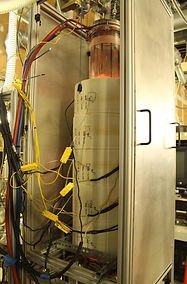
ZnMgO nanowires have many attractive features for light sensing and emitting (cathodoluminescence, electroluminescence, and photoluminescence), as well as for providing a rich flat white surface. Our new Vapor Liquid Solid - Chemical Vapor Deposition (VLS-CVD) hybrid tool features 3 main zones - growth zone, gas injection zone, and source sublimation zone, as well as trim heating regions. Our VLS-CVD 100 System, as shown below, is unique in that it has been designed with thermal and flow modeling to present a large area 100mm growth surface at a uniform growth temperature to a uniform flux of sublimed or vapor/gas precursors. The result is repeatable growth of large areas of nanowires - using VLS or a hybrid mode of VLS and CVD to grow doped and undoped nanowire alloys. Hot zone of the patent pending prototype vertical tube furnace of the hybrid Vapor-Liquid-Solid interface - CVD nanowire growth tool in the applications laboratory at SMI. Specifications: Hot Zone: 5 or 6, clamshell optional Temperature: Through 1000°C Source 1 Temperature: Through 1000°C Source 2 Temperature: Through 1000°C Gases: Primary Ar, O2 (NOx, O3, H2O options) dopants and others optional Substrate Sizes: 5” platter standard easily scalable to 8” wafers. Substrate and material loading: Linear slide loading.
CATEGORY
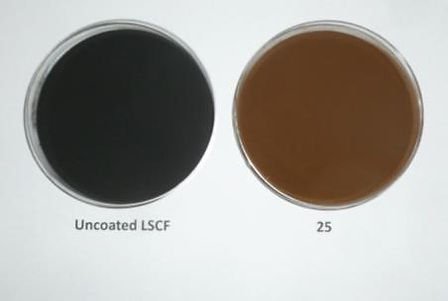
Recent works have shown the benefits of using surface functionalized powders for fabrication of solid oxide fuel cell (SOFC) cathodes. With this approach, the best characteristics of two different materials can be fully optimized and exploited. The present state of the art for surface functionalization uses an aqueous process to infiltrate the cathode after sintering. Multiple liquid infiltration and annealing cycles are required, which are both time consuming and expensive to implement in commercial production. SMI has developed an alternative dry approach for production of surface functionalized cathode powders prior to sintering. The resulting surface functionalized powders represent a "drop-in" replacement for presently available cathode powders, and can be seamlessly integrated into industrial SOFC manufacturing. Structured Materials Industries, Inc. (SMI) has demonstrated technical feasibility of this approach and now offers R&D scale quantities (up to 1 kg) of surface functionalized powders (Product name SFSOFC19). The SMI surface functionalization process produces uniform coatings on powders. In addition to our own SFSOFC19 product; a wide range of coating compositions can be produced. A wide range of base powder materials and particle sizes can be processed as can a wide range of materials for functionalization coatings. SFSOFC19 uses 0.7 μm average particle size, La0.6Sr0.4Co0.2Fe0.8O3-δ (LSCF) for the base material powder. In all tests, the surface functionalized powders outperform the uncoated LSFC powder, as indicated by lower polarization resistance. The figures indicate there is an optimum surface loading. The surface functionalized SFSOFC19 powder outperforms the uncoated LSFC powder, as indicated by lower polarization resistance and lower degradation rate.
CATEGORY
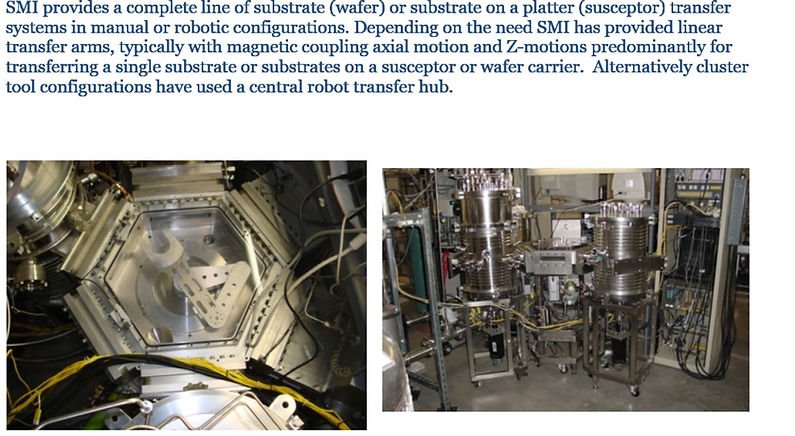
SMI provides a complete line of substrate (wafer) or substrate on a platter (susceptor) transfer systems in manual or robotic configurations. Depending on the need SMI has provided linear transfer arms, typically with magnetic coupling axial motion and Z-motions predominantly for transferring a single substrate or substrates on a susceptor or wafer carrier. Alternatively cluster tool configurations have used a central robot transfer hub. Structured Materials Industries, Inc. (SMI) offers automatic robotic and manual trandsfer load lock systems for substrate and or wafer carrier loading and unloading into our reactors or for custom homebuilt systems. The video shows two cycles of a load rotate and unload process; simulating an actual run cycle. Shown is 5" wafer arrier configured for three 2" wafers. Many other size transfer systems are also available.
CATEGORY
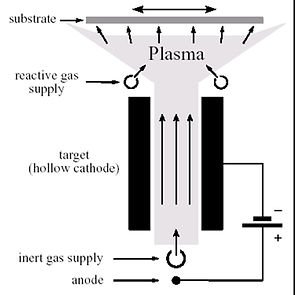
Gas Flow Hollow Cathode (GFHC0) Sputter Deposition has been shown to be ideal methodology for depositing a wide range of materials that benefit from high deposition rates, low deposition energy, use of reactive gases and low substrate temperature. The low deposition energy and substrate temperature reduce coating defects as compared to conventional sputtering and allow deposition on plastics. Reactive gases can be injected downstream of the sputtering and inert gas is followed through the sputter source cathode protects the cathode from the reactive gases sputter some and allows reactive deposition of metal compounds; like oxides, nitrides, selenides, and tellurides, with deposition rates competitive with the deposition rates of bare metals. The GFHC is also applicable to pure metal depositions.
CATEGORY
