By Attolight
Mönch-Compatible Sample Holders When it comes to the Mönch, not all sample holders are created equal. This page lists the range of sample holders that are currently available and compatible with the Mönch. Understanding Holder Compatibility Why Do You Need a Special Holder? In order to achieve its outstanding optical performance, including excellent light collection efficiency and small ultimate spot size for injection, the Mönch uses a high-numerical-aperture mirror that must fit into the tiny space between the sample holder and the pole piece, as shown in the diagram to the right. The spacing is extremely tight, and the working distance of the mirror with respect to the sample is a fraction of a millimeter. This limits the kind of sample holder that can be used; only sample holders that are sufficiently flat and thin on their top surface may be used. Despite these constraints, several holders have been developed and validated for use with the Mönch. This page lists the holders that are currently available. List of Existing Holders Mönch-Compatible Holders Mel-Build Liquid Nitrogen Cryo CL Holder The liquid-nitrogen cryo holder from Mel-Build can be used for experiments down to 77 K, enabling enhanced luminescence from many materials compared to room temperature experiments. Insight Chips 4-Inlet Liquid Cell CL Holder The 4-inlet flow holder from Insight Chips opens a world of possibilities for in-situ STEM-CL and related experiments, such as photocatalysis. CondenZero Liquid Helium Cryo CL Holder For the most advanced cryo CL experiments, the liquid helium holder from CondenZero offers sustained and stable 5 K operation. Thermo Fisher Caliper CL Holder Thermo Fisher’s Caliper CL holder offers simple, reliable operation for room temperature experiments on Thermo Fisher microscopes. What's Next? Future Developments Most major TEM sample holder companies have expressed an interest in developing Mönch-compatible holders to meet the wide and growing needs of our CL and light injection customers. If you have a particular application in mind, or a history of working with a particular holder company, feel free to contact us to see what might be possible! There are already several developments underway, so keep an eye out here for new additions to the growing collection of Mönch-compatible holders.
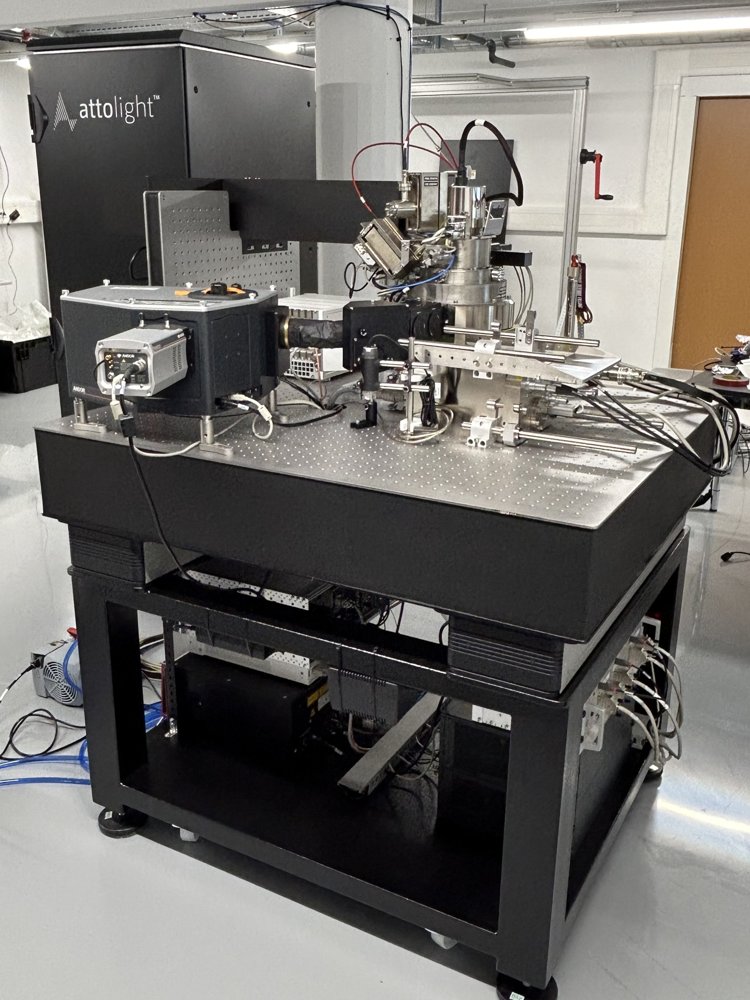
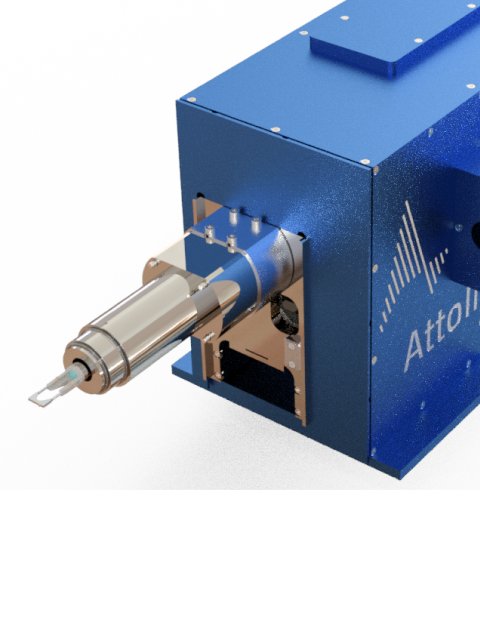
A streak camera for cathodoluminescence (CL) analysis is a high-performance detector designed to capture ultra-fast changes in light emission over time. It is particularly suited for studying transient processes and carrier dynamics in materials, as it provides detailed insights into recombination rates, lifetimes, and other time-resolved properties of the material under investigation. With rise times measured below 20 picoseconds, it offers the best full-system resolution available, making it ideal for applications requiring precise temporal analysis. Key applications include: - Material Characterization: The streak camera enables in-depth analysis of carrier recombination and defect emissions in semiconductors, helping optimize materials for applications in LEDs and solar cells. - Nanophotonics: It supports the study of light-matter interactions at the nanoscale, which is essential for designing devices with enhanced light confinement and emission efficiency. - Photonic Device Development: By assessing optical gain, decay times, and light propagation, the streak camera aids in the advancement of photonic devices, including lasers and waveguides.
CATEGORY
The unique design of the Allalin column enables direct light injection, making it ideal for performing high-resolution Raman spectroscopy on the sample. The Allalin column’s design enables in-situ Raman spectroscopy by analyzing the spectroscopic properties of the reflected beam using specialized filters and gratings. This approach provides insights that complement cathodoluminescence spectroscopy, allowing correlative measurements on the same sample without the need for repositioning. This setup unlocks the full range of Raman applications, including: - Strain Measurement in crystalline materials - Trace Element Detection for geological analysis - Compositional Mapping in polymers and polymer alloys - Phase Identification in crystalline materials In-SEM Raman spectroscopy is currently implemented using a 532 nm laser, though other wavelengths are available upon request. Mapping is made possible by using a specially developed stage-scanning algorithm that takes advantage of the nm-precise piezo technology featured in the Allalin stage. Precise laser power and polarization control is also featured, together with functions to automate power and polarization series.
CATEGORY
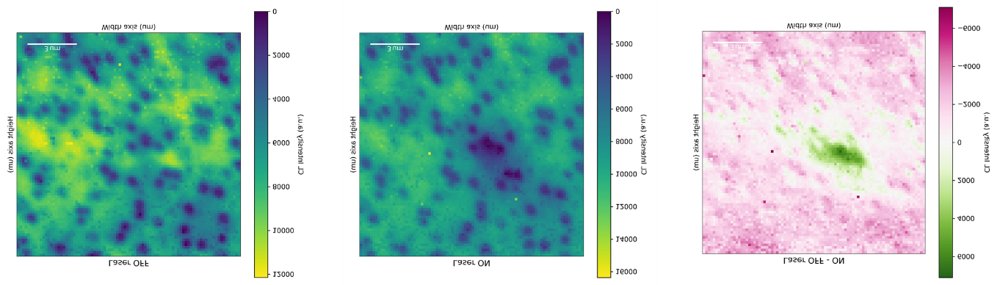
This option harnesses the Attolight Allalin column’s unique design to directly inject a laser, creating a tightly-focused spot on the sample, provoking photoluminescence. Comparing photoluminescence with cathodoluminescence is of significant interest because photons and electrons have fundamentally different properties in terms of their interactions with matter. Performing both techniques together in-situ allows for direct comparison of the two types of luminescence without needing to account for differences in the spectroscopy setup. Attolight’s implementation of in-column photoluminescence features both CW and pulsed lasers, with a range of regular and time-resolved detectors to match. Mapping is made possible by using a specially-developed stage-scanning algorithm that takes advantage of the nm-precise piezo technology featured in the Allalin stage. Precise laser power and polarization control is also featured, together with functions automate power and polarization series.
CATEGORY