
Cheap, flexible, wireless graphene communication devices such as mobile phones and healthcare monitors can be directly printed into clothing and even skin, University of Manchester academics have demonstrated.
In a breakthrough paper in Scientific Reports, the researchers show how graphene could be crucial to wearable electronic applications because it is highly-conductive and ultra-flexible.
The research could pave the way for smart, battery-free healthcare and fitness monitoring, phones, internet-ready devices and chargers to be incorporated into clothing and ‘smart skin’ applications – printed graphene sensors integrated with other 2D materials stuck onto a patient’s skin to monitor temperature, strain and moisture levels.
Examples of communication devices include:
• In a hospital, a patient wears a printed graphene RFID tag on his or her arm. The tag, integrated with other 2D materials, can sense the patient’s body temperature and heartbeat and sends them back to the reader. The medical staff can monitor the patient’s conditions wirelessly, greatly simplifying the patient’s care.
• In a care home, battery-free printed graphene sensors can be printed on elderly peoples' clothes. These sensors could detect and collect elderly people’s health conditions and send them back to the monitoring access points when they are interrogated, enabling remote healthcare and improving quality of life.
Existing materials used in wearable devices are either too expensive, such as silver nanoparticles, or not adequately conductive to have an effect, such as conductive polymers.
Graphene, the world’s thinnest, strongest and most conductive material, is perfect for the wearables market because of its broad range of superlative qualities. Graphene conductive ink can be cheaply mass produced and printed onto various materials, including clothing and paper.
The researchers, led by Dr Zhirun Hu, printed graphene to construct transmission lines and antennas and experimented with these in communication devices, such as mobile and Wifi connectivity.
Using a mannequin, they attached graphene-enabled antennas on each arm. The devices were able to ‘talk’ to each other, effectively creating an on-body communications system.
The results proved that graphene enabled components have the required quality and functionality for wireless wearable devices.
Dr Hu, from the School of Electrical and Electronic Engineering, said: “This is a significant step forward – we can expect to see a truly all graphene enabled wireless wearable communications system in the near future.
“The potential applications for this research are huge – whether it be for health monitoring, mobile communications or applications attached to skin for monitoring or messaging.
“This work demonstrates that this revolutionary scientific material is bringing a real change into our daily lives.”
Co-author Sir Kostya Novoselov, who with his colleague Sir Andre Geim first isolated graphene at the University in 2004, added: “Research into graphene has thrown up significant potential applications, but to see evidence that cheap, scalable wearable communication devices are on the horizon is excellent news for graphene commercial applications.”
University of Manchester
#Graphene #FlexibleElectronics #2DMaterials
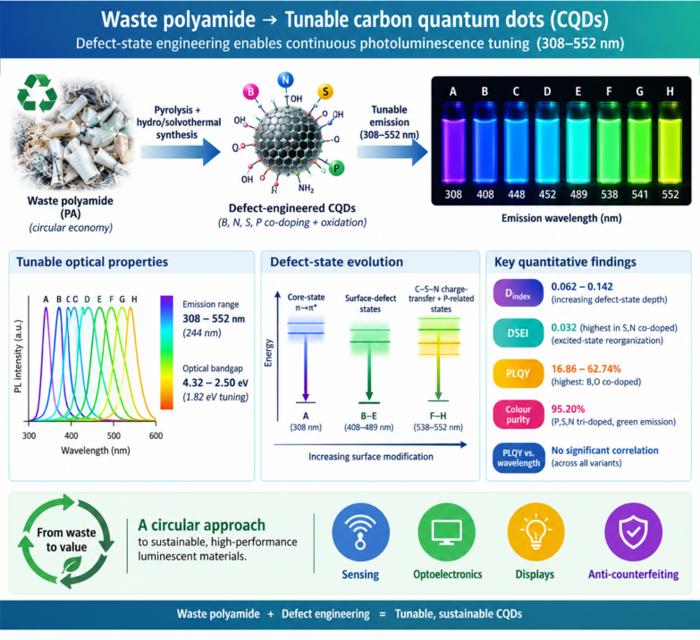
Waste polyamide-derived CQDs show continuous photoluminescence tuning from 308 to 552 nm through sequential defect-state engineering, with optical transition energies decreasing from 4.32 to 2.50 eV. @Christian Ebere Enyoh from Saitama University Carbon quantum dots (CQDs) are fluorescent carbon nanomaterials with potential applications in sensing, optoelectronics, displays, anti-counterfeiting, and environmental technologies. Their optical properties can be adjusted by modifying the carbon...

The researchers used circularly polarized light at normal incidence and found that helicity-dependent photocurrents appeared perpendicular to the crystal’s polarization but vanished when measured parallel to it, supporting a bulk origin of CPGE. @Institute of Science Tokyo The circular photogalvanic effect (CPGE), a phenomenon that generates helicity-dependent photocurrents in noncentrosymmetric materials, can originate purely from a crystal's internal structure without contribution from the...
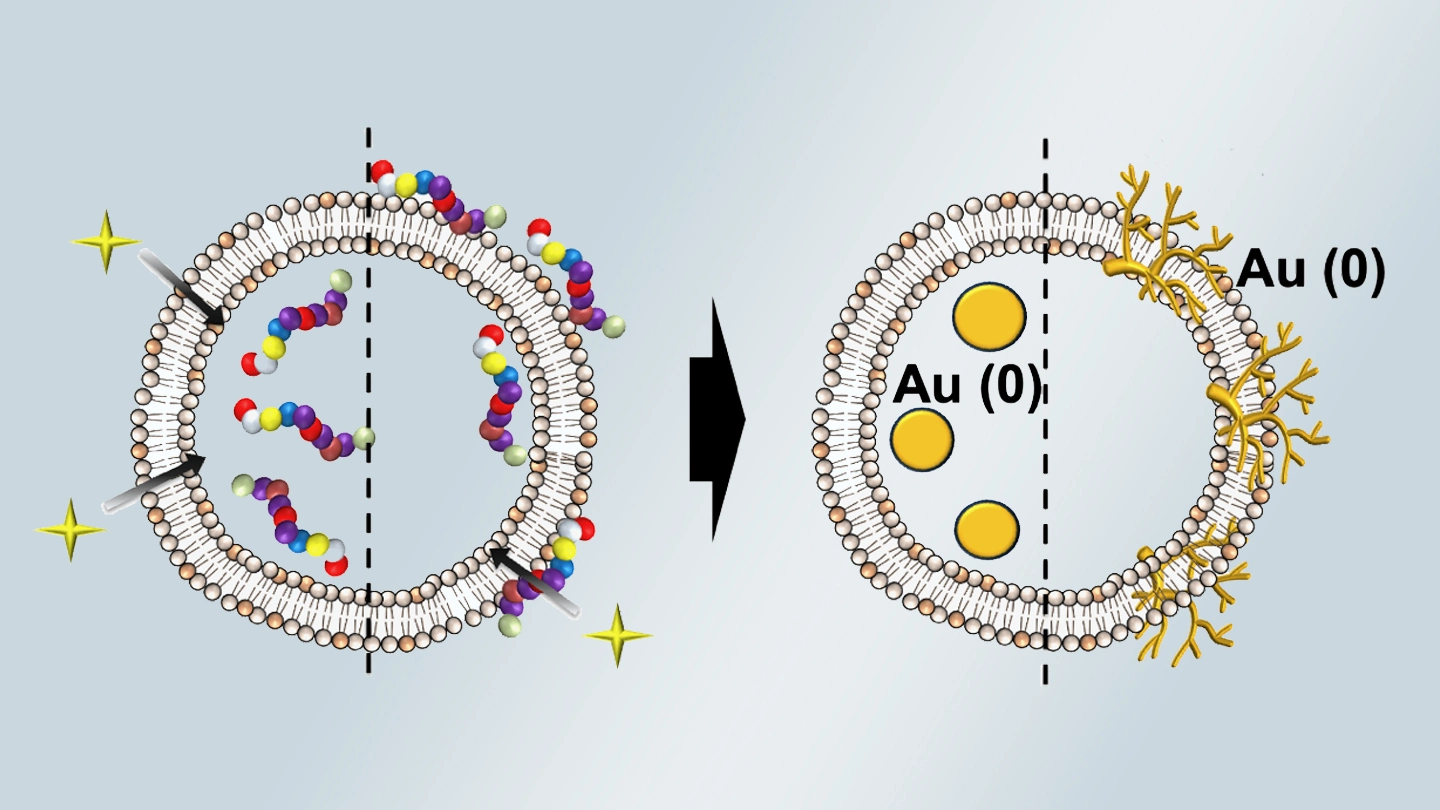
Summary of gold nanoparticle growth programming in liposome based on localization of biomineralization peptide The position of biomineralization peptides within liposomes can influence how gold nanoparticles grow, reports a research team from Institute of Science Tokyo. Peptides localized at the membrane interface promote branched structures, while those confined to the liposome interior favor spherical nanoparticles. The findings offer a new strategy for controlling nanoscale reaction...
