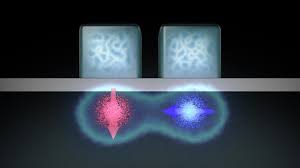
The power of future quantum computers stems from the use of qubits, or quantum bits, which do not have to be either 0 or 1, but can also be 0 and 1 at the same time. It is not yet clear on which technology these qubits in quantum computers will be based, but qubits based on electron spins are looking more and more promising. It was thought that these could only be produced in the expensive semiconductor material gallium arsenide, but researchers have now discovered that the more common material silicon, the basic material of modern computer chips, is even better. Researchers from Delft, the University of Wisconsin and Ames Laboratory, led by Prof. Lieven Vandersypen of TU Delft's QuTech discovered that the stability of qubits could be maintained 100 times more effectively in silicon than in gallium arsenide. They publishing their research in PNAS this week.
Fragile
Because qubits can be both 1 and 0 simultaneously, a quantum computer will be able to tackle computing problems that are out of reach of the current supercomputers. The main issue for researchers is that this superposition is very fragile. 'Two numbers are very important for qubits,' explains research leader Lieven Vandersypen. 'The length of time the superposition can be maintained before it spontaneously reverts to 1 or 0 is critical for an effectively functioning quantum computer. In gallium arsenide, this is about 10 nanoseconds, but in silicon we have achieved a factor of 100 longer. Using smart technologies we were able to stretch this to 0.4 milliseconds. Although a coherence time of 0.4 milliseconds may not sound very long, for a computer it is nearly an eternity. Moreover, the gate fidelity in silicon is 10-100 times better. The gate fidelity is the measure of whether an operation you perform on a qubit will actually work.'
Silicon
The researchers used 'standard' silicon, an extremely cheap material of which there is an almost infinite supply: it is the main ingredient of sand. Earlier research by the University of New South Wales in Australia demonstrated that isotopically purified silicon-28 can produce even better results. "Silicon naturally contains three isotopes, including the common form Si-28, and the less common form with atomic number 29. The latter form has been proven to degrade the coherence and gate fidelity considerably. Researchers believe that replacing gallium arsenide with silicon will be extremely important for the design of the quantum computer. The required technology for fabricating nanostructures in silicon has already reached an advanced stage in chip technology, and now, as the researchers hoped, silicon also proves to be a better qubit material.
Scaling up
Researchers of TU Delft are collaborating intensively with other researchers, among others from Intel Corporation, who joined a partnership with QuTech last year. The greatest challenge for quantum technologists now is to scale up the various qubits for use in circuits of multiple interplaying qubits. 'At least hundreds of qubits - and preferably many more - will need to work together to make a working quantum computer,' says Vandersypen.
Gate fidelity and coherence of an electron spin in an Si/SiGe quantum dot with micromagnet
Erika Kawakami, doi: 10.1073/pnas.1603251113
TU Delft
#QuantumInformation #QuantumComputing