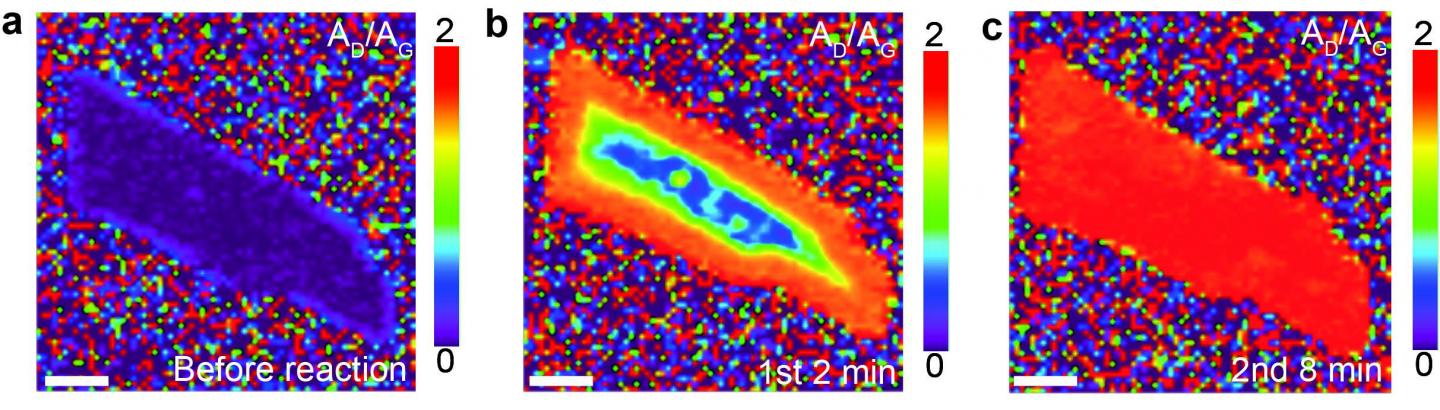
Adding hydrogen to graphene could improve its future applicability in the semiconductor industry, when silicon leaves off. Researchers at the Center for Multidimensional Carbon Materials (CMCM), within the Institute for Basic Science (IBS) have recently gained further insight into this chemical reaction. Published in Journal of the American Chemical Society, these findings extend the knowledge of the fundamental chemistry of graphene and bring scientists perhaps closer to realizing new graphene-based materials.
Understanding how graphene can chemically react with a variety of chemicals will increase its utility. Indeed, graphene has superior conductivity properties, but it cannot be directly used as an alternative to silicon in semiconductor electronics because it does not have a bandgap, that is, its electrons can move without climbing any energy barrier. Hydrogenation of graphene opens a bandgap in graphene, so that it might serve as a semiconductor component in new devices.
While other reports describe the hydrogenation of bulk materials, this study focuses on hydrogenation of single and few-layers thick graphene. IBS scientists used a reaction based on lithium dissolved in ammonia, called the "Birch-type reaction", to introduce hydrogen onto graphene through the formation of C-H bonds.
The research team discovered that hydrogenation proceeds rapidly over the entire surface of single-layer graphene, while it proceeds slowly and from the edges in few-layer graphene. They also showed that defects or edges are actually necessary for the reaction to occur under the conditions used, because pristine graphene with the edges covered in gold does not undergo hydrogenation.
Using bilayer and trilayer graphene, IBS scientists also discovered that the reagents can pass between the layers, and hydrogenate each layer equally well. Finally, the scientists found that the hydrogenation significantly changed the optical and electric properties of the graphene.
"A primary goal of our Center is to undertake fundamental studies about reactions involving carbon materials. By building a deep understanding of the chemistry of single-layer graphene and a few layer graphene, I am confident that many new applications of chemically functionalized graphenes could be possible, in electronics, photonics, optoelectronics, sensors, composites, and other areas," notes Rodney Ruoff, corresponding author of this paper, CMCM director, and UNIST Distinguished Professor at the Ulsan National Institute of Science and Technology (UNIST).
Joanna Aizenberg, Harvard Birch-Type Hydrogenation of Few-Layer Graphenes: Products and Mechanistic Implications
DOI: 10.1021/jacs.6b08625
Publication Date (Web): November 2, 2016
Institute for Basic Science (IBS)
#Graphene #Hydrogen
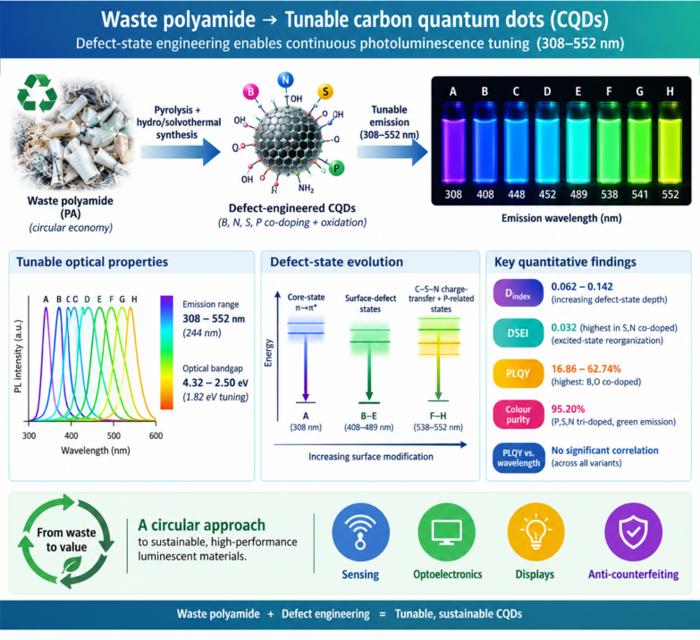
Waste polyamide-derived CQDs show continuous photoluminescence tuning from 308 to 552 nm through sequential defect-state engineering, with optical transition energies decreasing from 4.32 to 2.50 eV. @Christian Ebere Enyoh from Saitama University Carbon quantum dots (CQDs) are fluorescent carbon nanomaterials with potential applications in sensing, optoelectronics, displays, anti-counterfeiting, and environmental technologies. Their optical properties can be adjusted by modifying the carbon...
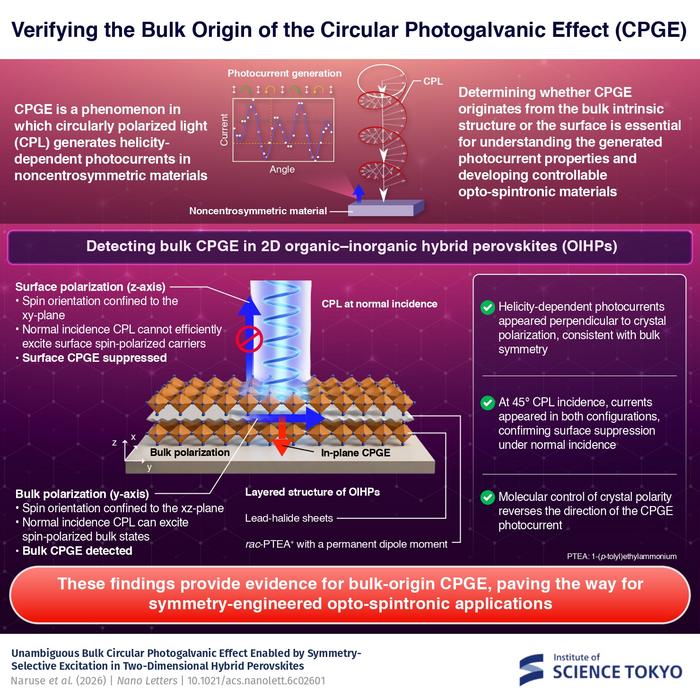
The researchers used circularly polarized light at normal incidence and found that helicity-dependent photocurrents appeared perpendicular to the crystal’s polarization but vanished when measured parallel to it, supporting a bulk origin of CPGE. @Institute of Science Tokyo The circular photogalvanic effect (CPGE), a phenomenon that generates helicity-dependent photocurrents in noncentrosymmetric materials, can originate purely from a crystal's internal structure without contribution from the...
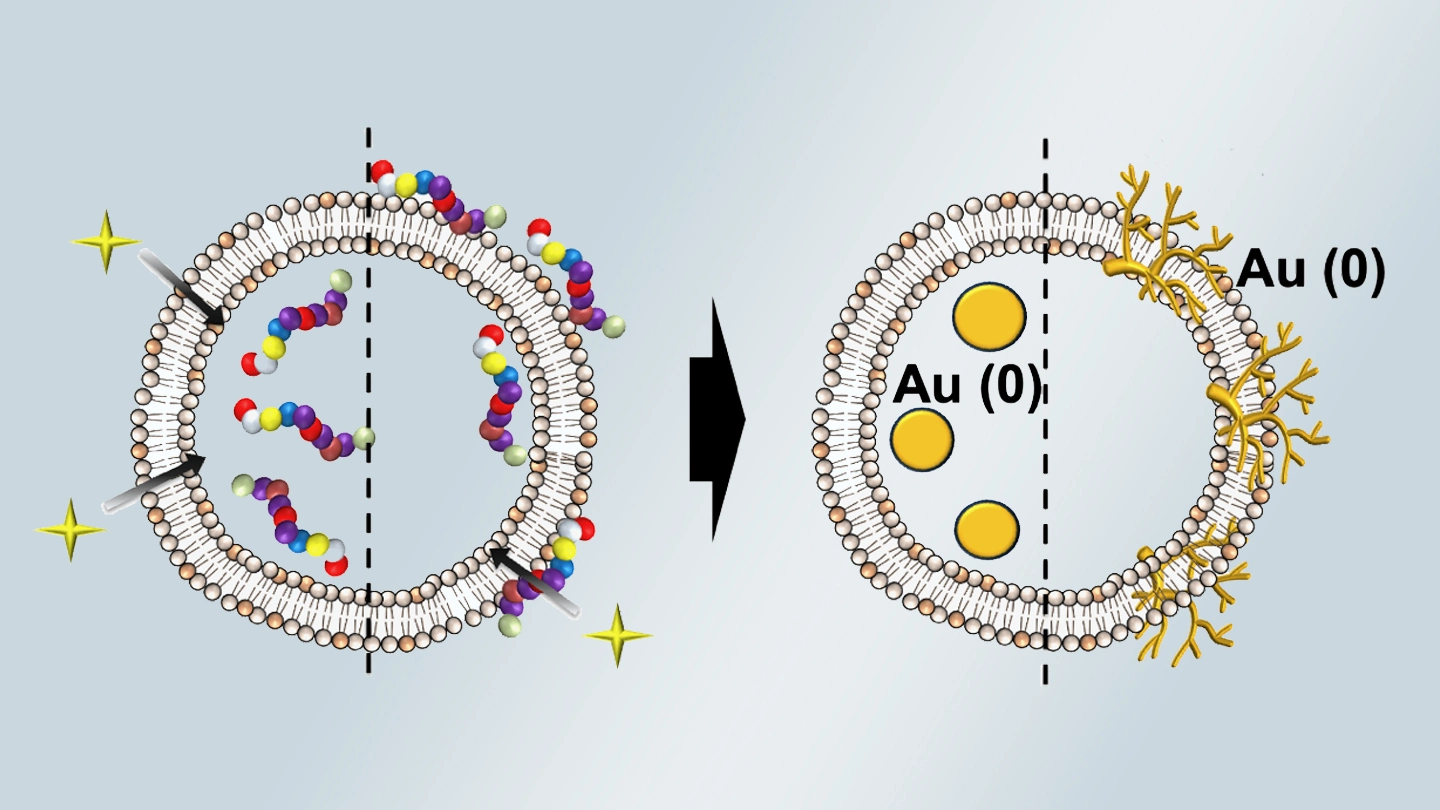
Summary of gold nanoparticle growth programming in liposome based on localization of biomineralization peptide The position of biomineralization peptides within liposomes can influence how gold nanoparticles grow, reports a research team from Institute of Science Tokyo. Peptides localized at the membrane interface promote branched structures, while those confined to the liposome interior favor spherical nanoparticles. The findings offer a new strategy for controlling nanoscale reaction...
