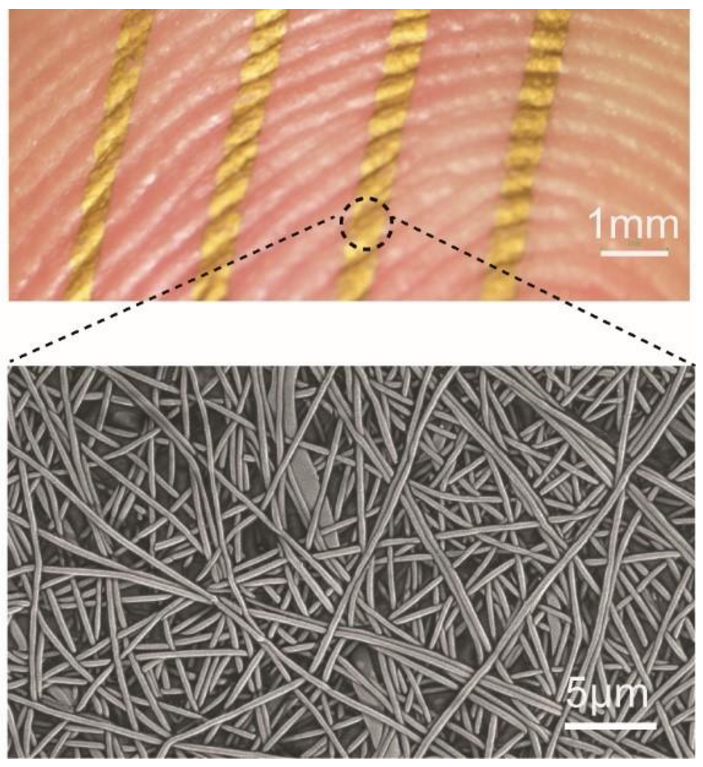
A hypoallergenic electronic sensor can be worn on the skin continuously for a week without discomfort, and is so light and thin that users forget they even have it on, says a Japanese group of scientists. The elastic electrode constructed of breathable nanoscale meshes holds promise for the development of noninvasive e-skin devices that can monitor a person's health continuously over a long period.
Wearable electronics that monitor heart rate and other vital health signals have made headway in recent years, with next-generation gadgets employing lightweight, highly elastic materials attached directly onto the skin for more sensitive, precise measurements. However, although the ultrathin films and rubber sheets used in these devices adhere and conform well to the skin, their lack of breathability is deemed unsafe for long-term use: dermatological tests show the fine, stretchable materials prevent sweating and block airflow around the skin, causing irritation and inflammation, which ultimately could lead to lasting physiological and psychological effects.
"We learned that devices that can be worn for a week or longer for continuous monitoring were needed for practical use in medical and sports applications," says Professor Takao Someya at the University of Tokyo's Graduate School of Engineering whose research group had previously developed an on-skin patch that measured oxygen in blood.
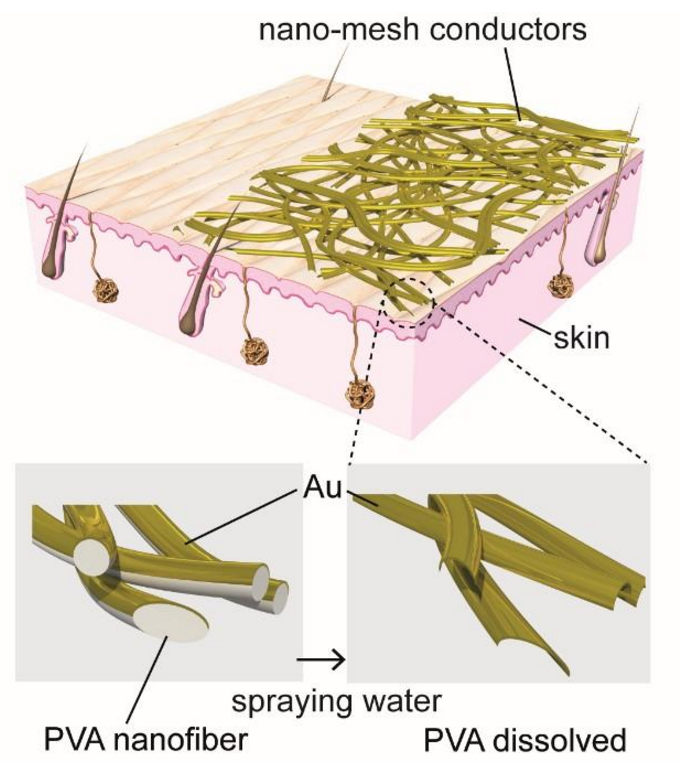
In the current research, the group developed an electrode constructed from nanoscale meshes containing a water-soluble polymer, polyvinyl alcohol (PVA), and a gold layer--materials considered safe and biologically compatible with the body. The device can be applied by spraying a tiny amount of water, which dissolves the PVA nanofibers and allows it to stick easily to the skin--it conformed seamlessly to curvilinear surfaces of human skin, such as sweat pores and the ridges of an index finger's fingerprint pattern.
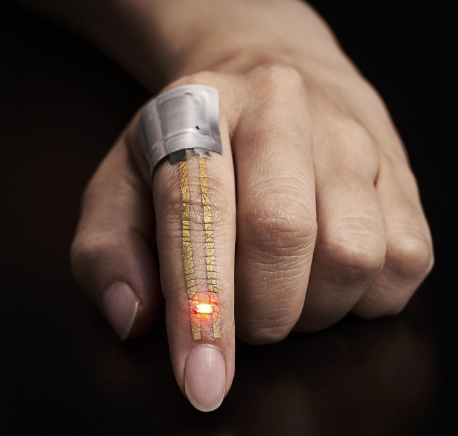
The researchers next conducted a skin patch test on 20 subjects and detected no inflammation on the participants' skin after they had worn the device for a week. The group also evaluated the permeability, with water vapor, of the nanomesh conductor--along with those of other substrates like ultrathin plastic foil and a thin rubber sheet--and found that its porous mesh structure exhibited superior gas permeability compared to that of the other materials.
Furthermore, the scientists proved the device's mechanical durability through repeated bending and stretching, exceeding 10,000 times, of a conductor attached on the forefinger; they also established its reliability as an electrode for electromyogram recordings when its readings of the electrical activity of muscles were comparable to those obtained through conventional gel electrodes.
"It will become possible to monitor patients' vital signs without causing any stress or discomfort," says Someya about the future implications of the team's research. In addition to nursing care and medical applications, the new device promises to enable continuous, precise monitoring of athletes' physiological signals and bodily motion without impeding their training or performance.
Akihito Miyamoto, Sungwon Lee, Nawalage Florence Cooray, Sunghoon Lee, Mami Mori, Naoji Matsuhisa, Hanbit Jin, Leona Yoda, Tomoyuki Yokota, Akira Itoh, Masaki Sekino, Hiroshi Kawasaki, Tamotsu Ebihara, Masayuki Amagai, and Takao Someya, Inflammation-free, gas-permeable, lightweight, stretchable on-skin electronics with nanomeshes, Nature Nanotechnology (2017)
DOI: 10.1038/nnano.2017.125
University of Tokyo
#Bionano #Sensors #Nanomedicine #WearableDevice
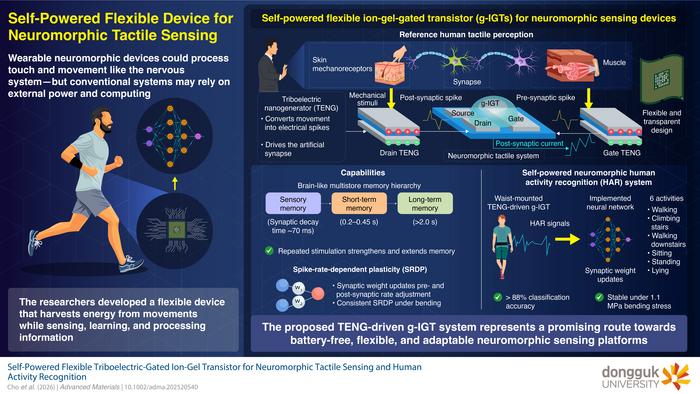
The proposed TENG-driven g-IGT is a flexible, self-powered neuromorphic device capable of reproducing multiple memory states and spike-rate-dependent learning Neuromorphic devices, which are designed to emulate aspects of biological neural networks, are promising candidates for developing low-power and intelligent sensing technologies, including wearable applications. Among the device architectures explored for neuromorphic computing, graphene-channel ion-gel-gated transistors (g-IGTs) are...

Rice University researchers have shown that sub-nanometer wrinkles in graphene generate flexoelectric charge separation, reshaping local electrical behavior through curvature alone. Extreme bending produces polarization far stronger than in larger systems and may enable geometry-controlled electronics without chemical doping. Published in Advanced Materials.
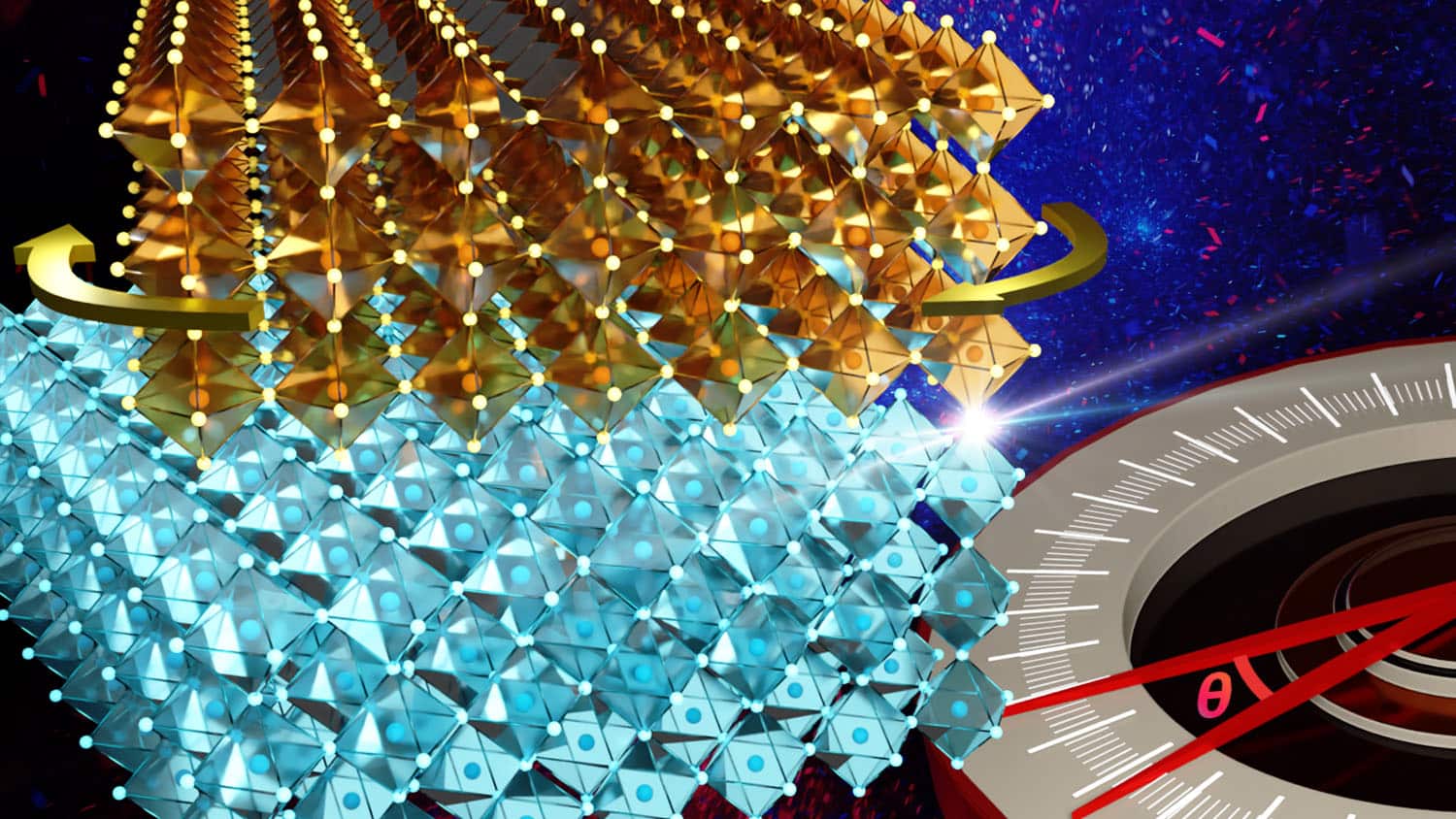
Researchers at NC State have extended twistronics beyond van der Waals materials into strongly bonded crystalline oxides. By stacking sodium niobate membranes with twist angles controlled down to 0.1 degrees, and confirming results via synchrotron X-ray diffraction, the team found interlayer bonds distort the atomic lattice, shifting phase structure and domain configuration. The technique works at near-millimeter scale, far larger than typical twistronic devices, marking a real step toward pract
