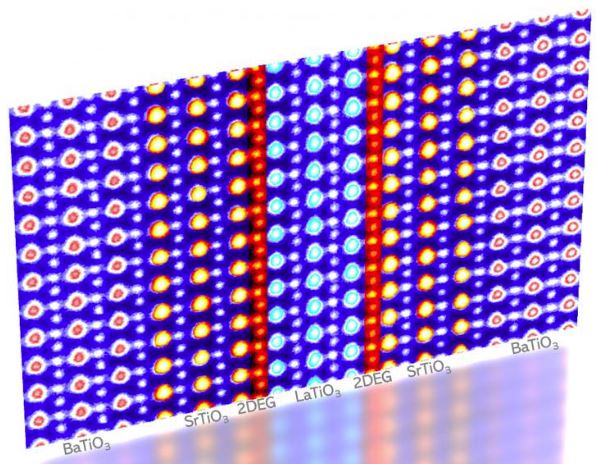
In 1965, a renowned Princeton University physicist theorized that ferroelectric metals could conduct electricity despite not existing in nature.
For decades, scientists thought it would be impossible to prove the theory by Philip W. Anderson, who shared the 1977 Nobel Prize in physics. It was like trying to blend fire and water, but a Rutgers-led international team of scientists has verified the theory and their findings are published online in Nature Communications.
"It's exciting," said Jak Chakhalian, a team leader of the study and Professor Claud Lovelace Endowed Chair in Experimental Physics at Rutgers University-New Brunswick. "We created a new class of two-dimensional artificial materials with ferroelectric-like properties at room temperature that don't exist in nature yet can conduct electricity. It's an important link between a theory and an experiment."
A cornerstone of technology, ferroelectric materials are used in electronics such as cell phone and other antennas, computer storage, medical equipment, high precision motors, ultra-sensitive sensors and sonar equipment. None of their materials conducts electricity and the Rutgers-led findings potentially could spawn a new generation of devices and applications, Chakhalian said.
"Ferroelectrics are a very important class of materials technologically," he said. "They move, shrink and expand when electricity is applied and that allows you to move things with exquisite precision. Moreover, every modern cell phone has tens of components with properties similar to ferroelectric material."
Like many physicists, Chakhalian relishes a challenge and he could not find a law of physics that says ferroelectric metals could not be created. So his team, including study lead author Yanwei Cao, a former doctoral student who is now a professor at the Chinese Academy of Sciences, tapped Chakhalian's state-of-the-art tools to create sheets of materials only a few atoms thick. It's like making sandwiches, Chakhalian said.
"When a material becomes ferroelectric, its atoms shift permanently and we wanted to add metallic properties to an artificial crystal that conducts electricity," he said. "So we took two very thin layers to create a two-dimensional metal at the interface and added a third layer with special properties to shift the atoms in that metallic layer, creating a ferroelectric-like metal. The new structure has several functionalities built-in, and this is a big win-win."
Artificial two-dimensional polar metal at room temperature
Yanwei Cao, Zhen Wang, Se Young Park, Yakun Yuan, Xiaoran Liu, Sergey M. Nikitin, Hirofumi Akamatsu, M. Kareev, S. Middey, D. Meyers, P. Thompson, P. J. Ryan, Padraic Shafer, A. N’Diaye, E. Arenholz, Venkatraman Gopalan, Yimei Zhu, Karin M. Rabe & J. Chakhalian
Nature Communicationsvolume 9, Article number: 1547 (2018) (Open)
http://dx.doi.org/10.1038/s41467-018-03964-9
Rutgers University
#Nanoelectronics #MaterialScience #2DMaterials
SPECS reports on work at the LMA microscopy lab, where Dr. David Serrate's team used the JT-STM to study graphene nanoribbons on MgO/Ag(001) and the Aarhus 150 to monitor nanostructure growth.
Nanologica's board has resolved on a rights issue of units of appx. SEK 110.5 million, with an oversubscription option of up to SEK 10 million. Commitments and a guarantee intention cover appx. SEK 85.7 million.
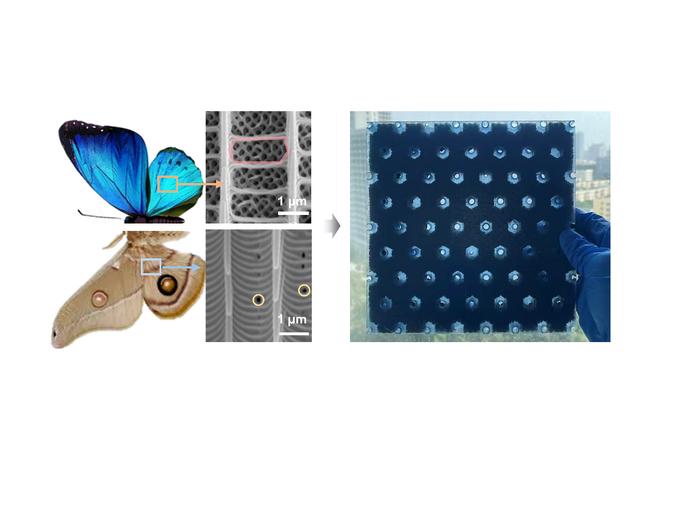
Researchers at Harbin Institute of Technology have printed a 24 mm metamaterial that absorbs impact, shields microwaves and damps low-frequency noise at once. Inspired by butterfly wing scales, it nests a gyroid lattice inside a hexagonal honeycomb, absorbing 21.9 times more impact energy than an equal-weight honeycomb and capturing over 90% of 2-40 GHz radiation and 600-900 Hz sound.
This week in nanotech
$108.5M raised
8 funding rounds · 44 deals tracked
New products
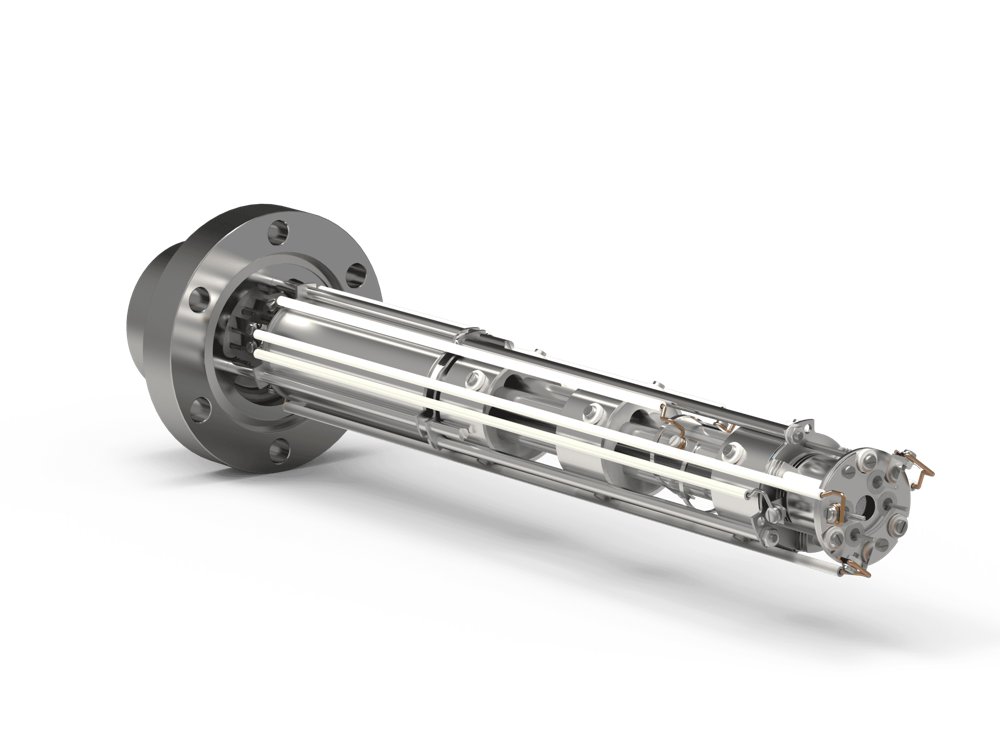 DLS-1 Mass Spectrometer for Fusion Gas AnalysisHiden Analytical Featured
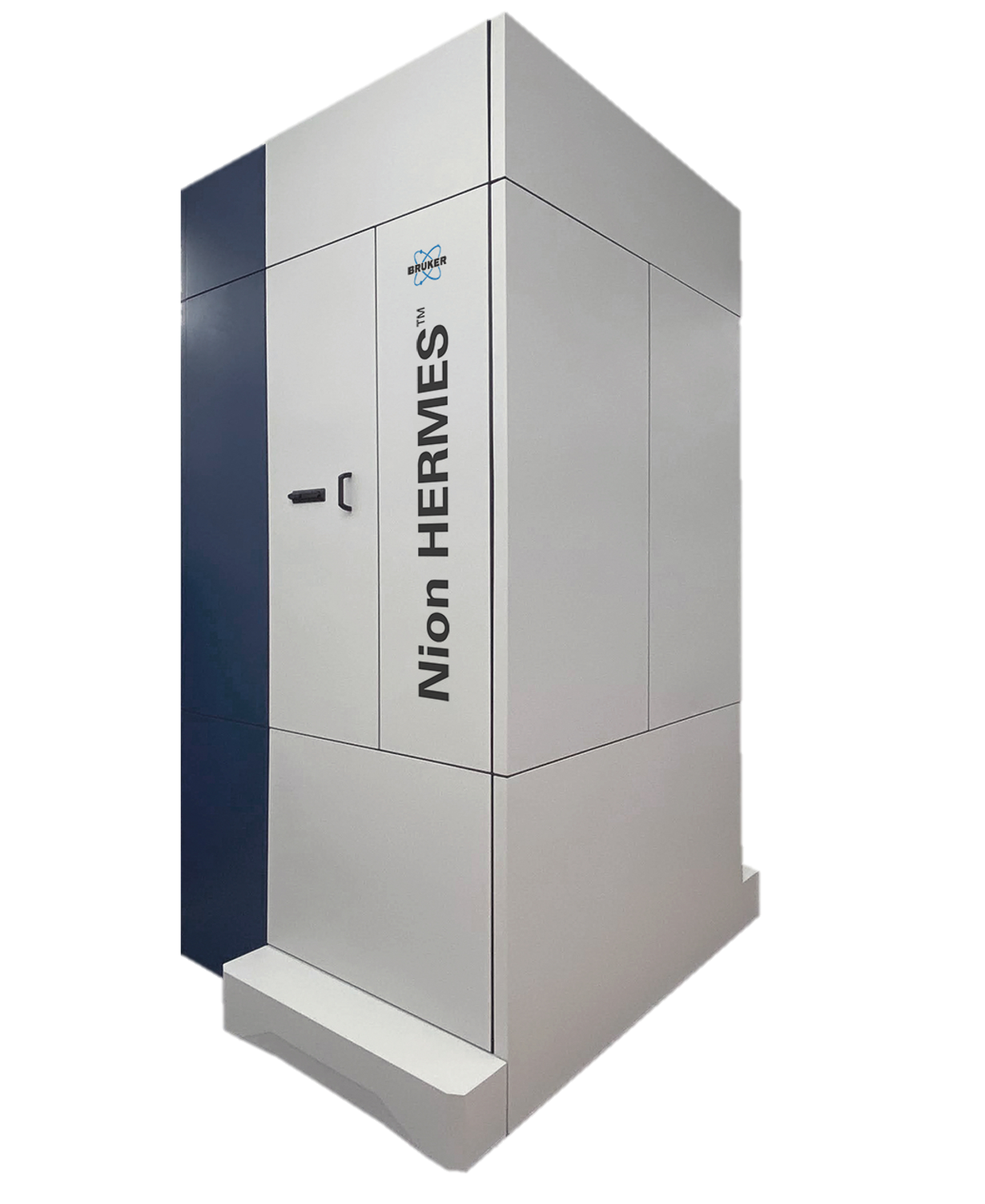 Nion-compatible In Situ STEM Holders for Electrical BiasingHummingbird Scientific Featured
 Talphene™ Graphene AdditivesTalga Group
Market insights
Last 30 days: Quantum Technologies drew the most money: $3.17B.
Money raised per month