Thermoelectric materials, capable of transforming heat into electricity, are very promising when converting residual heat into electrical energy, since they allow us to utilize hardly usable or almost lost thermal energy in an efficient way.
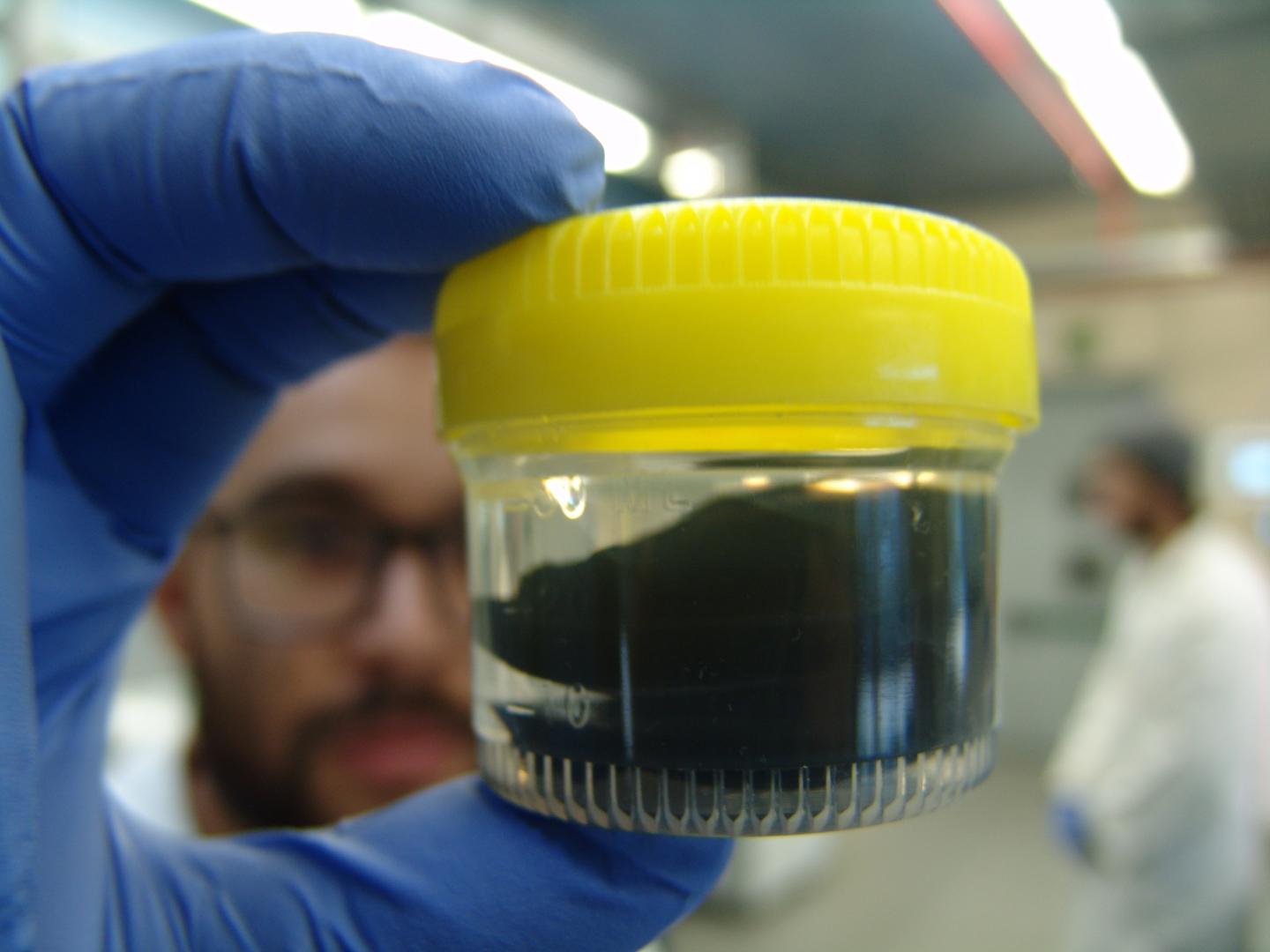
Researchers at the Institute of Materials Science of Barcelona (ICMAB-CSIC) have created a new concept of thermoelectric material, published in the journal Energy & Environmental Science. It is a device composed of cellulose, produced in situ in the laboratory by bacteria, with small amounts of a conductive nanomaterial, carbon nanotubes, using a sustainable and environmentally friendly strategy.
"Instead of making a material for energy, we cultivate it" explains Mariano Campoy-Quiles, a researcher of this study. "Bacteria, dispersed in an aqueous culture medium containing sugar and carbon nanotubes, produce the nanocellulose fibers that end up forming the device, in which the carbon nanotubes are embedded" continues Campoy-Quiles.
"We obtain a mechanically resistant, flexible and deformable material, thanks to the cellulose fibers, and with a high electrical conductivity, thanks to the carbon nanotubes," explains Anna Laromaine, researcher of this study. "The intention is to approach the concept of circular economy, using sustainable materials that are not toxic for the environment, which are used in small amounts, and which can be recycled and reused," explains Anna Roig, researcher of this study, "The device is made with sustainable and recyclable materials, and with a high added value," she adds.
Roig claims that, in comparison to other similar materials, "this one has a higher thermal stability compared to other thermoelectric materials based on synthetic polymers, which allows it to reach temperatures of 250 °C. In addition, the device does not use toxic elements, and the cellulose can easily be recycled, since it can be degraded by an enzymatic process converting it into glucose, while recovering the carbon nanotubes, which are the most expensive element of the device". Moreover, the thickness, color and transparency of the material can be controlled.
Campoy-Quiles explains that carbon nanotubes have been chosen for their dimensions: "Thanks to their nanoscale diameter and their few microns in length, carbon nanotubes allow, with very little quantity (in some cases up to 1% ), to obtain electrical percolation, i.e. a continuous path where the electrical charges can travel through the material, allowing cellulose to be conductive". Additionally, the use of such a small amount of nanotubes (up to a maximum of 10%), while maintaining the overall efficiency of a material containing 100 %, makes the process very economic and energy efficient" adds Campoy-Quiles. "On the other hand, the dimensions of carbon nanotubes are similar to those of cellulose nanofibres, which results in a homogeneous dispersion. In addition, the inclusion of these nanomaterials has a positive impact on the mechanical properties of cellulose, making it even more deformable, extensible and resistant, "adds Roig.
These devices could be used to generate electricity from residual heat to feed sensors in the field of the Internet of Things, Agriculture 4.0 or Industry 4.0. "In the near future, they could be used as wearable devices, in medical or sports applications, for example. And if the efficiency of the device was even more optimized, this material could lead to intelligent thermal insulators or to hybrid photovoltaic-thermoelectric power generation systems" explains Campoy-Quiles. In addition "due to the high flexibility of the cellulose and to the scalability of the process, these devices could be used in applications where the residual heat source has unusual forms or extensive areas, as they could be completely covered with this material" indicates Roig.
Because bacterial cellulose can be home made, perhaps we are facing the first step towards a new energy paradigm, where users will be able to make their own electric generators. We are still far away, but this study is a beginning. We have to start somewhere.
Farming thermoelectric paper
Deyaa Abol-Fotouh, Bernhard Dörling, Osnat Zapata-Arteaga, Xabier Rodríguez-Martínez, Andrés Gómez, J. Sebastian Reparaz, Anna Laromaine, Anna Roig and Mariano Campoy-Quiles
DOI:10.1039/C8EE03112F
Institute of Materials Science of Barcelona (ICMAB-CSIC)
#MaterialScience #Nanotubes #Nanomaterials
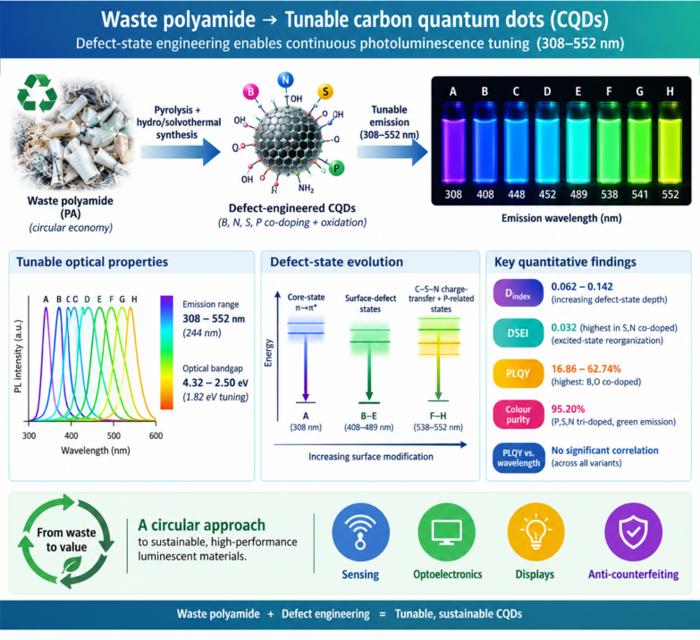
Waste polyamide-derived CQDs show continuous photoluminescence tuning from 308 to 552 nm through sequential defect-state engineering, with optical transition energies decreasing from 4.32 to 2.50 eV. @Christian Ebere Enyoh from Saitama University Carbon quantum dots (CQDs) are fluorescent carbon nanomaterials with potential applications in sensing, optoelectronics, displays, anti-counterfeiting, and environmental technologies. Their optical properties can be adjusted by modifying the carbon...
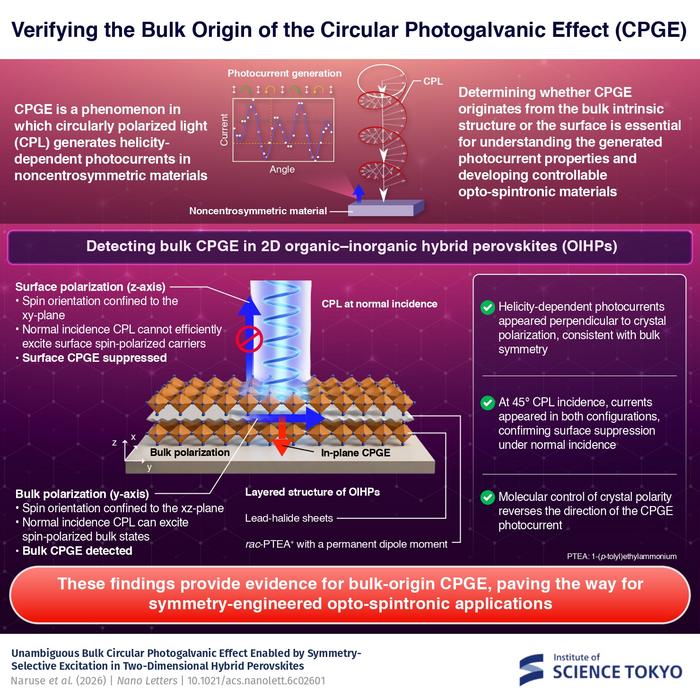
The researchers used circularly polarized light at normal incidence and found that helicity-dependent photocurrents appeared perpendicular to the crystal’s polarization but vanished when measured parallel to it, supporting a bulk origin of CPGE. @Institute of Science Tokyo The circular photogalvanic effect (CPGE), a phenomenon that generates helicity-dependent photocurrents in noncentrosymmetric materials, can originate purely from a crystal's internal structure without contribution from the...
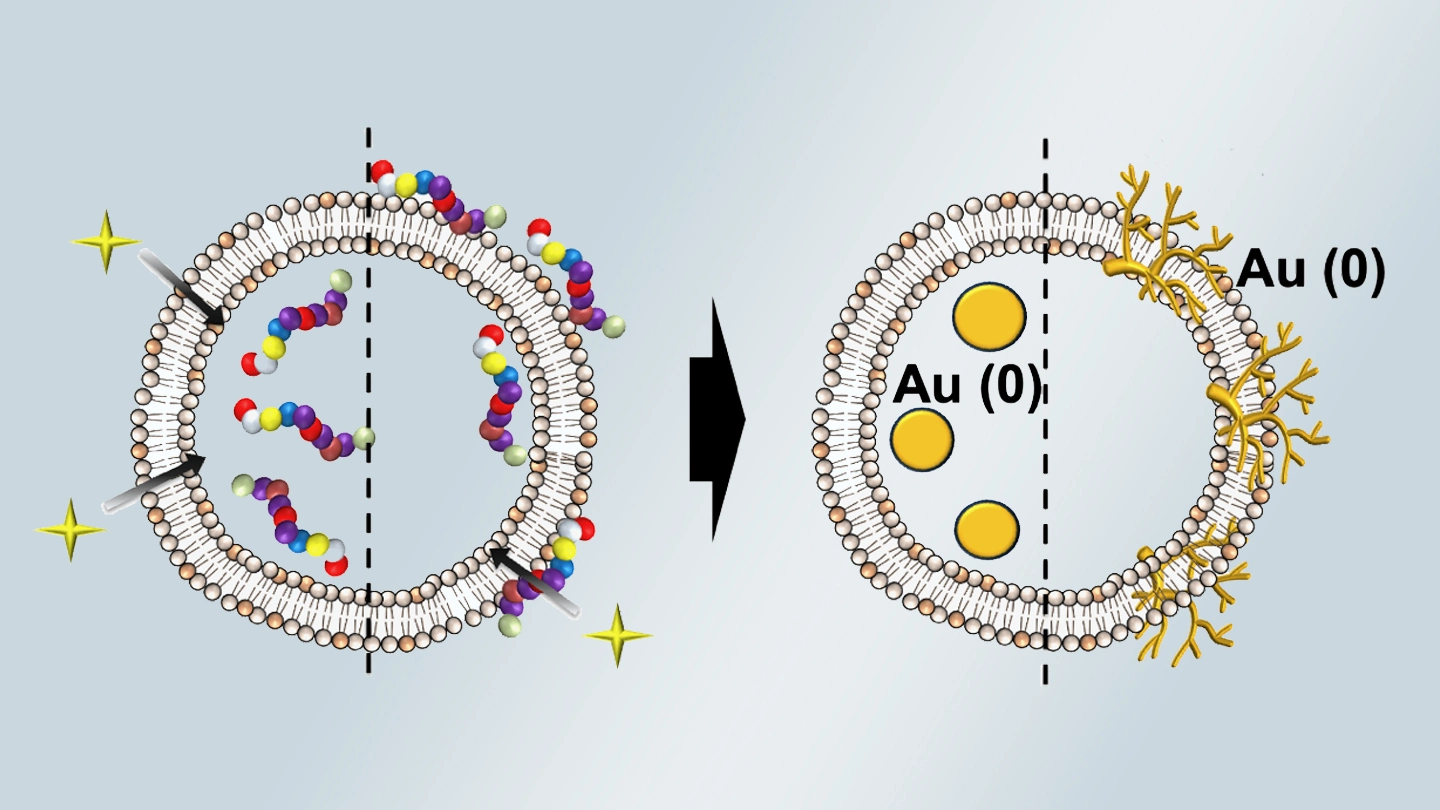
Summary of gold nanoparticle growth programming in liposome based on localization of biomineralization peptide The position of biomineralization peptides within liposomes can influence how gold nanoparticles grow, reports a research team from Institute of Science Tokyo. Peptides localized at the membrane interface promote branched structures, while those confined to the liposome interior favor spherical nanoparticles. The findings offer a new strategy for controlling nanoscale reaction...
