Swiss Federal Institute of Technology Lausanne (EPFL)

Human tissues experience a variety of mechanical stimuli that can affect their ability to carry out their physiological functions, such as protecting organs from injury. The controlled application of such stimuli to living tissues in vivo and in vitro has now proven instrumental to studying the conditions that lead to disease.
The tools consist of microactuators and soft robotic devices that are wirelessly activated by laser beams. They can also incorporate microfluidic chips, which means they can be used to perform combinatorial tests that involve high-throughput chemical and mechanical stimulation of a variety of biological samples. This research has been published in Lab on a Chip.
Like Legos
The scientists came up with the idea after observing the locomotor system in action. "We wanted to create a modular system powered by the contraction of distributed actuators and the deformation of compliant mechanisms," says Sakar.
Their system involves assembling various hydrogel components -- as if they were Lego bricks -- to form a compliant skeleton, and then creating tendon-like polymer connections between the skeleton and the microactuators. By combining the bricks and actuators in different ways, scientists can create an array of complicated micromachines.
"Our soft actuators contract rapidly and efficiently when activated by near-infrared light. When the entire nanoscale actuator network contracts, it tugs on the surrounding device components and powers the machinery," says Berna Ozkale, the study's lead author.
With this method, scientists are able to remotely activate multiple microactuators at specified locations -- a dexterous approach that produces exceptional results. The microactuators complete each contraction-relaxation cycle in milliseconds with large strain.
In addition to its utility in fundamental research, this technology offers practical applications as well. For instance, doctors could use these devices as tiny medical implants to mechanically stimulate tissue or to actuate mechanisms for the on-demand delivery of biological agents.
Modular soft robotic microdevices for dexterous biomanipulation.
Berna Özkale, Raquel Parreira, Ahmet Bekdemir, Lucio Pancaldi, Ece Özelçi, Claire Amadio, Murat Kaynak, Francesco Stellacci, David J. Mooney, Mahmut Selman Sakar. Lab on a Chip, 2019; DOI: 10.1039/c8lc01200h
Contact information:
Selman Sakar
Assistant Professor at EPFL's School of Engineering
selman.sakar@epfl.ch
Tel: +41 21 69 31095
Web: Microbiorobotic Systems Laboratory
Berna Özkale Edelmann
boedelmann@g.harvard.edu
Postdoctoral fellow at Harvard University
Berna Özkale Edelmann
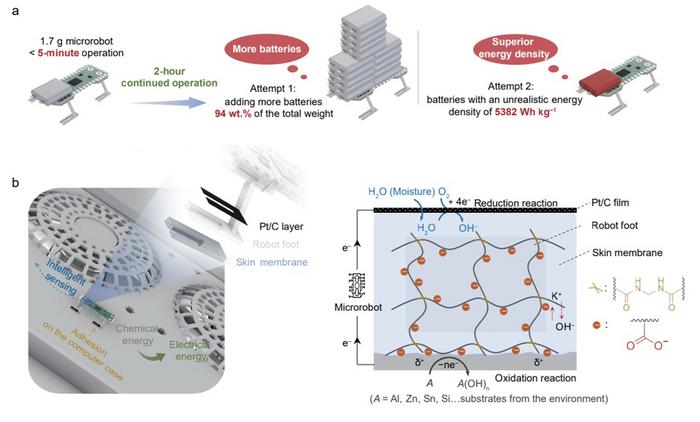
A Fudan University team has built a microrobot skin that generates electricity from the surface it walks on, eliminating onboard batteries. The crosslinked potassium polyacrylate membrane, as thin as 135 micrometres, reacts with aluminum, zinc and other active substrates plus atmospheric moisture and oxygen, reaching 133 mW cm−2 on zinc, roughly ten times typical microbatteries.
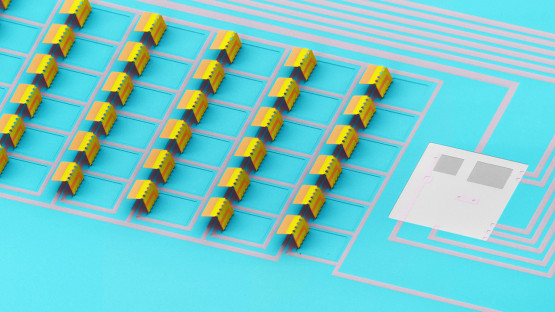
In northeastern Brazil, termites have transformed an area about the size of Great Britain by sensing their environment, communicating with each other about it and working together to build vast tunnel systems. Inspired by this and other instances of the small but mighty collective activity in nature, Cornell physics researchers have made robots that for the first time can sense the temperature of their surroundings and react together to change it. “Little things can have a large impact,” said...
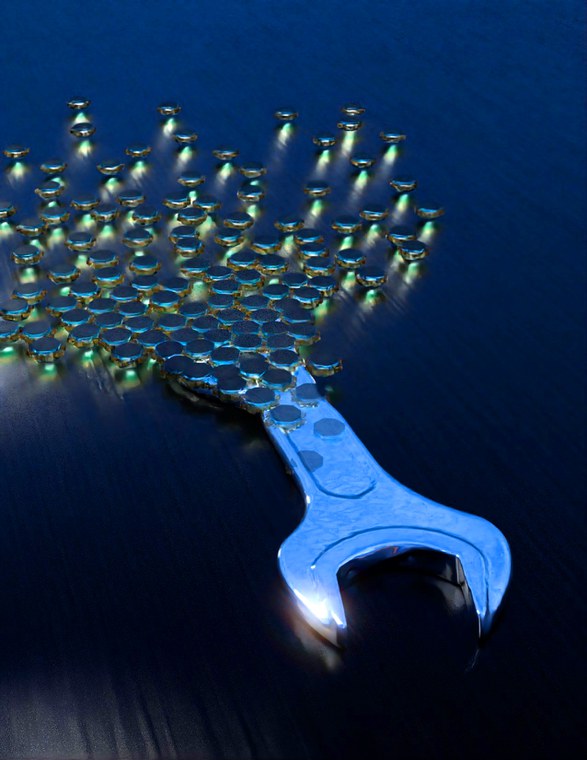
In the world of robots, the equivalent of cell-cell adhesion is achieved with magnets, which are incorporated into the perimeter of the robo
This week in nanotech
$24.4M raised
5 funding rounds · 33 deals tracked
New products
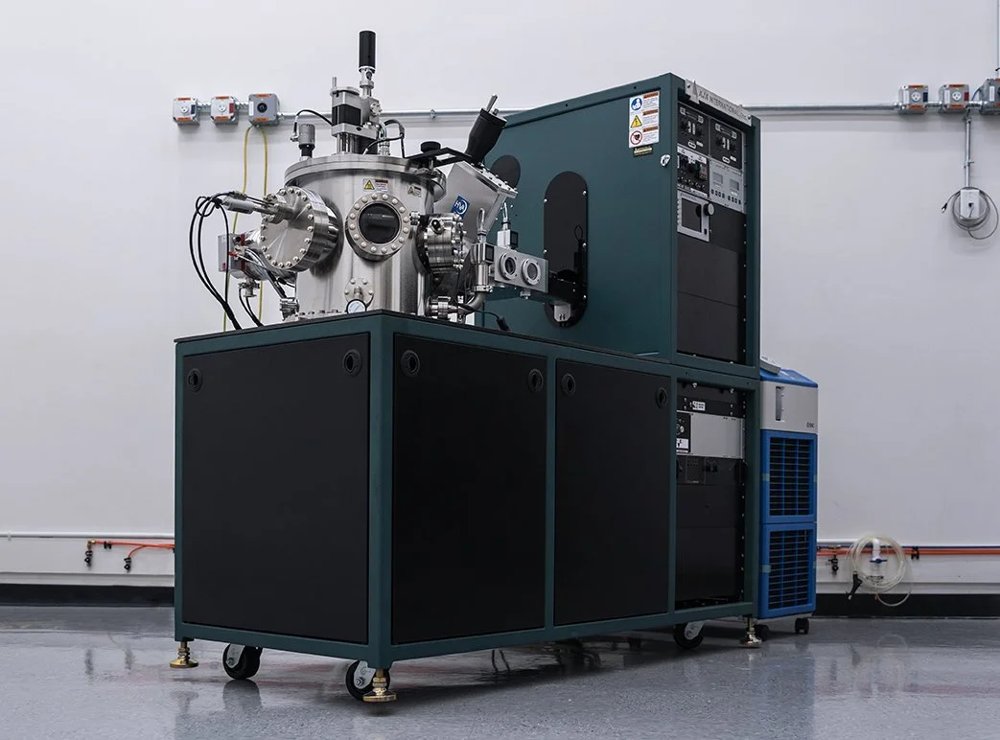 Orion Sputtering Deposition SystemsAJA International Featured
 Nion-compatible In Situ STEM Holders for Electrical BiasingHummingbird Scientific Featured
 NanoFlow® S1-20Levidian
Market insights
Last 30 days: Quantum Technologies drew the most money: $3.17B.
Money raised per month
Behind the deal
Who led Qilimanjaro Quantum Tech’s $21.9M Series A?
See the investors with Insights Pro →