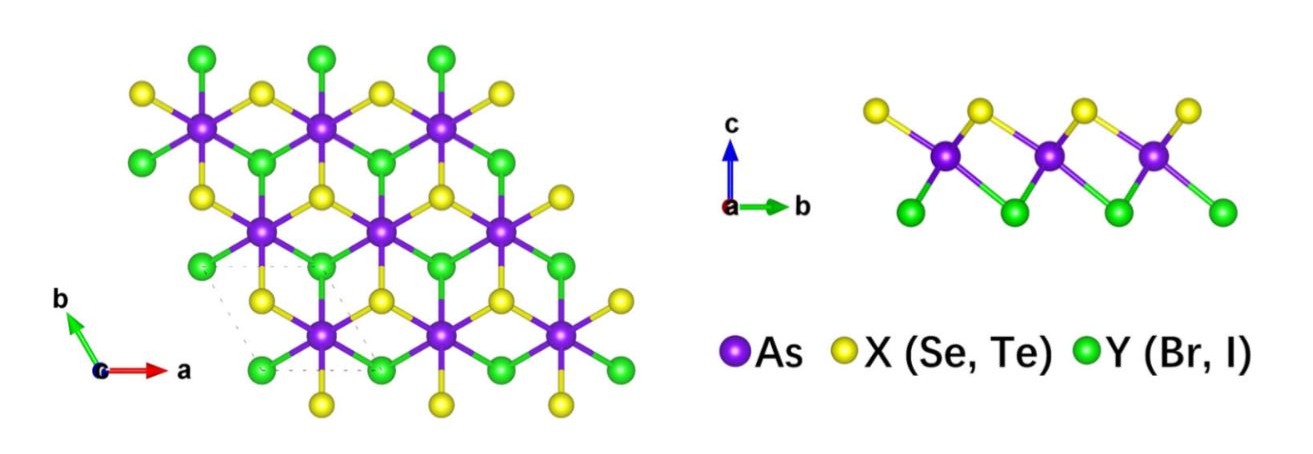
Several studies have predicted that the water splitting reaction could be catalysed by certain groups of 2D materials – each measuring just a few atoms thick. One particularly promising group are named 2D Janus materials, whose two sides each feature a different molecular composition. Through new calculations detailed in EPJ B, Junfeng Ren and colleagues at Shandong Normal University in China present a new group of four 2D Janus materials, which could be especially well suited to the task.
Since hydrogen releases an abundance of energy when combusted, with only water as a by-product, it is now widely seen as an excellent alternative to fossil fuels. Splitting water molecules involves a ‘redox reaction,’ where electrons and holes participate in reduction and oxidation reactions. Since they are excellent semiconductors, 2D Janus materials are particularly well suited to catalysing this reaction. When an electron in a semiconductor’s insulating ‘valence band’ absorbs a photon, it is excited to the material’s ‘conduction band,’ leaving behind a positively charged hole. In turn, these materials as both source and acceptors of electrons – allowing redox reactions to occur more readily.
In their theoretical study, Ren’s team examined a group of four of these materials: with one surface composed of either selenium or tellurium, and the other from either bromine or iodine – with both sides sandwiching a middle layer of astatine. In these semiconductors, the energies of their valence and conduction bands were far enough apart to prevent electrons and holes from readily recombining: allowing them to combine electrons and holes to produce hydrogen and oxygen. With all four materials displaying excellent stability and light absorption, the researchers believe they could be incredibly promising candidates for catalysing the water splitting reaction. If these results can be reproduced in experiments, Ren’s team hope the four materials could become a key element of the global effort to eliminate our carbon emissions in the next few decades.
Reference
Two-dimensional Janus AsXY (X = Se, Te; Y = Br, I) monolayers for photocatalytic water splitting
Jiali Wang, Jiajun Lu, Xiuwen Zhao, Guichao Hu, Xiaobo Yuan & Junfeng Ren
https://link.springer.com/article/10.1140/epjb/s10051-023-00486-2
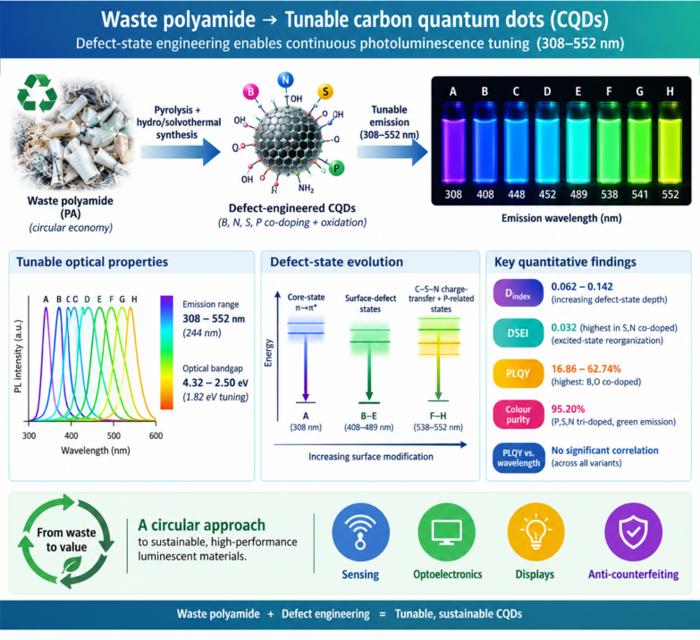
Waste polyamide-derived CQDs show continuous photoluminescence tuning from 308 to 552 nm through sequential defect-state engineering, with optical transition energies decreasing from 4.32 to 2.50 eV. @Christian Ebere Enyoh from Saitama University Carbon quantum dots (CQDs) are fluorescent carbon nanomaterials with potential applications in sensing, optoelectronics, displays, anti-counterfeiting, and environmental technologies. Their optical properties can be adjusted by modifying the carbon...
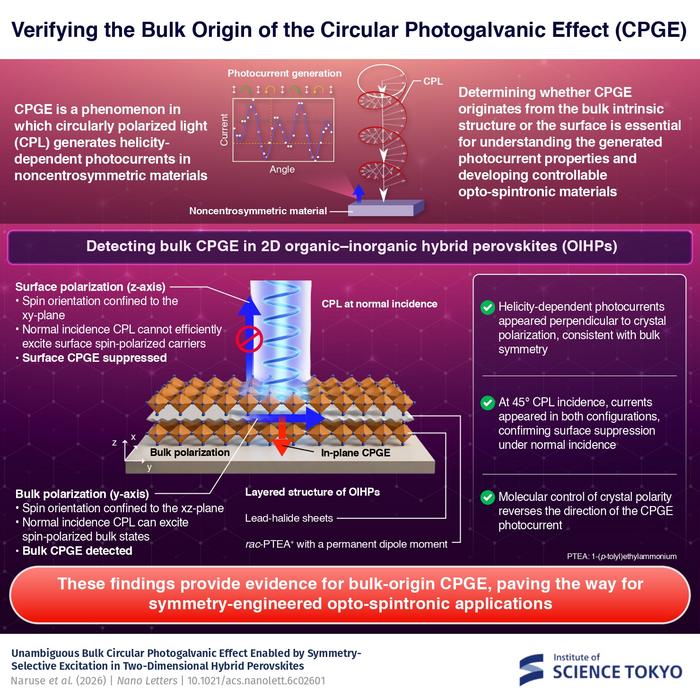
The researchers used circularly polarized light at normal incidence and found that helicity-dependent photocurrents appeared perpendicular to the crystal’s polarization but vanished when measured parallel to it, supporting a bulk origin of CPGE. @Institute of Science Tokyo The circular photogalvanic effect (CPGE), a phenomenon that generates helicity-dependent photocurrents in noncentrosymmetric materials, can originate purely from a crystal's internal structure without contribution from the...
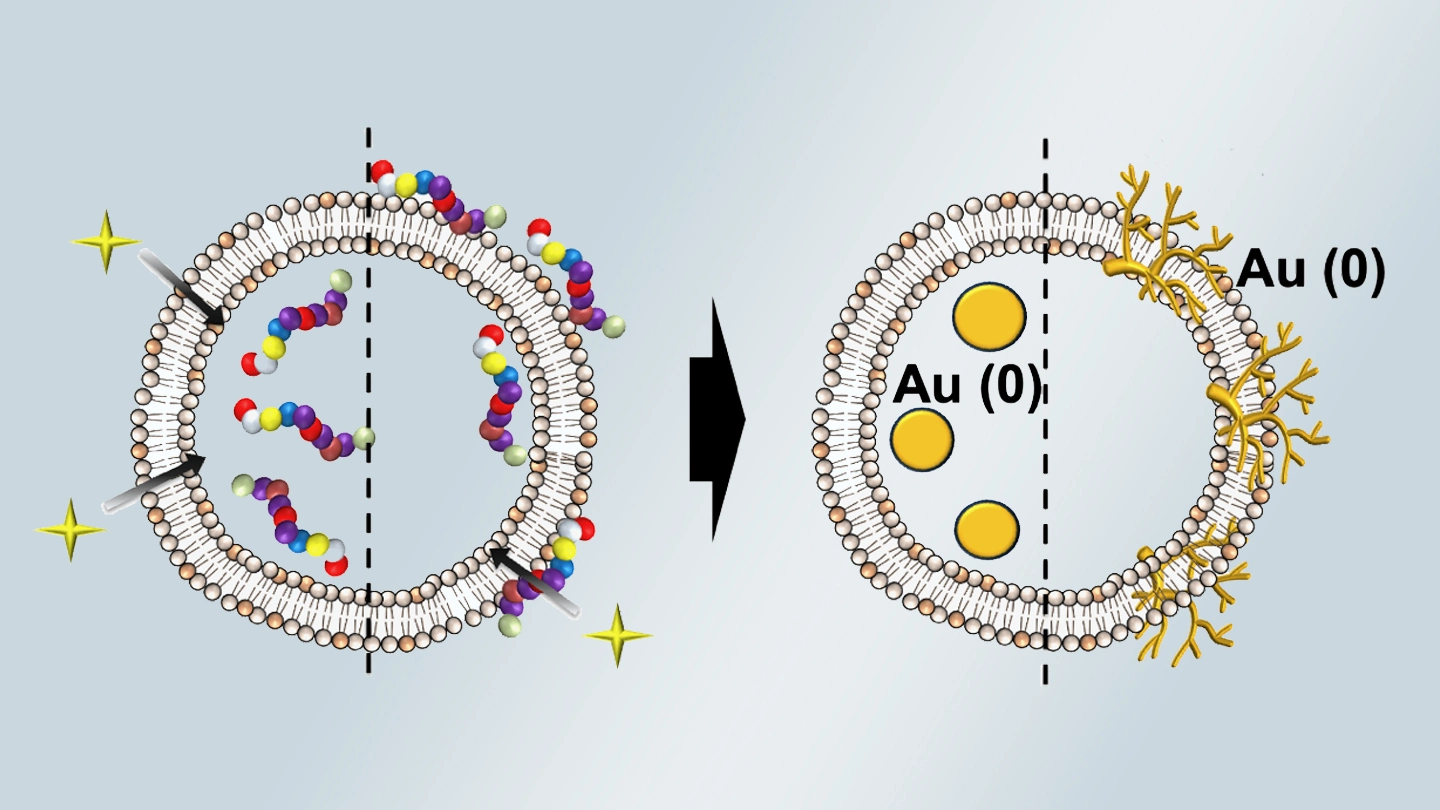
Summary of gold nanoparticle growth programming in liposome based on localization of biomineralization peptide The position of biomineralization peptides within liposomes can influence how gold nanoparticles grow, reports a research team from Institute of Science Tokyo. Peptides localized at the membrane interface promote branched structures, while those confined to the liposome interior favor spherical nanoparticles. The findings offer a new strategy for controlling nanoscale reaction...
