
A sandwich of molybdenum, sulfur and selenium turns out to be deliciously useful for detecting biomolecules.
Tests at Rice University's Brown School of Engineering of a two-dimensional Janus compound showed it could be an effective and universal platform for improving the detection of biomolecules via surface-enhanced Raman spectroscopy (SERS).
Using glucose to test the material proved its ability to boost its Raman enhancement factor by more than 100,000 times, which the researchers say is comparable to the highest-reported enhancement factor for 2D substrates.
SERS is an established technique that enables the detection and identification of small concentrations of molecules -- or even single molecules -- that get close to or adsorbed by metallic surfaces, including nanoparticles. It's often used to detect nanoscale proteins in bodily fluids, helping to detect diseases and determine treatments, and in environmental analysis.
But metallic SERS media often prompt side reactions that create background noise. Janus MoSSe synthesized at Rice is nonmetallic. "This work mainly addresses whether we can enhance the target molecules' signal strength," said materials scientist and principal investigator Jun Lou. "We wanted to know if we could make it stand out from the background noise."
The answer was clearly yes, as Lou and his team reported in Nanoscale.
MoSSe introduced by the Lou lab in 2017 was produced by chemical vapor deposition. Molybdenum sits in the middle with a layer of sulfur on one side and another of selenium on the other; hence the two-faced Janus characterization.
The different electronegativities of each layer make it a SERS superstar, said lead author and Rice alumnus Shuai Jia, a former graduate student in Lou's lab.
"The dipole created between the top sulfur and the bottom selenium lands out-of-plane, and this creates an electrical field a few nanometers beyond the MoSSe," Jia said. That field interacts with molecules that come close, enhancing their vibrational intensity enough to be detected.
The researchers noted tests with MoSSe also detected molecules of the neurotransmitter dopamine and that the substrate should be adaptable to sense other molecules.
Lou said there's room for improvement. "We're looking at hybrids of MoSSe with some metallic nanoparticles, and also trying to enhance the dipole strength," he said.
Biomolecular sensing by surface-enhanced Raman scattering of monolayer Janus transition metal dichalcogenide
Shuai Jia, Arkamita Bandyopadhyay, Hemant Kumar, Jing Zhang, Weipeng Wang, Tianshu Zhai, Vivek B. Shenoy and Jun Lou
Nanoscale (2020)
DOI: 10.1039/D0NR00300J
Contact information:
Jun Lou
Rice Professor of Materials Science and NanoEngineering
jlou@rice.edu
Phone: (713)348-3573
Rice University
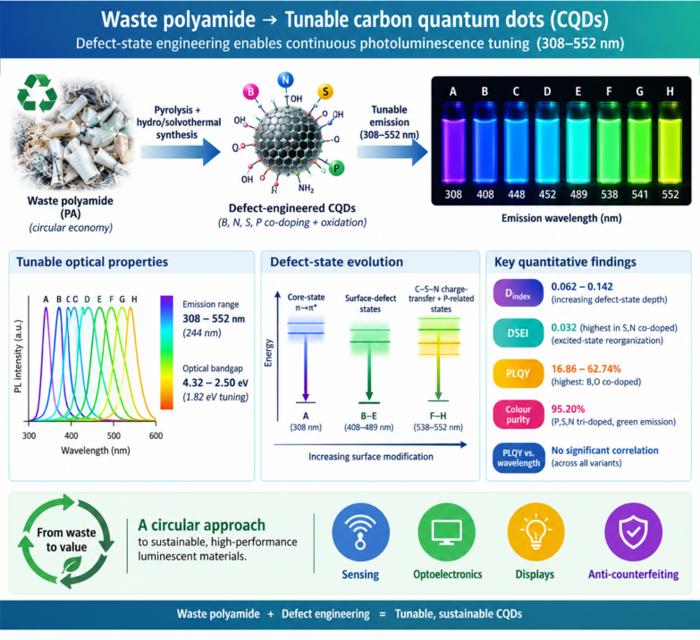
Waste polyamide-derived CQDs show continuous photoluminescence tuning from 308 to 552 nm through sequential defect-state engineering, with optical transition energies decreasing from 4.32 to 2.50 eV. @Christian Ebere Enyoh from Saitama University Carbon quantum dots (CQDs) are fluorescent carbon nanomaterials with potential applications in sensing, optoelectronics, displays, anti-counterfeiting, and environmental technologies. Their optical properties can be adjusted by modifying the carbon...
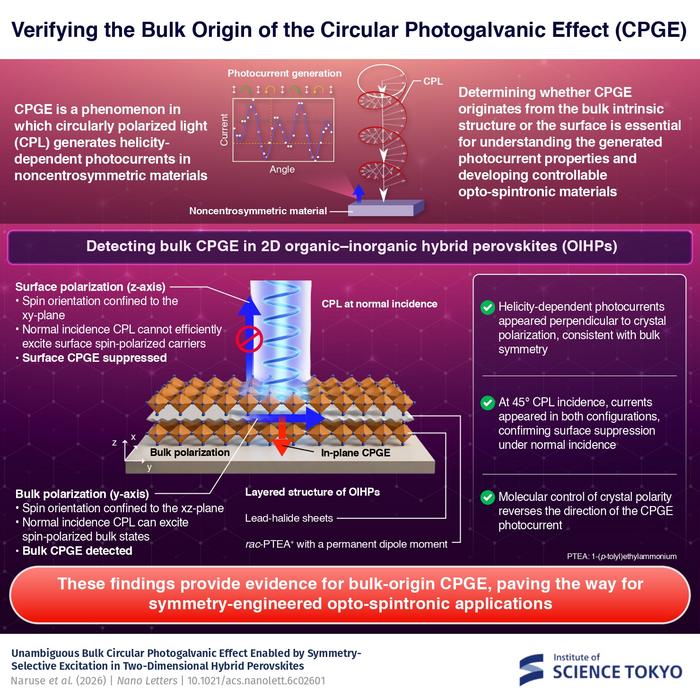
The researchers used circularly polarized light at normal incidence and found that helicity-dependent photocurrents appeared perpendicular to the crystal’s polarization but vanished when measured parallel to it, supporting a bulk origin of CPGE. @Institute of Science Tokyo The circular photogalvanic effect (CPGE), a phenomenon that generates helicity-dependent photocurrents in noncentrosymmetric materials, can originate purely from a crystal's internal structure without contribution from the...
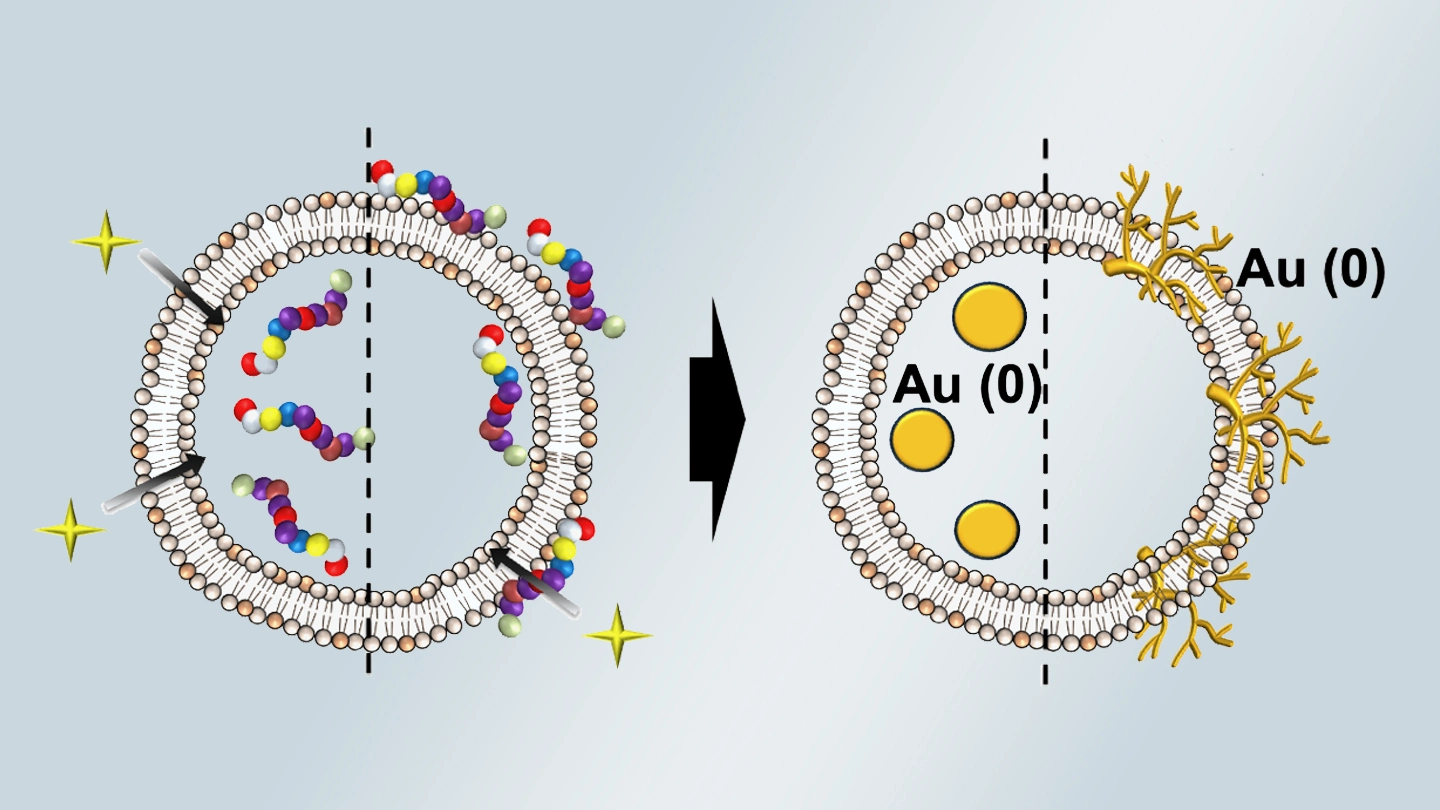
Summary of gold nanoparticle growth programming in liposome based on localization of biomineralization peptide The position of biomineralization peptides within liposomes can influence how gold nanoparticles grow, reports a research team from Institute of Science Tokyo. Peptides localized at the membrane interface promote branched structures, while those confined to the liposome interior favor spherical nanoparticles. The findings offer a new strategy for controlling nanoscale reaction...
