Helmholtz-Zentrum Berlin für Materialien und Energie

(Fe0.63Ni0.3Pd0.07)3P or FNPP is a magnetic material that exhibits complex magnetic structures even at room temperature. This makes the material of interest for spintronics, a field that could enable data processing with significantly lower energy consumption. One potential application is novel magnetic memory devices. However, generating and modifying the desired structures in a controlled manner remains a challenge to date. A new study led by HZB has now taken a step forward in this regard. They demonstrated at the worldwide unique VEKMAG-Station at BESSY II, that a tiny external B-field in the plane of the magnetic patterns is sufficient to change them.
The team led by Dr Florin Radu investigated FNPP samples using soft X-rays and ptychography at BESSY II. The experiments aimed to map the magnetic textures whilst the sample was exposed to an external magnetic field in specific spatial directions. For this purpose, BESSY II is equipped with a globally unique instrument developed by Radu’s team themselves: the VEKMAG vector magnet can generate a magnetic field of up to 1 T in all three spatial directions.
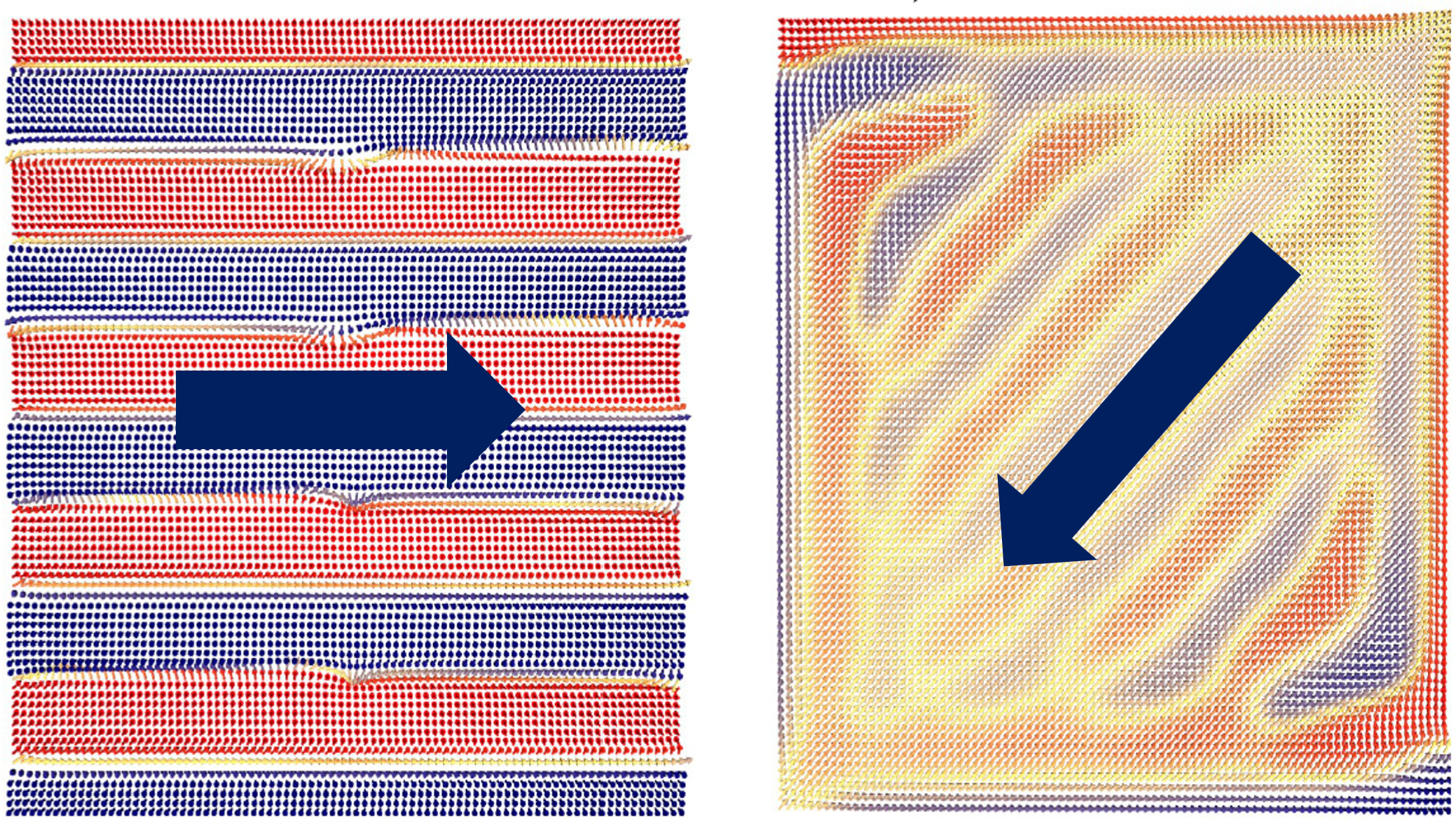
“We observed that the magnetic stripe domains can be controlled by an external magnetic field when applied parallel to these patterns, rather than perpendicular” says Dr Victor Ukleev, first author of the study. “The surprising thing was that even a very small field of just 10 millitesla was sufficient to transform a chiral stripe configuration into an achiral fan configuration.”
Modelling provides a good explanation for this behaviour. Within the FNPP, different magnetic interactions compete with one another, resulting in complex magnetic textures. While one of these interactions is rather isotropic, another key interaction is anisotropic, with a direction of preference. "Due to our experimental observations, and thanks to collaboration with our partners, we could now identify the mechanism and understand how a weak in-plane B-field establishes an equilibrium between these interactions, thereby altering the stripe state," says Ukleev.
The FNPP material is therefore suitable as a model system for externally controlling spin textures. The results obtained here advance the development of functional magnetic materials for spintronics.
Reference
Vector-field control and emergent basal-plane anisotropy of magnetic textures in noncentrosymmetric (Fe0.63Ni0.3Pd0.07)3P
V. Ukleev, O. I. Utesov, L. Ubilla, C. Luo, R. Abrudan, P. Wild, H. Kropf, M. Winter, S. Schneider, A. Tahn, B. Rellinghaus, T. Butcher, S. Finizio, S. Wintz, M. Weigand, M. Birch, Y. Tokura, Y. Taguchi, K. Karube und Florin Radu
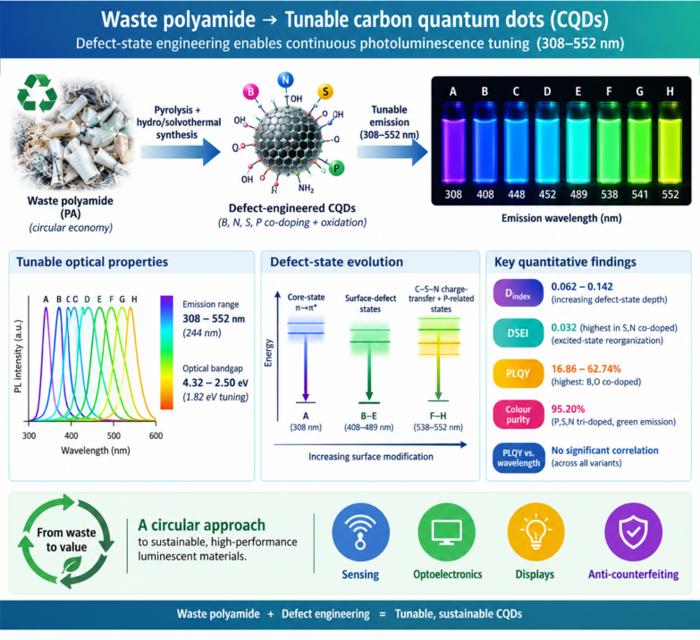
Waste polyamide-derived CQDs show continuous photoluminescence tuning from 308 to 552 nm through sequential defect-state engineering, with optical transition energies decreasing from 4.32 to 2.50 eV. @Christian Ebere Enyoh from Saitama University Carbon quantum dots (CQDs) are fluorescent carbon nanomaterials with potential applications in sensing, optoelectronics, displays, anti-counterfeiting, and environmental technologies. Their optical properties can be adjusted by modifying the carbon...
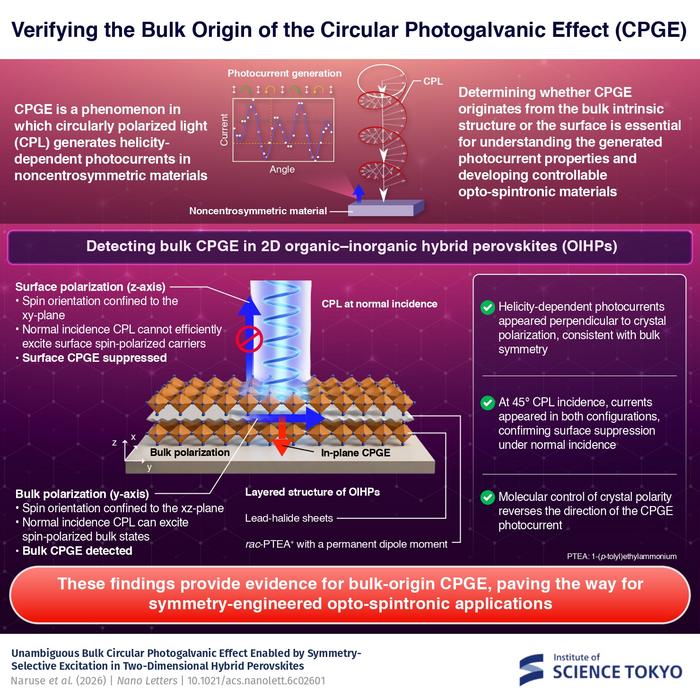
The researchers used circularly polarized light at normal incidence and found that helicity-dependent photocurrents appeared perpendicular to the crystal’s polarization but vanished when measured parallel to it, supporting a bulk origin of CPGE. @Institute of Science Tokyo The circular photogalvanic effect (CPGE), a phenomenon that generates helicity-dependent photocurrents in noncentrosymmetric materials, can originate purely from a crystal's internal structure without contribution from the...
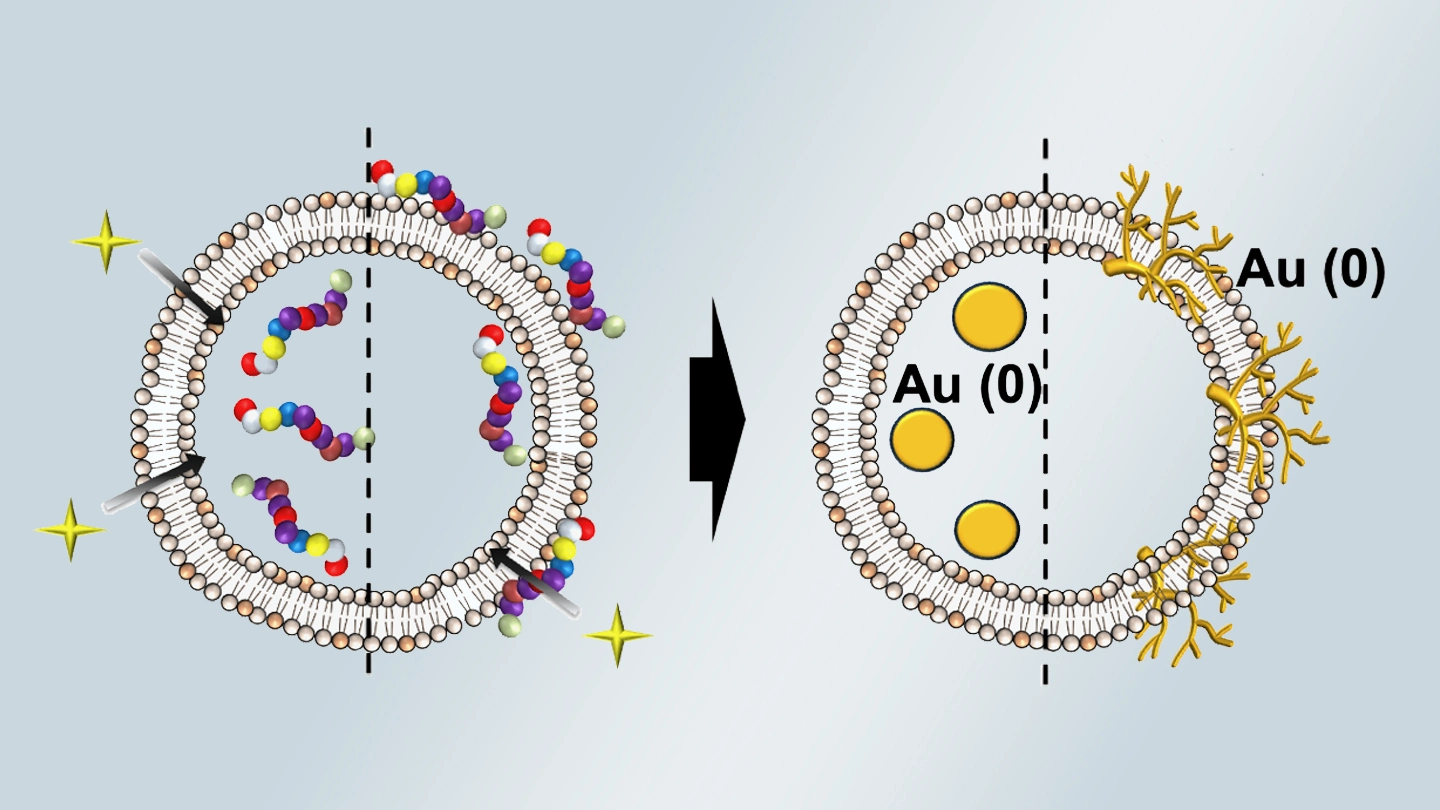
Summary of gold nanoparticle growth programming in liposome based on localization of biomineralization peptide The position of biomineralization peptides within liposomes can influence how gold nanoparticles grow, reports a research team from Institute of Science Tokyo. Peptides localized at the membrane interface promote branched structures, while those confined to the liposome interior favor spherical nanoparticles. The findings offer a new strategy for controlling nanoscale reaction...
