Shanghai Jiao Tong University Journal Center
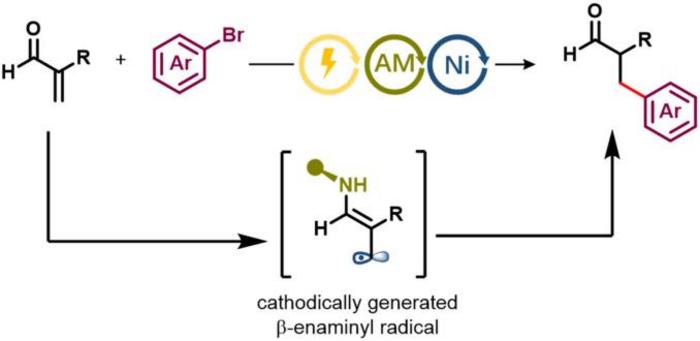
A study published in Transformative Chemistry by Yingdong Duan, Fanzhu Zeng, Qifeng Lin and Sanzhong Luo from Tsinghua University reports a primary amine/nickel dual catalytic system that uses electrochemistry to invert the conventional reactivity of aminocatalytic intermediates, delivering β-aryl and β-alkenyl aldehydes from α-branched acroleins and readily available aryl or alkenyl halides. The reaction runs at a constant cell voltage of 1.10 V with a nickel plate anode, a graphite felt cathode, 15 mol% of a simple achiral primary amine and 10 mol% of a NiCl2–terpyridine complex, giving the model adduct in 91% yield and 80% on gram scale.
Why This Research Matters
· Reversing the polarity of aminocatalysis: For almost twenty years, radical aminocatalysis has depended on oxidizing enamines to α-imino radical cations, which requires strong bases or specially tailored, high-oxidation-potential aminocatalysts. The authors instead reduce the electron-deficient iminium ion directly at the cathode, providing a mild and general route to β-enaminyl radicals that no longer depends on a bespoke catalyst architecture.
· A cheap, achiral amine does the job: The optimised catalyst C1 is inexpensive and achiral, yet it matches the performance of a chiral primary amine. Only three components are indispensable—the nickel source, C1 and a proton source—and the reaction becomes virtually inactive when any one of them is removed.
· Enals that usually fail in reductive coupling: α-Branched acroleins are poor substrates for classical reductive cross-coupling, yet they are converted efficiently here. The nickel cycle outcompetes the competing Giese-type addition of the β-enaminyl radical, and an intramolecular variant delivers the cyclised product 3ac.
Innovative Design and Mechanisms
· Two cycles coupled through a radical: The protonated primary amine condenses with the enal to form an iminium ion (int-1), which undergoes single-electron reduction at the cathode to the key β-enaminyl radical (int-2). A nickel(II) aryl species (int-4) traps this radical to give a Ni(III) intermediate (int-5); reductive elimination and hydrolysis then release the β-functionalised aldehyde and regenerate both catalysts. Cyclic voltammetry supports the picture: adding C1·HOTf shifts the reduction of the enal from −1.64 V to −1.40 V vs Ag/AgCl and moves the onset potential from −1.50 V to −0.94 V.
· Mechanistic evidence for the radical intermediate: TEMPO suppresses the reaction and the corresponding adduct 4 is detected by HRMS. An allyl sulfone also intercepts the β-enaminyl radical through addition–desulfonylation, giving the β-allylated product 6 only when C1·HOTf is present. A kinetic induction period of more than 8 h is observed without the amine salt and disappears in its presence.
· The nickel anode is not innocent: XPS shows that nickel is deposited on the cathode during electrolysis (Ni atomic fraction rising from 0.63% to 1.39%), so the sacrificial nickel plate both balances charge and feeds the catalytic cycle.
Applications and Future Outlook
Electron-poor aryl bromides bearing esters, ketones, nitriles or imides, fluorinated and trifluoromethylthio groups, sulfones and thioethers, boronate esters, naphthalenes and ortho-substituted arenes are all accommodated, and basic heterocycles such as quinoline, pyridine and morpholinobenzene can be installed at the cost of yield. Vinyl bromides give β-alkenylated products, and aryl bromides derived from the drug RU58841 and aldehydes derived from elaidic and linoleic acids are converted with the alkene left intact. Because the enantiodetermining step of the asymmetric version—the final protonation of the enamine—is decoupled from C–C bond formation, the authors expect the platform to open a broad family of reductive aminocatalytic couplings.
Reference
Electrochemical Reductive β-Arylation and Alkenylation of α-Branched Acroleins by Primary Amine/Nickel Dual Catalysis
Yingdong Duan, Fanzhu Zeng, Qifeng Lin, and Sanzhong Luo
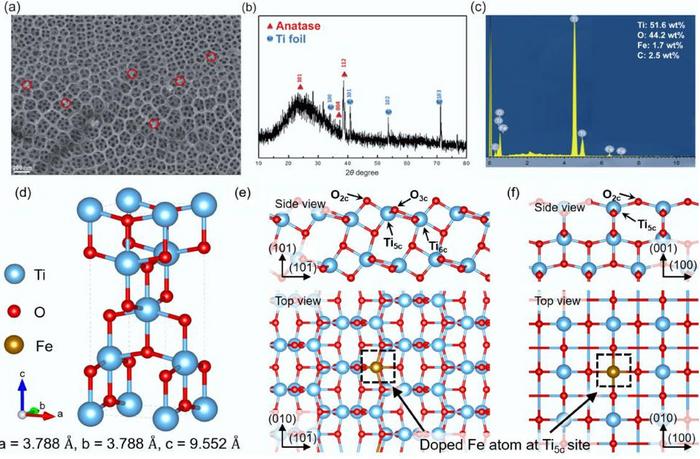
Iron-modified titanium dioxide nanotube electrodes removed 92.1% of nitrobenzene from water within two hours when combined with heat, electricity and ultraviolet light, versus 7.5% for electrical treatment alone. Nitrate-based estimates put mineralization at 62.4%, and intermediate products pointed to a shorter degradation pathway.
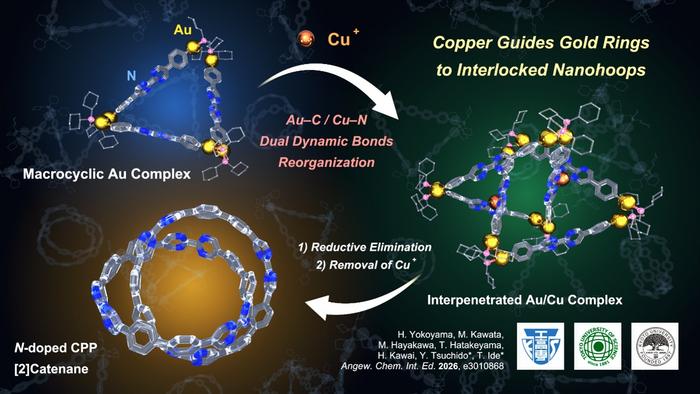
Researchers in Japan have combined gold(I) carbon bonds and copper(I) nitrogen coordination to assemble an interlocked catenane of nitrogen-doped carbon nanohoops in a single pot. Demetallation gave a metal-free [2]catenane of two fully conjugated [12]CPP rings in only eight steps, with a 2.9% overall yield that improves on conventional routes.
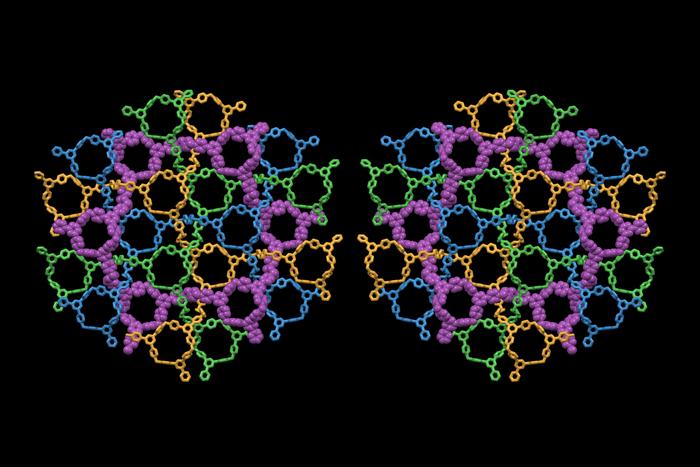
Chemists at UT Austin and Zhejiang University have developed a self-assembling molecularly woven fabric that separates benzene from cyclohexane far more efficiently than distillation, whose near-identical boiling points make conventional processing costly. Stacked layers of clockwise and counterclockwise chiral networks form a springy, reusable filter that absorbed 97.9% of benzene from a 50/50 mixture.
This week in nanotech
25 deals tracked
New products
 Ti-WCMBN Nanomaterialia Featured
 Nion-compatible In Situ STEM Holders for Electrical BiasingHummingbird Scientific Featured
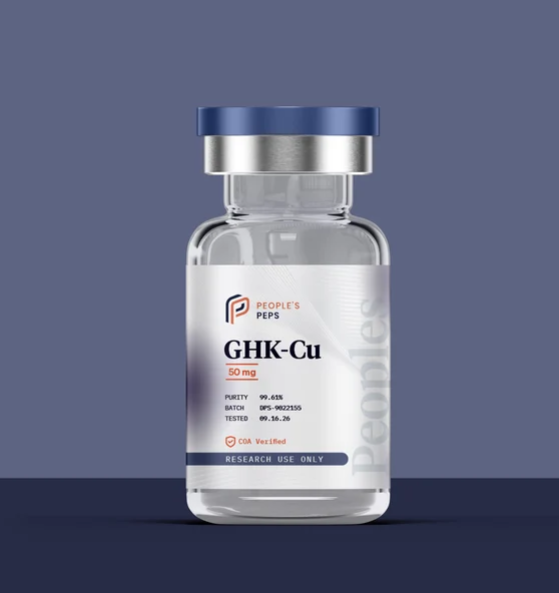 GHK-CuPeoples Peps
Market insights
Last 30 days: Semiconductors & Electronics was the busiest vertical: 55 of 176 events (31%).
Money raised per month