University of Queensland (UQ)
University of Queensland researchers have combined quantum liquids and silicon-chip technology to study turbulence for the first time, opening the door to new navigation technologies and improved understanding of the turbulent dynamics of cyclones and other extreme weather.
Professor Warwick Bowen, from UQ's Precision Sensing Initiative and the Australian Research Council Centre of Excellence for Engineered Quantum Systems said the finding was "a significant advance" and provided a new way to study turbulence.
"Turbulence is often described as the oldest unsolved problem in physics," Professor Bowen said.
"Our finding allows us to observe nanoscale quantum turbulence, which mirrors the sort of behaviour you see in cyclones.
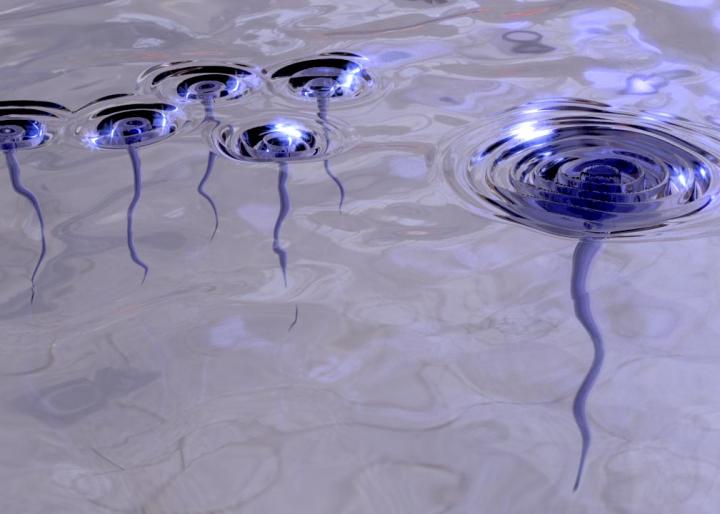
Artists' impression of quantum vortices in a liquid. These are the quantum equivalent of vortices in water or a tornado. Their interactions cause dynamics analogous to that of a cyclone. Image: Christopher Baker"This advance is enabled by the properties of quantum liquids, which are fundamentally different to everyday liquids."
Professor Bowen said it was postulated more than 50 years ago that the turbulence problem could be simplified using quantum liquids.
"Our new technique is exciting because it allows quantum turbulence to be studied on a silicon chip for the first time," he said.
The research also had implications in space, where quantum liquids are predicted to exist within dense astrophysical objects.
"Our research could help to explain how these objects behave," Dr Bowen said.
Dr Yauhen Sachkou, the paper's lead author, said rotating neutron stars lost angular momentum in fits and starts.
"The way this occurs is thought to hinge on quantum turbulence," Dr Sachkou said.
Dr Christopher Baker, who co-led the research, said the finding made possible silicon-chip based accelerometers with sensitivity far beyond current state of the art.
"In quantum liquids, atoms behave more like waves than particles," Dr Baker said.
"This allows us to build laser-like sensors from atoms."
Coherent vortex dynamics in a strongly interacting superfluid on a silicon chip
Yauhen P. Sachkou, Christopher G. Baker, Glen I. Harris, Oliver R. Stockdale, Stefan Forstner, Matthew T. Reeves, Xin He, David L. McAuslan, Ashton S. Bradley, Matthew J. Davis, Warwick P. Bowen
Science (2019) Vol. 366, Issue 6472, pp. 1480-1485
Contact information:
Warwick Bowen
UQ Professor of Physics
wbowen@physics.uq.edu.au
Phone: +61 404 618 722
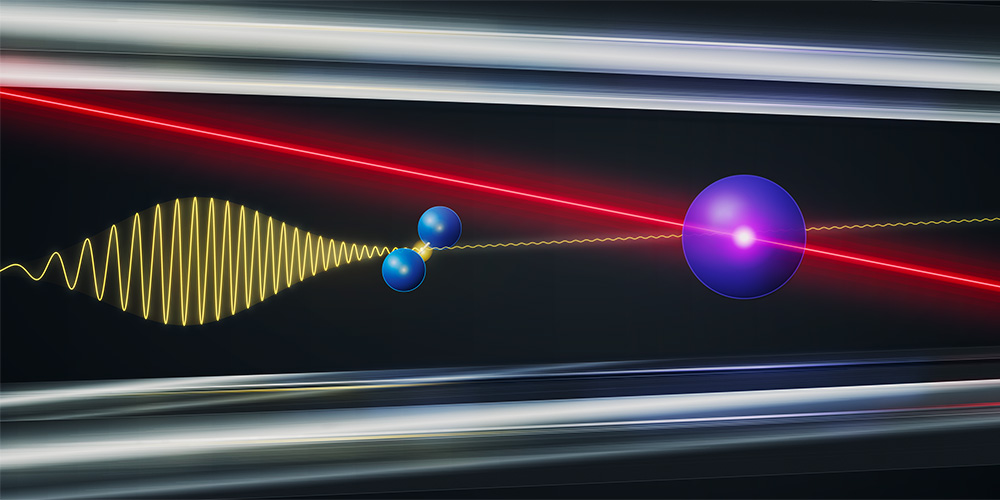
Researchers at the University of Basel have identified and coherently controlled so called forbidden vibrational transitions in individual trapped nitrogen molecular ions without destroying them. Using quantum logic spectroscopy, a single calcium ion served as messenger, letting the team probe the molecule repeatedly and determine its fundamental vibrational frequency ten times more precisely than before.
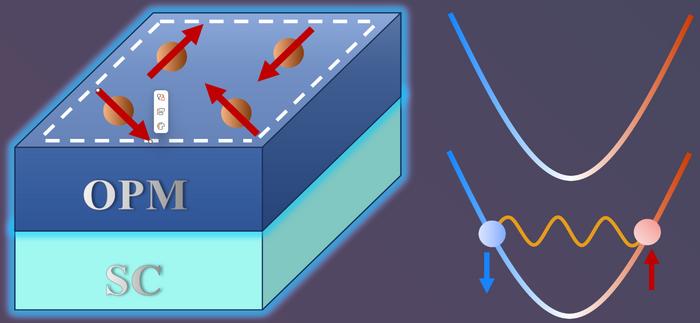
Odd-parity magnets host an intrinsic hidden Zeeman field that lifts Kramers degeneracy without any applied field, researchers report. Using an f-wave magnet model on a triangular lattice, the team shows how non-relativistic spin splitting and this hidden field combine to stabilize s-wave superconductivity far beyond the Pauli limit.
Rhombohedral hexalayer graphene, in which six carbon sheets are stacked with a slight lateral offset like staircase steps, hosts both superconductivity and electrically controllable orbital magnetism, researchers report in Nature Physics. The arrangement yields a rich collection of quantum states in a simple carbon-based material, positioning rhombohedral multilayer graphene as a platform for probing the fundamental mechanisms of superconductivity and magnetism and potentially for new ways of…
This week in nanotech
9 deals tracked
New products
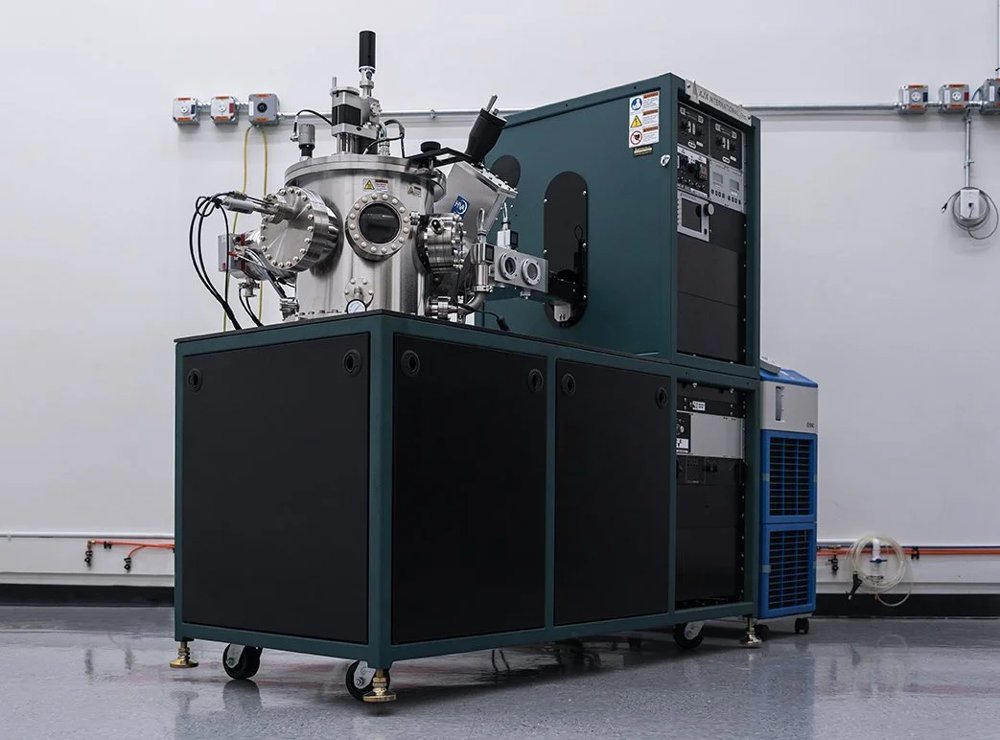 Orion Sputtering Deposition SystemsAJA International Featured
 Nion-compatible In Situ STEM Holders for Electrical BiasingHummingbird Scientific Featured
 Talphene™ Graphene AdditivesTalga Group
Market insights
Last 30 days: Semiconductors & Electronics was the busiest vertical: 39 of 130 events (30%).
Money raised per month