
Graphene, a material made of carbon atoms arranged in an atomically thin sheet, continues to surprise scientists with its remarkable electronic properties, according to Xiaomeng Liu, assistant professor of physics in the College of Arts and Sciences.
Liu and members of his research group have discovered that stacking six graphene layers in a rhombohedral arrangement – in which each graphene sheet is shifted slightly sideways from the one beneath it, like steps in a staircase – creates a versatile platform for exploring two unusual quantum phenomena: superconductivity and electrically controllable orbital magnetism.
These findings reveal how a seemingly simple carbon-based material can host a remarkably rich collection of quantum states, Liu said. They also establish rhombohedral multilayer graphene as a promising platform for investigating the fundamental mechanisms of superconductivity and magnetism. Potentially, it could be used to develop new ways of controlling quantum materials.
“Superconductivity and Ferroelectric Orbital Magnetism in Semimetallic Rhombohedral Hexalayer Graphene” was published in Nature Physics on Oct. 22. Co-first authors are Kavli postdoctoral associates Jinghao Deng and Hongyuan Li (a former Klarman Postdoctoral Fellow in A&S) and doctoral student Jiabin Xie. Liu is the corresponding author.
Jie Shan, visiting professor in Cornell Duffield Engineering and Kin Fai Mak, adjunct professor in physics in A&S, also contributed, as did researchers from the National Institute for Materials Science in Tsukuba, Japan.
The Liu research group explores emergent quantum phenomena arising from the collective motion of electrons in quantum materials, specializing in van der Waals heterostructures, which are created by stacking layers of two-dimensional materials – six-layer graphene is such a material.
In this study, the researchers found that superconducting states emerge in six-layer graphene when two types of charge carriers – electrons and holes – coexist in the material, with a surprising resilience to the in-plane magnetic field.
“This unusual coexistence offers new clues about how superconductivity can arise through interactions among electrons,” Liu said.
The team also discovered a form of magnetism, arising from the electron’s orbital motion, that is closely coupled to the material's electric polarization. Remarkably, this magnetic state can be switched using an electric field, suggesting opportunities to control magnetic properties through electrical signals.
“What excites us is that a material made entirely of carbon can support such rich collective behaviors of electrons,” Liu said. “Six-layer graphene gives us a platform to investigate how superconductivity and magnetism emerge and how we can control them electrically. This advances our broader goal of understanding and controlling quantum states in materials built from atomically thin layers.”
Reference
Superconductivity and Ferroelectric Orbital Magnetism in Semimetallic Rhombohedral Hexalayer Graphene
Jinghao Deng, Jiabin Xie, Hongyuan Li, Takashi Taniguchi, Kenji Watanabe, Jie Shan, Kin Fai Mak, and Xiaomeng Liu
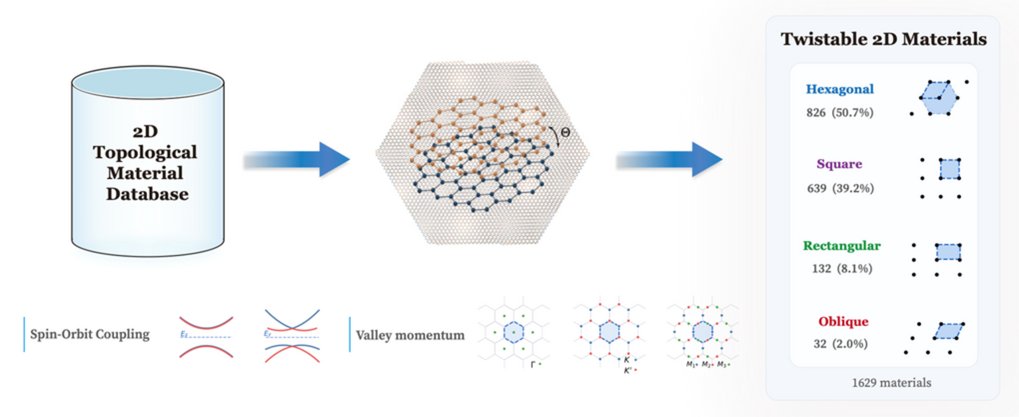
Two new studies catalog nearly 9,000 two-dimensional materials and identify 61 semimetals and 1,568 insulators suited to twistronics, the stacking and rotating of atomically thin layers to engineer narrow electronic bands. The work maps topological electronic structures, predicts promising twisted bilayers such as tin diselenide and hafnium disulfide, and confirms several candidates can be grown in bulk and exfoliated into working devices, giving researchers a systematic route to designer…
Ultrafast light pulses have given physicists fresh evidence on the pseudogap, the enigmatic quantum state that has clouded cuprate superconductors for nearly four decades. Using time- and angle-resolved photoemission spectroscopy, researchers suppressed superconductivity in a copper-based compound and watched the pseudogap appear in its place, then fade as superconductivity returned.
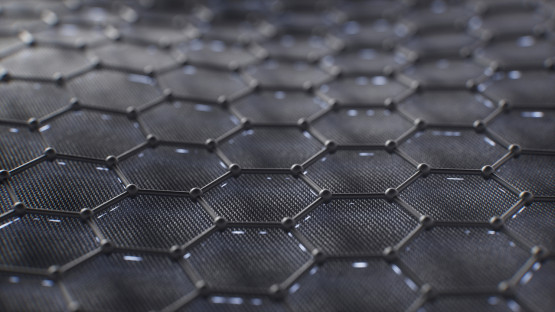
Cornell researchers found that applying voltage to a four-layer graphene stack slides the layers between atomic stacking arrangements, reversibly switching the material between nonmagnetic and magnetic states. The effect, reported in Nature Nanotechnology, exploits weak van der Waals bonds rather than breaking chemical bonds, and the resulting state persists after voltage is removed.
This week in nanotech
$548.4M raised
3 funding rounds · 31 deals tracked
New products
 Ti-WCMBN Nanomaterialia Featured
 DLS-1 Mass Spectrometer for Fusion Gas AnalysisHiden Analytical Featured
 Aether®Lam Research
Market insights
Last 30 days: Quantum Technologies drew the most money: $2.15B.
Money raised per month
Behind the deal
Who led Qilimanjaro Quantum Tech’s $21.9M Series A?
See the investors with Insights Pro →