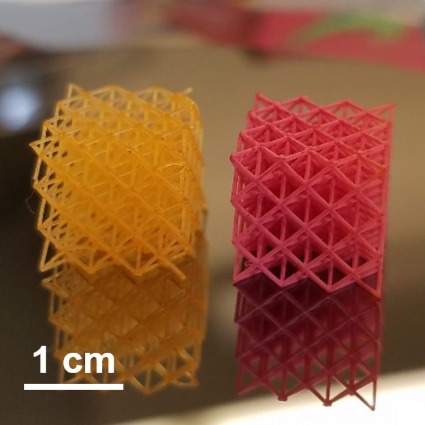
Rutgers engineers have created a highly effective way to paint complex 3D-printed objects, such as lightweight frames for aircraft and biomedical stents, that could save manufacturers time and money and provide new opportunities to create "smart skins" for printed parts.
The findings are published in the journal ACS Applied Materials & Interfaces.
Conventional sprays and brushes can't reach all nooks and crannies in complex 3D-printed objects, but the new technique coats any exposed surface and fosters rapid prototyping.
"Our technique is a more efficient way to coat not only conventional objects, but even hydrogel soft robots, and our coatings are robust enough to survive complete immersion in water and repeated swelling and de-swelling by humidity," said senior author Jonathan P. Singer, an assistant professor in the Department of Mechanical and Aerospace Engineering in the School of Engineering at Rutgers University-New Brunswick.
The engineers discovered new capabilities of a technology that creates a fine spray of droplets by applying a voltage to fluid flowing through a nozzle. This technique (electrospray deposition) has been used mainly for analytical chemistry. But in recent decades, it has also been used in lab-scale demonstrations of coatings that deliver vaccines, light-absorbing layers of solar cells and fluorescent quantum dots (tiny particles) for LED displays.
Using their approach, Rutgers engineers are building an accessory for 3D printers that will, for the first time, allow automated coating of 3D-printed parts with functional, protective or aesthetic layers of paint. Their technique features much thinner and better-targeted paint application, using significantly fewer materials than traditional methods. That means engineers can use cutting-edge materials, such as nanoparticles and bioactive ingredients, that would otherwise be too costly in paints, according to Singer.
Next steps include creating surfaces that can change their properties or trigger chemical reactions to create paints that can sense their environment and report stimuli to onboard electronics. The engineers hope to commercialize their technique and create a new paradigm of rapid coating immediately after printing that complements 3D printing.
Self-limiting electrospray deposition for the surface modification of additively manufactured parts
Dylan A. Kovacevich, Lin Lei, Daehoon Han, Christianna Kuznetsova, Steven E. Kooi, Howon Lee, Jonathan P. Singer
ACS Applied Materials & Interfaces (April 15, 2020) 12, 18, 20901-20911
DOI: 10.1021/acsami.9b23544
Contact information:
Howon Lee
Rutgers Assistant Professor of Mechanical & Aerospace Engineering
howon.lee@rutgers.edu
Phone: 848-445-2213
Howon Lee Lab
Jonathan Singer
Rutgers Assistant Professor of Mechanical & Aerospace Engineering
jonathan.singer@rutgers.edu
Phone: 848-445-3328
Hybrid Micro/Nanomanufacturing Lab
Rutgers University
