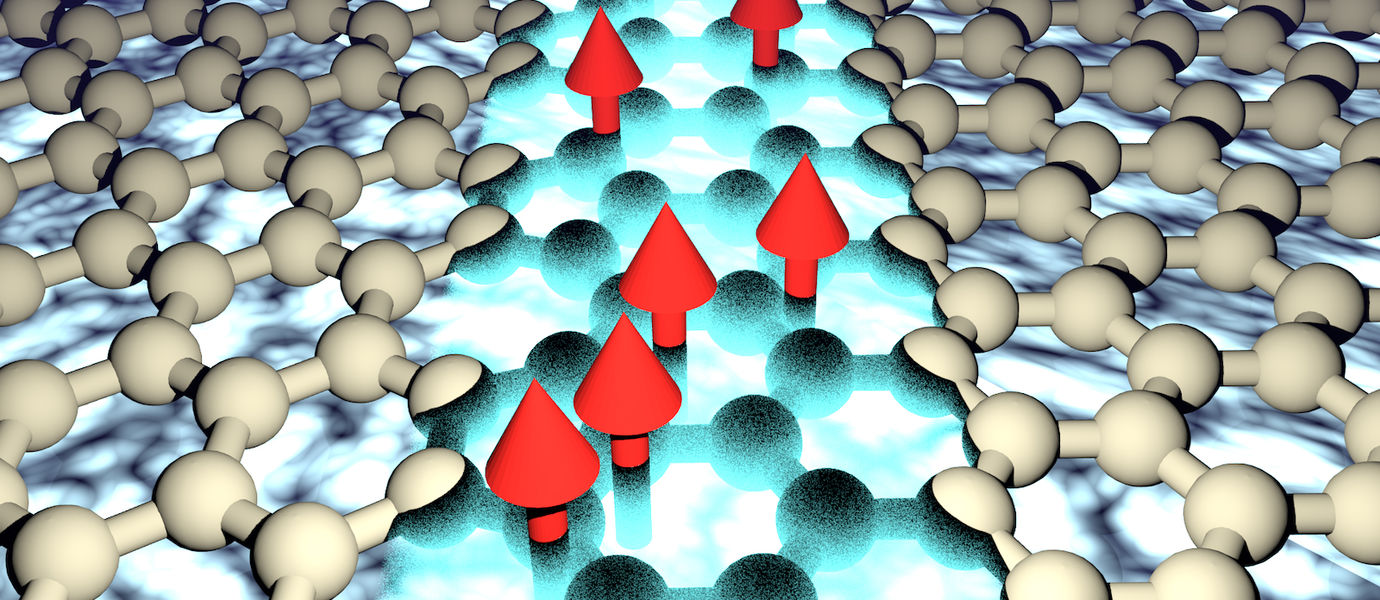
In the quantum realm, electrons can group together to behave in interesting ways. Magnetism is one of these behaviors that we see in our day-to-day life, as is the rarer phenomena of superconductivity. Intriguingly, these two behaviors are often antagonists, meaning that the existence of one of them often destroys the other. However, if these two opposite quantum states are forced to coexist artificially, an elusive state called a topological superconductor appears, which is exciting for researchers trying to make topological qubits.
Topological qubits are exciting as one of the potential technologies for future quantum computers. In particular, topological qubits provide the basis for topological quantum computing, which is attractive because it is much less sensitive to interference from its surroundings from perturbing the measurements. However, designing and controlling topological qubits has remained a critically open problem, ultimately due to the difficulty of finding materials capable of hosting these states, such as topological superconductors.
To overcome the elusiveness of topological superconductors, which are remarkably hard to find in natural materials, physicists have developed methodologies to engineer these states by combining common materials. The basic ingredients to engineer topological superconductors – magnetism and superconductivity – often require combining dramatically different materials. What’s more, creating a topological superconducting material requires being able to finely tune the magnetism and superconductivity, so researchers have to prove that their material can be both magnetic and superconductive at the same time, and that they can control both properties. In their search for such a material, researchers have turned to graphene.
Graphene – a single layer of carbon atoms – represents a highly controllable and common material and has been raised as one of the critical materials for quantum technologies. However, the coexistence of magnetism and superconductivity has remained elusive in graphene, despite long-standing experimental efforts that demonstrated the existence of these two states independently. This fundamental limitation represents a critical obstacle towards the development of artificial topological superconductivity in graphene.
In a recent breakthrough experiment, researchers at the UAM in Spain, CNRS in France, and INL in Portugal, together with the theoretical support of Prof. Jose Lado at Aalto University, have demonstrated an initial step along a pathway towards topological qubits in graphene. The researchers demonstrated that single layers of graphene can host simultaneous magnetism and superconductivity, by measuring quantum excitations unique to this interplay. This breakthrough finding was accomplished by combining the magnetism of crystal domains in graphene, and the superconductivity of deposited metallic islands.
‘This experiment shows that two key paradigmatic quantum orders, superconductivity, and magnetism, can simultaneously coexist in graphene,’ said Professor Jose Lado, ‘Ultimately, this experiment demonstrates that graphene can simultaneously host the necessary ingredients for topological superconductivity. While in the current experiment we have not yet observed topological superconductivity, building on top of this experiment we can potentially open a new pathway towards carbon-based topological qubits.’
The researchers induced superconductivity in graphene by depositing an island of a conventional superconductor close to grain boundaries, naturally forming seams in the graphene which have a slightly different magnetic properties to the rest of the material. The superconductivity and grain boundary magnetism was demonstrated to give rise to Yu-Shiba-Rusinov states, which can only exists in a material when magnetism and superconductivity coexisting together. The phenomena the team observed in the experiment matched up with the theoretical model developed by Professor Lado, showing that the researchers can fully control the quantum phenomena in their designer hybrid system.
The demonstration of Yu-Shiba-Rusinov states in graphene is the first step towards the ultimate development of graphene-based topological qubits. In particular, by carefully controlling Yu-Shiba-Rusinov states, topological superconductivity and Majorana states can be created. Topological qubits based on Majorana states can potentially drastically overcome the limitations of current qubits, protecting quantum information by exploiting the nature of these unconventional states. The emergence of these states requires meticulous control of the system parameters. The current experiment establishes the critical starting point towards this goal, which can be built upon to hopefully open a disruptive road to carbon-based topological quantum computers.
Reference
Observation of Yu–Shiba–Rusinov States in Superconducting Graphene
Eva Cortés‐del Río Jose Luis Lado Vladimir Cherkez Pierre Mallet Jean‐Yves Veuillen Juan Carlos Cuevas José María Gómez‐Rodríguez Joaquín Fernández‐Rossier Iván Brihuega
https://onlinelibrary.wiley.com/doi/10.1002/adma.202008113
Contact
Jose Lado
Assistant Professor, Aalto University
T304 Dept. Applied Physics
jose.lado@aalto.fi
+358503133730
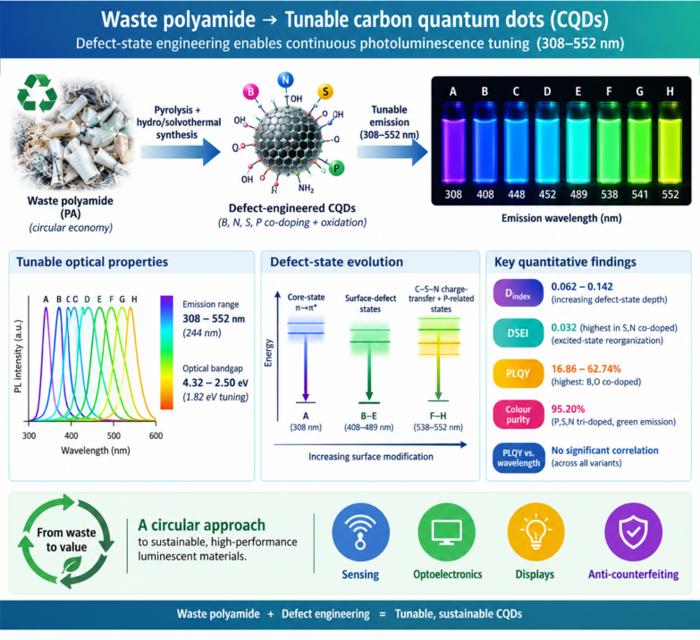
Waste polyamide-derived CQDs show continuous photoluminescence tuning from 308 to 552 nm through sequential defect-state engineering, with optical transition energies decreasing from 4.32 to 2.50 eV. @Christian Ebere Enyoh from Saitama University Carbon quantum dots (CQDs) are fluorescent carbon nanomaterials with potential applications in sensing, optoelectronics, displays, anti-counterfeiting, and environmental technologies. Their optical properties can be adjusted by modifying the carbon...

The researchers used circularly polarized light at normal incidence and found that helicity-dependent photocurrents appeared perpendicular to the crystal’s polarization but vanished when measured parallel to it, supporting a bulk origin of CPGE. @Institute of Science Tokyo The circular photogalvanic effect (CPGE), a phenomenon that generates helicity-dependent photocurrents in noncentrosymmetric materials, can originate purely from a crystal's internal structure without contribution from the...
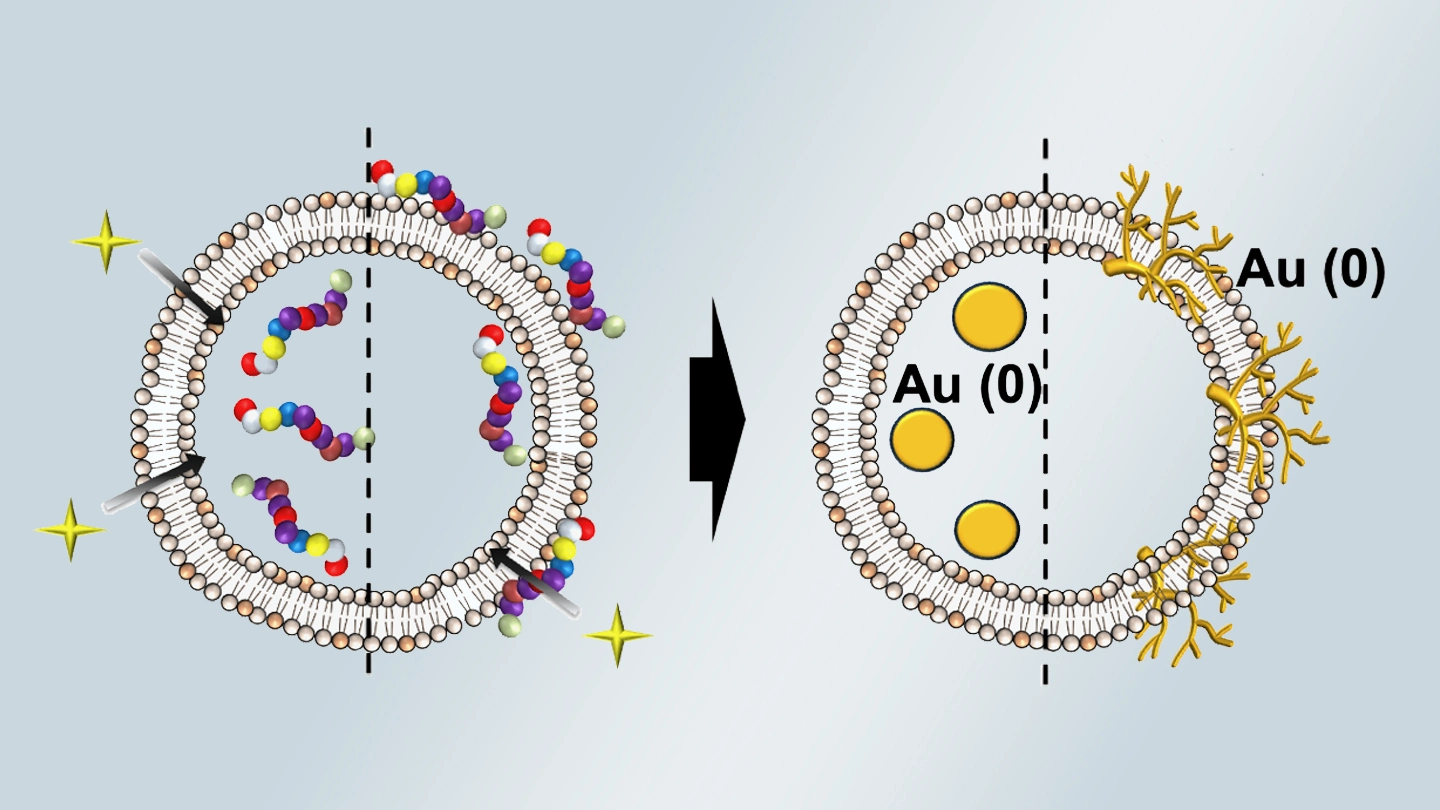
Summary of gold nanoparticle growth programming in liposome based on localization of biomineralization peptide The position of biomineralization peptides within liposomes can influence how gold nanoparticles grow, reports a research team from Institute of Science Tokyo. Peptides localized at the membrane interface promote branched structures, while those confined to the liposome interior favor spherical nanoparticles. The findings offer a new strategy for controlling nanoscale reaction...
